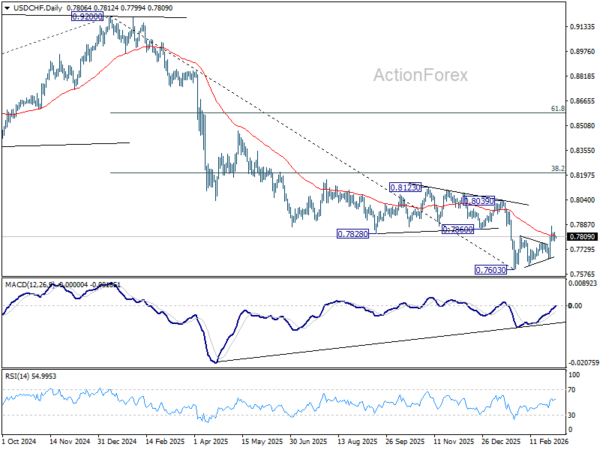
The current market environment is the definition of a “powder keg” waiting for a spark, something that the February US Non-Farm Payroll report could be. While the Wednesday relief rally offered a temporary reprieve, the swift pullback in US stocks overnight suggests that bulls lack the conviction to fight against a darkening energy backdrop.
At the same time, WTI breaking 80 psychological level is not just a technical breakout; it is a fundamental alarm bell. With the Strait of Hormuz facing a de facto closure and the White House offering no timeline for a resolution, we are seeing a “war premium” being baked into every barrel.
Meanwhile, the U.S. decision to grant a 30-day waiver to India for Russian crude is a clear admission of vulnerability. By allowing “stranded” Russian oil to reach Indian refiners, Washington is attempting to cap global prices without formally backing down on sanctions. This “stopgap” measure highlights the desperation to keep the global economy from seizing up before the Middle East conflict finds a floor.
The significance of the US jobs data has been amplified by the geopolitical backdrop. With the Middle East conflict pushing oil prices higher and reviving inflation risks, a strong payrolls report could further reduce expectations for Fed rate cuts. Such a scenario would likely support higher Treasury yields and provide further strength to the Dollar.
For the week so far, Dollar remains the strongest performer among major currencies. Loonie follows closely behind, benefiting from rising oil prices, while Sterling holds third place. At the other end of the spectrum, Euro remains the weakest currency, reflecting concerns about Europe’s exposure to energy disruptions. Swiss Franc and Kiwi also lag, while the Aussie and Yen sit near the middle of the performance rankings.
In Asia, Nikkei closed up 0.57%. Hong Kong HSI is up 1.74%. China Shanghai SSE is up 0.32%. Singapore Strait Times is up 0.18%. Japan 10-year JGB yield rose 0.007 to 2.164. Overnight, DOW fell -1.61%. S&P 500 fell -0.56%. NASDAQ fell -0.26%. 10-year yield rose 0.066 to 4.146.
War shock amplifies NFP stakes, Dollar set for double-engine boost
Today’s US Non-Farm Payroll report has taken on unusual importance in a week dominated by geopolitical turmoil. The escalation of conflict in the Middle East has triggered a surge in oil prices and pushed US Treasury yields sharply higher, with the 10-year yield climbing above 4.14% overnight. Dollar has remained broadly firm as investors reassess inflation risks and monetary policy expectations.
Under normal circumstances, the monthly payroll report is already one of the most influential data releases for global markets. But this week’s geopolitical developments have amplified its significance. Skyrocketing energy costs has already threatened to keep headline inflation elevated for longer. Market expectations for Fed policy have shifted noticeably over the past few days.
Traders have started to abandon the view that the Fed could resume easing in June. Instead, September 2026 is increasingly seen as the earliest realistic timing for the next reduction. The shift does not stop there. Markets are now pricing only a single quarter-point cut for the entire year, a sharp downgrade from earlier expectations of multiple reductions as inflation gradually cooled.
With this backdrop, a strong NFP would almost certainly push the 10-year yield higher. That would also act as a powerful “double engine” for Dollar, with the rise in the 10-year yield providing the mechanical fuel for the greenback’s ascent.
Economists expect payroll growth in the range of 58k to 65k jobs. The unemployment rate is forecast to hold steady at 4.3%, while average hourly earnings are expected to increase by around 0.3% to 0.4% mom.
Recent labor indicators point to a resilient, though not overheated, labor market. ADP private payrolls rose by 63k earlier this week, beating expectations The employment component of ISM Services climbed to 51.8. Since the service sector is the largest employer in the US, this expansionary reading points toward a stronger headline NFP.
At the same time, the latest JOLTS report showed job openings falling to 6.54 million, the lowest since 2020. But that’s more of a little “crack” in the armor only.
Technically, 10-year yield’s strong rebound this week and firm break of 4.106 resistance suggests that fall from 4.311 has completed at 3.956. The development kept 10-year yield within the converging triangle that started back in 4.629 (or 3.886). That is, medium term outlook is neutral, instead of being bearish.
Further rise is now in favor in the near term towards 4.311 resistance. But strong resistance is expected there to cap upside to continue range trading.
WTI Oil crosses 80 after White House timeline uncertainty, 84.3 now key
Crude oil has entered a new phase of the geopolitical crisis. WTI crude officially broke above the 80 per barrel level, marking both an important psychological milestone and its highest level since mid-2024. The move reflects a shift in market perception—from treating the Middle East conflict as a temporary geopolitical flare-up to pricing a more sustained disruption to global energy flows.
The latest “bullish nudge” came from comments of White House press secretary Karoline Leavitt, who said the Trump administration has no timeline for when commercial shipping through the Strait of Hormuz will be safe again. When asked about reopening the critical waterway, Leavitt declined to commit to any timeframe, saying the situation is still being “actively calculated” by both the Department of War and the Department of Energy.
For energy markets, the absence of a timeline was itself the message. Traders had been looking for signals that military operations were close to stabilizing the shipping route. Instead, the administration’s remarks suggested that the roughly 20 million barrels of oil that normally transit the Strait of Hormuz each day may remain effectively off the market for an extended period.
Equally important was the implication that restoring commercial shipping is not currently the immediate priority. Leavitt’s wording suggested that U.S. strategy may still be focused on degrading Iranian military infrastructure rather than quickly reopening the sea lanes for tankers. That interpretation reinforced fears that the disruption could persist longer than previously assumed.
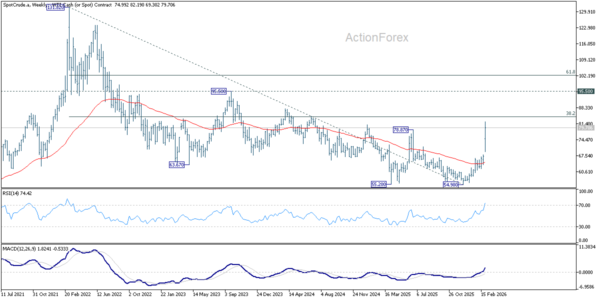
Technically, the latest rally has also triggered an important chart development. WTI’s break above the key resistance level at 78.87 could confirm the completion of a medium-term double bottom pattern formed around the 55.20 and 54.98 lows. That structure suggests the multi-year downtrend from the 2022 peak at 131.82 may be reversing.
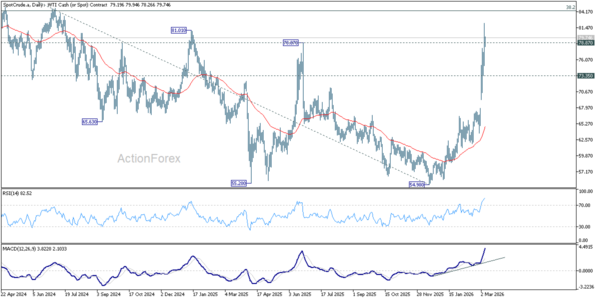
If that interpretation holds, attention now turns to the next major technical level of 38.2% retracement of 131.82 to 54.98 at 84.33. A decisive break above that level would strengthen the case that crude has entered a broader up trend rather than simply experiencing a war-driven spike.
That could trigger further upward acceleration to 95.50 structural resistance or even further to 61.8% retracement at 102.46.
Still, the rally remains sensitive to shifts in geopolitical expectations. A drop below 73.35 support level would signal stabilization in some form. Oil prices may then enter a consolidation phase while waiting for further developments in the conflict.
Fed’s Barkin: Inflation fight not over amid strong data and war risks
Richmond Fed President Thomas Barkin cautioned that the Fed need to reassess its policy risks as recent economic data and geopolitical developments complicate the inflation outlook. In remarks to Bloomberg Television overnight, Barkin highlighted that stronger job growth and persistently elevated inflation readings could challenge earlier assumptions about the trajectory of price pressures.
He noted that last year’s rate cuts were justified largely by concerns that the labor market was weakening while inflation risks were fading. However, :the data that’s come in over the last couple months suggests it has moved in the other direction,” he said.
At the same time, the ongoing conflict between the U.S. and Iran could further intensify inflation risks through higher energy prices. With recent run of stronger inflation readings, “that certainly puts pause to any conclusion that we’re done fighting this,” he emphasized.
USD/CHF Daily Outlook
Daily Pivots: (S1) 0.7781; (P) 0.7810; (R1) 0.7838; More….
Intraday bias in USD/CHF remains neutral and more consolidations could be seen below 0.7877 temporary top first. Further rise is expected as long as 0.7671 support holds. Rebound from 0.7603 is seen as correcting the whole fall from 0.9022. Above 0.76877 will target 0.8039 resistance next.
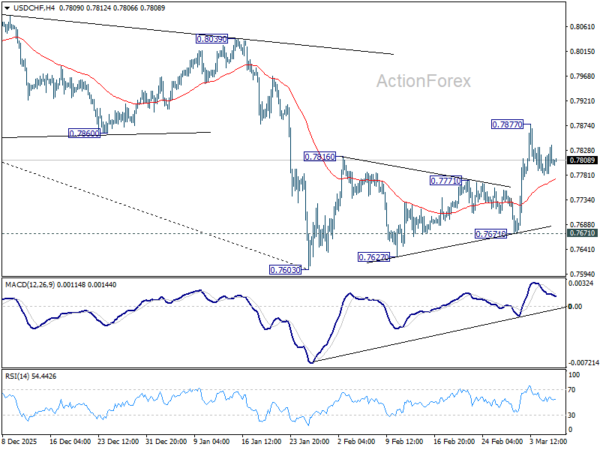
In the bigger picture, a medium term bottom could be in place at 0.7603 on bullish convergence condition in D MACD, Firm break of 0.8039 resistance will argue that it’s at least correcting the down trend from 0.9002. Stronger rebound would then be seen to 38.2% retracement of 0.9200 to 0.7603 at 0.8213.