Markets were steady in Asian session today, with equities posting modest gains led by Japan, as investors showed signs of “war fatigue” amid the ongoing Middle East conflict. Despite continued escalation between Iran, Israel and the U.S., price action across major asset classes has become increasingly muted, suggesting that geopolitical risks are not the dominant driver of near-term market moves, at least for now.
The latest developments saw Iran intensify attacks on Israel and U.S. assets in the region, following Israel’s killing of Iran’s security chief Ali Larijani, head of the Supreme National Security Council. While such escalation would typically trigger strong risk-off reactions, markets have largely absorbed the news without significant disruption.
This muted response is most visible in oil markets. After briefly surging above the 100 level earlier in the week, WTI crude has now retreated back toward the 92 handle. The inability to sustain gains signals that the “geopolitical risk premium” is fading, as traders increasingly view the conflict as a prolonged but contained disruption rather than an immediate threat to global supply.
As attention shifts away from geopolitics, central banks are moving back to the forefront. Today’s Bank of Canada decision serves as the opening act for a highly concentrated policy week, with Federal Reserve, Bank of Japan, Swiss National Bank, Bank of England and European Central Bank all set to announce decisions tomorrow.
In currency markets, Dollar is showing signs of weakness for the week so far. A key driver appears to be growing skepticism around expectations for a “hawkish hold” from the Fed. Traders are beginning to question whether policymakers will deliver a sufficiently strong signal to justify current market positioning.
This shift reflects a broader uncertainty surrounding Fed policy. With officials in blackout period and no direct guidance on how they assess the recent oil-driven inflation risks, markets are left navigating a “valuation vacuum.”
Meanwhile, Loonie is also under pressure ahead of the BoC decision. Canada faces a markedly different macro backdrop compared to other major economies, with cooling inflation and weakening labor market offsetting the impact of higher oil prices. This raises the risk that the BoC may lean dovish even as global inflation risks rise.
In contrast, Aussie continues to outperform following this week’s RBA rate hike and Governor Michele Bullock’s clear message that the board remains united on the direction of policy. This clarity has reinforced expectations for further tightening.
Kiwi is also benefiting from the improved tone in risk sentiment, while European majors and Yen are trading in the middle of the pack. Overall, major currency pairs and crosses remain largely range-bound, reflecting the market’s reluctance to take strong directional bets ahead of key policy decisions.
In Asia, Nikkei rose 2.77%. Hong Kong HSI is up 0.85%. China Shanghai SSE is up 0.17%. Singapore Strait Times is up 1.39%. Japan 10-year JGB yield is down -0.048 at 2.215. Overnight, DOW rose 0.10%. S&P 500 rose 0.25%. NASDAQ rose 0.47%. 10-year yield fell -0.018 to 4.202.
“Hawkish hold” may disappoint as Fed avoids committing either way
A “hawkish hold” is priced in—but the Fed may deliver something more neutral. If so, markets could be caught off guard, opening the door to a sharp repricing in Dollar and global assets. Read more.
Fed boost or bull trap? S&P 500 rebound to faces resistance at 55-Day EMA
A Fed-driven bounce in S&P 500 may prove temporary, with the index still in a downtrend and facing key resistance at the 55-day EMA. A break below 6521 support would confirm a deeper correction toward 6174 and could support renewed Dollar strength. Read more.
AUD/CAD targets 0.9889 as BoC dovish risk supports breakout setup
AUD/CAD is building upside momentum as markets brace for a potentially dovish BoC hold, with cooling inflation and weak jobs data offsetting oil-driven price pressures. A sustained break above 0.9749 would pave the way toward 0.9889 while 0.9576 support holds. Read more.
Japan trade data highlights diversification, shift away from China and U.S.
Japan’s exports rose 4.2% yoy in February, beating forecasts despite sharp declines in shipments to China and the U.S. Strong demand from Southeast Asia and Europe helped offset weakness, signaling a shift in trade dynamics. Read more.
USD/JPY Daily Outlook
Daily Pivots: (S1) 158.65; (P) 159.07; (R1) 159.43; More…
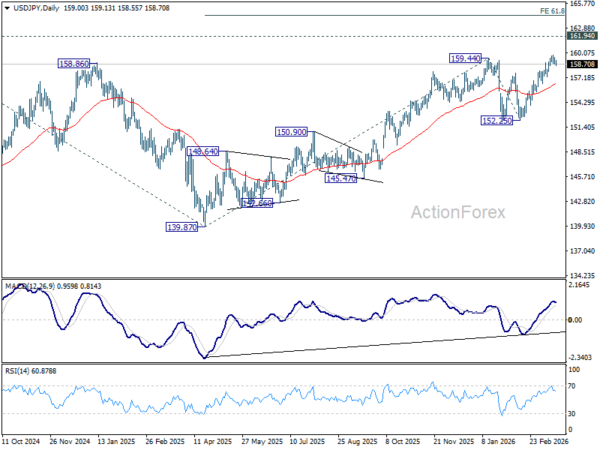
Intraday bias in USD/JPY remains neutral for the moment. Considering bearish divergence condition in 4H MACD, break of 158.55 should indicate short term topping. Intraday bias will then be back on the downside for 38.2% retracement of 152.25 to 159.74 at 156.87. Nevertheless, strong bounce from current level, followed by break of 159.74, will target a retest of 161.94. Firm break there will confirm larger up trend resumption and target 61.8% projection of 139.87 to 159.44 from 152.25 at 164.34.
In the bigger picture, outlook is unchanged that corrective pattern from 161.94 (2024 high) should have completed with three waves at 139.87. Larger up trend from 102.58 (2021 low) could be ready to resume through 161.94. This will remain the favored case as long as 55 W EMA (now at 152.70) holds. Firm break of 161.94 will pave the way to 61.8% projection of 102.58 to 161.94 from 139.87 at 176.75.