Markets are entering the Federal Reserve decision with remarkably little uncertainty about what policymakers will do, but considerable uncertainty about what they will signal next. The first FOMC meeting under Kevin Warsh as Chair is widely expected to deliver an unchanged federal funds rate at 3.50%-3.75%, with little chance of dissent. Following Stephen Miran’s departure from the Committee, there is no obvious constituency for an immediate rate cut, while even the Fed’s hawkish members have not signaled that conditions warrant a hike at this stage.
That leaves investors focused on two issues: the updated dot plot and Warsh’s first press conference as Chair. Across markets, positioning reflects caution rather than conviction. NASDAQ futures are modestly higher, but S&P 500 and DOW futures are largely unchanged. The 10-year Treasury yield is slightly lower on the day but remains comfortably above 4.43%, while Gold continues to trade in a narrow range around 4300. In currency markets, the Dollar is broadly rangebound against its major peers as traders await a catalyst for a directional breakout.
Several aspects of today’s announcement are already largely priced in. The Fed is expected to remove the easing bias from its statement, acknowledging that recent inflation developments have reduced the likelihood that the next policy move will be a cut. Similarly, the median projection in the Summary of Economic Projections is expected to shift from one cut this year, as projected in March, to no change through year-end. Neither development would be particularly surprising given the recent rise in inflation and resilience of economic activity.
The real question is whether the Fed is merely abandoning its easing bias or beginning to contemplate tightening again. The answer lies in the distribution of the dots rather than the median itself. If two or three policymakers project a future rate hike, markets are likely to dismiss those projections as the views of the Committee’s traditional hawks. However, if four or more officials place their dots above the current policy range, investors may conclude that the Fed is moving beyond a “higher for longer” framework and beginning to actively discuss the possibility of additional tightening.
The other wild card is Kevin Warsh himself. Investors want to know whether he views recent inflation pressures as a temporary energy shock or the beginning of a more persistent second-round inflation cycle. Yet there is a catch. Warsh has long argued that central bankers should communicate less rather than more. As a result, investors may find that the Fed’s new Chair offers fewer policy signals than markets have become accustomed to receiving.
In foreign exchange markets, the Dollar remains trapped between competing forces. The Swiss Franc is currently the strongest performer for the week, followed by the Euro and Australian Dollar. The New Zealand Dollar, Canadian Dollar and Yen lag behind. Sterling and the Dollar sit in the middle of the rankings. By the time the Fed decision is announced, markets will already know the rate outcome. What they do not know is how many policymakers now believe the next move could eventually be higher. That question may ultimately determine the Dollar’s next major move.
Sterling Slips on UK Inflation Misses, But GBP/CAD Bullish Case Remains Intact
DOW Hits Record High as Falling Oil Prices Offset Fed Fears
US Retail Sales Surge 0.9% in May, Signaling Resilient Consumer Demand
Eurozone Core Inflation Accelerates to 2.6% as Services and Energy Drive Prices Higher
UK Inflation Holds at 2.8% as Goods Disinflation Offsets Services Pressure
Japan Exports Beat Expectations as AI Demand Offsets War-Related Disruptions
USD/CAD Daily Outlook
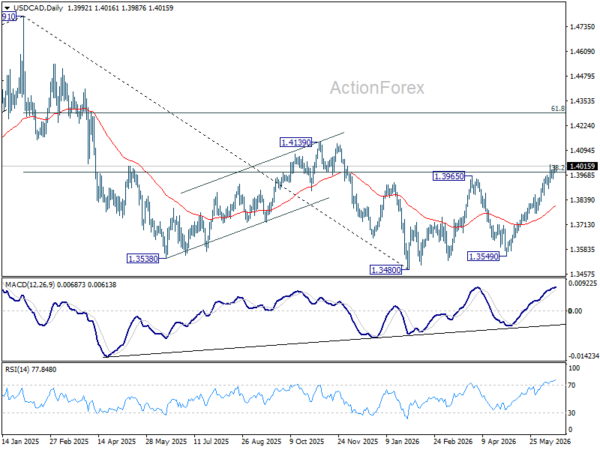
USD/CAD is still bounded in range below 1.4023 and intraday bias stays neutral. Further rise is expected as long as 1.3897 support holds. On the upside, sustained break of 38.2% retracement of 1.4791 to 1.3480 at 1.3981. Decisive break there will carry larger bullish implications and target 61.8% retracement at 1.4290 next. However, firm break of 1.3897 will turn bias back to the downside for deeper pullback.
In the bigger picture, price actions from 1.4791 are seen as a corrective pattern to the whole up trend from 1.2005 (2021 low). Rejection by 38.2% retracement of 1.4791 to 1.3480 at 1.3981 will keep the decline intact, and bring another fall through 1.3480 at a later stage. However, firm break of 1.3981 will argue that the decline has completed, and set up further rise back to retest 1.4791 instead.