
TL;DR: The RBA raised rates 25bp to 4.60% unanimously with hawkish statement language, yet AUD/USD reversed sharply after Governor Michele Bullock said further tightening was merely a “hope” rather than a base case, breaking the 0.7000 support zone within the hour.
Why This Matters
A fully-priced rate hike is not supposed to move a currency much—the market has already absorbed the outcome before the decision lands. What moves price is any gap between the decision and what it implies about the next one. Tuesday’s RBA meeting produced almost the cleanest version of that principle: a unanimous, hawkishly-worded hike that AUD/USD barely acknowledged, followed by a press conference that erased any doubt about which signal the market actually cared about.
For traders positioning around central bank events, the distinction between what a policy statement says and what the governor is willing to commit to live is often the real trade. This is one of those cases, and it carries directly into how November’s meeting and the next CPI print should be read.
The Hike Lasted an Hour
The RBA delivered almost everything that should, in theory, have supported the Australian Dollar on Tuesday. It raised the cash rate by 25bp to 4.60%, the highest level since November 2011. The decision was unanimous. The statement said upside inflation risks were “materialising” and explicitly kept further tightening in play.
AUD/USD barely responded. The pair initially edged up to around 0.7021 after the 2:30pm AEST decision, a move of only a handful of pips that never seriously challenged resistance. The important reaction came an hour later, after RBA Governor Michele Bullock began her press conference. AUD reversed sharply, broke through the 0.7000 area and fell to around 0.6977 within the following hour. The size and timing of the move matter: the initial response to the hike was negligible, while the selloff following Bullock’s remarks was several times larger.
The message from the market was unusually clean: the decision itself was not the surprise. The interpretation of what comes next was.
The Written Statement Was Clearly Hawkish
The RBA’s policy statement gave investors little reason to doubt the seriousness of the inflation problem. The Board said “some of the upside risks flagged in August are materialising,” citing higher global energy prices following the broadening Middle East conflict, AI-related pressure on technology-goods prices and continued domestic capacity constraints.
Australian data have also become less comfortable. Recent inflation outcomes were stronger than the RBA expected at its previous meeting, short-term inflation expectations remain elevated, and liaison suggests firms are either raising prices or preparing to do so as costs rise. The Bank also said higher fuel prices have already been “partially passed through to prices of other goods and services.” That matters because it means the RBA is not treating the energy shock as an isolated relative-price move—it is watching whether the initial impulse spreads into broader inflation.
The policy language reflected that concern. The Board said it remained focused on ensuring high inflation does not become embedded, judged that “a further tightening in financial conditions is warranted,” and retained the option of “increasing the cash rate target further if needed.” The unanimous vote reinforced that message. Taken in isolation, the statement was hawkish.
Then Bullock Said “Hope”
The tone changed in the press conference. Asked whether underlying inflation around 3.6% would be unacceptably high, Bullock said:
“What we are predicting, what is the hope here, is that this will be restrictive enough.”
The significance lies less in the word “hope” itself than in what it revealed about the RBA’s confidence in the next step. A unanimous hike to 4.60% could have been accompanied by language suggesting that inflation developments were likely to require still more tightening. Bullock did not provide that confirmation. Instead, she repeatedly emphasized the possibility that the restraint already delivered may prove sufficient.
That creates a meaningful distinction between the written and spoken signals. The statement preserved the RBA’s option to hike again. Bullock declined to make another hike the base case. For a market that had already priced Tuesday’s move heavily, that distinction mattered more than the decision itself.
One Word Was Not the Story—The Pattern Was
The interpretation does not rest on a single choice of wording. Asked about market pricing that takes the cash rate above 5% by May, Bullock said that if the restrictiveness already introduced turns out to be enough, “then maybe there doesn’t need to be any more interest rate rises.” Asked about the latest strong CPI reading, she cautioned “we’re not going to put a lot of emphasis necessarily on one number.” And on the possibility of recession, she said it was “not our central base case.”
None of those answers is particularly dovish by itself. But taken together, they establish a consistent pattern: conditional, data-dependent and reluctant to extrapolate Tuesday’s hike into a preset sequence of further increases. That is why the better description is not simply “hawkish statement, dovish governor.” Bullock did not reverse the RBA’s inflation warning. Rather, the statement kept further tightening available, while the press conference refused to validate it as the most likely next step. That was enough to undercut AUD.
November Is Open, Not Pre-Signalled
The press conference also changes how the next meeting should be approached. Tuesday’s decision does not automatically create momentum for a back-to-back hike. Bullock’s comments suggest the Board now wants to assess whether 4.60% and the cumulative tightening already delivered are restrictive enough before deciding whether more is needed.
That leaves November genuinely open. The RBA did not use the statement to push markets toward another move, nor did Bullock suggest the Bank needs to wait for the next Statement on Monetary Policy before making up its mind. The emphasis instead remained on incoming evidence, which makes the next inflation reading more important than the calendar date of the next meeting:
- A strong CPI result would directly challenge the “hope” that current policy restraint is enough and could force markets to rebuild expectations for another hike.
- A softer result would support Bullock’s more cautious interpretation—inflation remains too high, but the Bank may have already delivered enough tightening to wait and assess.
ActionForex’s Technical View on AUD/USD: Breaks the 0.7000 Pivot
The policy split was mirrored almost perfectly by the chart. AUD/USD had already been under pressure from the 0.7237 secondary high, but the area around 0.7000 was important technical support. More precisely, 0.7003 support sat almost directly alongside the 61.8% retracement of the 0.6864–0.7237 advance at 0.7006. Tuesday’s selloff pushed through both, confirming resumption of the decline from the 0.7237 area and shifting the near-term structure back to the downside.
The break is also psychologically important: a fully priced hike failed to protect a well-defined support zone; instead, the press conference provided the catalyst for it to give way. Near term, 0.7041 becomes the important resistance. As long as rebounds remain capped below that level, the bearish correction remains intact. An impulsive recovery back above 0.7041 would be the first warning that Tuesday’s break was failing.
The larger daily structure still does not necessarily point to a new major AUD/USD downtrend. The decline from the 0.7277 high can still be interpreted as a three-leg corrective structure, under which the current fall from 0.7237 is the third leg rather than the beginning of an entirely new bearish trend. The first obvious target is the prior 0.6864 swing low. A 100% projection of the first corrective leg from the 0.7237 secondary high comes in around 0.6824, placing the two levels close enough to form a broader 0.6864–0.6824 target zone, which should be more important than any intermediate support.
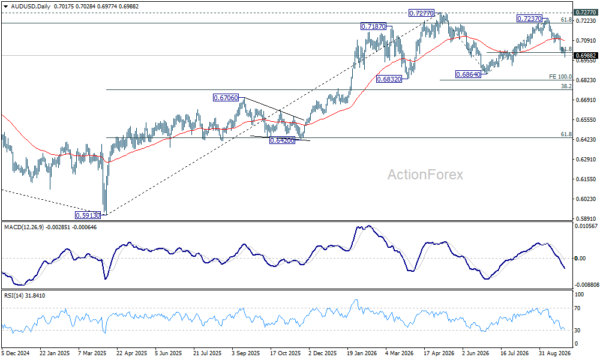
Momentum is already becoming stretched. Four-hour RSI is near 30 and daily RSI is only slightly above it. That does not mean the decline has ended, but it increases the importance of watching how AUD/USD behaves if it reaches 0.6864. A lower price low accompanied by bullish momentum divergence would strengthen the case that the corrective third leg is approaching completion. If 0.6864 gives way cleanly without such a signal, the deeper 0.6756 support becomes relevant—the 38.2% retracement of the much larger 0.5913–0.7277 advance and a more substantial barrier to further downside.
A Rate Hike Is Only Bullish If It Changes the Expected Path
Tuesday’s AUD reaction illustrates a basic FX principle particularly clearly: a rate hike that is already priced does not automatically strengthen a currency. What matters is whether the decision changes expectations for where policy goes next. The RBA raised rates unanimously, strengthened its inflation language and preserved the option of further tightening. Yet Bullock repeatedly emphasized that the Bank still does not know whether another move will be necessary. That distinction was enough to turn a tiny post-hike AUD gain into a much larger selloff and break the 0.7000 support area.
The next question is therefore not whether Tuesday’s hike was hawkish—it was. The question is whether incoming inflation data force the RBA to turn its tightening option into another actual increase. Until then, Bullock’s “hope” that 4.60% proves restrictive enough has become part of the AUD price.
Key Takeaways
- The RBA hiked 25bp to 4.60% unanimously with hawkish statement language, but AUD/USD barely moved on the decision itself.
- Governor Bullock’s comment that restrictive policy being “enough” was a “hope” rather than a base case triggered the real selloff, breaking 0.7000 support within an hour.
- AUD/USD broke below 0.7003–0.7006 support, confirming resumption of the decline from the 0.7237 high, with 0.7041 now the key resistance to watch.
- The 0.6864–0.6824 zone is the next major downside target, with 0.6756 as deeper support if that zone fails to hold.
- November’s meeting is genuinely data-dependent—the next CPI print, not the calendar, will determine whether the RBA turns its tightening option into another hike.