
TL;DR: September’s soft NFP report pushed the probability of an October Fed pause to 77.9%, but Treasury yields and Dollar Index both reversed higher by Friday’s close as markets judged the data wasn’t enough to resolve the bigger inflation risk—a risk Brent crude’s hold above $100, despite a coordinated G7 reserve release, helped confirm is still live. Together, that shows markets are repricing when the Fed moves next, not whether further tightening is still on the table.
Why This Matters
Markets spent the week taking October off the Fed table—not taking rate hikes off the table. Energy inflation, rising yields and a resilient Dollar made sure of that.
September’s weak payroll report looked initially like the catalyst that would finally break the rates-Dollar trade that dominated the third quarter. Instead, Friday produced a more revealing outcome. Treasury yields fell sharply on the NFP headline, only to reverse and finish higher. Dollar Index retreated but held its broader technical structure. Meanwhile, the FedWatch curve shifted decisively toward an October pause while continuing to price additional tightening thereafter. The distinction emerging from the week is therefore between timing and destination: labor data strengthened the case for waiting in October, but persistent inflation risks—above all from energy—left the broader tightening question unresolved.
October Was Already Being Repriced Before NFP
The move away from an October hike did not begin with Friday’s employment report. Expectations for another immediate increase had built aggressively during the second half of September as stronger activity data and hawkish Fed signals encouraged markets to extend the tightening path. But the correction began before payrolls arrived.
New York Fed President John Williams provided an important signal on September 29 at the University at Buffalo, saying that after September’s rate increase there was “no need for urgency” and that policymakers had time to collect more information. He still saw another upward adjustment as potentially appropriate later in the year, separating the question of whether rates should rise again from whether October was the right meeting to do it.
Softer PCE inflation subsequently reinforced that repricing, while Federal Reserve Vice Chair Philip Jefferson on October 1 emphasized at the University of Virginia’s Darden School of Business that future policy adjustments should depend on incoming data, the outlook and the balance of risks. At the same time, Jefferson continued to characterize inflation risks as tilted to the upside.
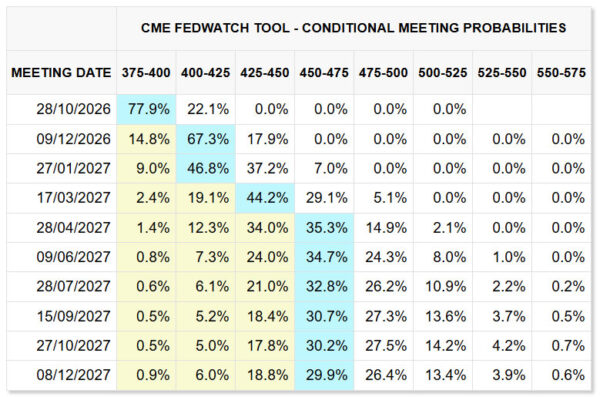
By the time NFP arrived, the October pause trade was therefore already well advanced. The latest CME FedWatch snapshot shows a 77.9% probability of no change on October 28, compared with only 35.8% a week earlier. A hike is priced at 22.1%.
Friday’s jobs report confirmed that timing shift rather than creating it.
And the forward curve remains important. For December, 4.00–4.25% is the modal outcome at 67.3%, implying one further 25bp hike from the current 3.75–4.00% range. By April 2027, the largest individual probability bucket has moved to 4.50–4.75% at 35.3%, narrowly ahead of 4.25–4.50%.
Chicago Fed President Austan Goolsbee captured the distinction after NFP on Friday, saying both a pause and another hike remained possible while emphasizing that inflation, rather than labor-market weakness, remained the central problem.
October has been repriced. Further tightening has not been removed.
NFP Confirms the Skip—Then Treasuries Reverse Higher
The payroll report itself was unmistakably soft.
Nonfarm employment slowed from a revised 133K in August to 29K in September, far below the 90K consensus. Unemployment rose from 4.1% to 4.2%, while average hourly earnings slowed from 0.3% to just 0.1% m/m and stood at 3.0% y/y.
Revisions weakened the recent hiring profile further. July was cut from +21K to -10K, while August was revised from 162K to 133K, leaving the previous two months 60K lower than first reported. That puts the July-September average at only about 51K jobs per month.
But Friday’s most revealing market signal came after the initial reaction.
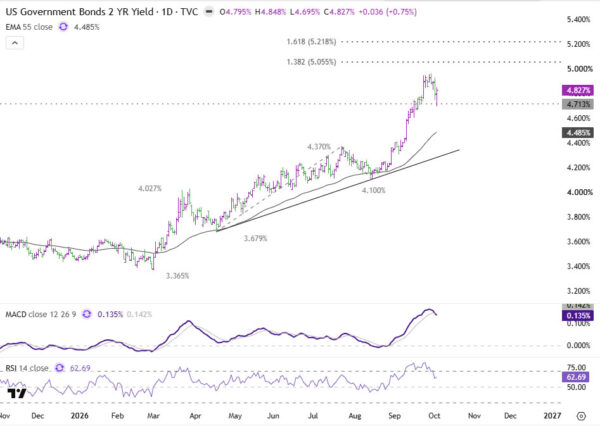
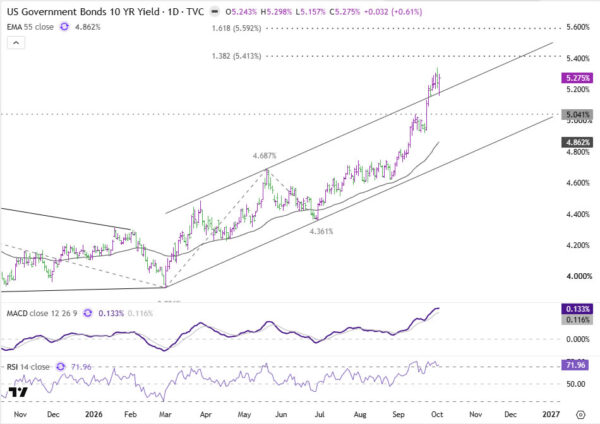
The 2-year Treasury yield dropped as low as 4.695%, briefly breaking the 4.713% technical reference level, before reversing to close around 4.827%. The 10-year yield similarly recovered from its post-NFP decline and ended around 5.28%, up on the day. Reuters recorded the 10-year yield about 4.7bp higher and the 2-year roughly 4bp higher late Friday, even after both initially fell on the employment data.
That reversal matters more for the Weekly than the first reaction.
NFP won the first move. Inflation risk won the closing argument.
Technically, the 2-year remains within its broader advance despite Friday’s volatility. The next upside projections remain 138.2% projection of 3.679% to 4.370% from 4.100% at 5.055%.
The 10-year also stayed firmly above its rising medium-term channel, with 138.2% projection of 3.926% to 4.687% from 4.361% at 5.413% the next projection target. Daily momentum is stretched, with the 10-year RSI above 70, but neither maturity produced the sort of breakdown that would confirm a durable dovish turn.
The bond market therefore ended the week refusing to treat 29K payroll growth as sufficient to overturn the larger inflation problem.
Energy Keeps the Inflation Question Open
That inflation problem remains heavily dependent on energy.
Friday brought headline relief when the G7 agreed to a coordinated release of 100M barrels of diesel, crude and other emergency reserves through the IEA over four months, including a substantial front-loaded diesel release during the first 20 days.
But emergency reserves are a painkiller, not a cure.
The release adds physical supply and can suppress the immediate scarcity premium. It does not resolve the geopolitical and refining disruptions responsible for the shock. That helps explain why crude did not collapse on the announcement. Brent remained around the $102 area into the end of the week even as WTI came under greater pressure.
The technical structure reinforces that caution. Brent’s retreat from 109.97 to 95.12 found support in a particularly dense area: the rising daily EMA55 together with the 94.27 61.8% retracement of 84.56–109.97 and the 94.75 38.2% retracement of 70.14–109.97. Price subsequently recovered back above 100.
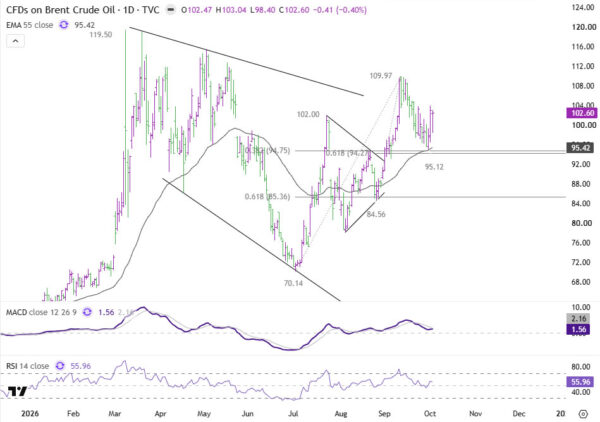
As long as that support cluster holds, the decline from 109.97 is better treated as a correction within the broader rise from 70.14 than as evidence that the energy shock has run its course. Another rally through 109.97 remains in favor.
This is why the coming CPI and PPI reports may carry more weight for the next Fed decision than another round of labor-market commentary. Payrolls gave policymakers a reason to wait. Inflation will determine whether waiting extends beyond October.
Dollar Still Has Two Supports
Dollar ended the week in a similarly revealing position.
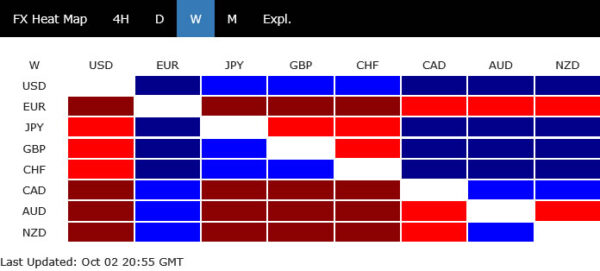
DXY initially fell after NFP but finished around 101.92, and the weekly FX heat map still showed Dollar outperforming the other major currencies over the week. The report denied Dollar an immediate breakout catalyst, but it did not materially damage the rising structure from the 95.551 low.
The near-term technical map clear.
101.026 remains the important support. While that level holds, the pullback from Friday’s 102 area remains consolidation, not a correction, and not even a confirmed reversal.
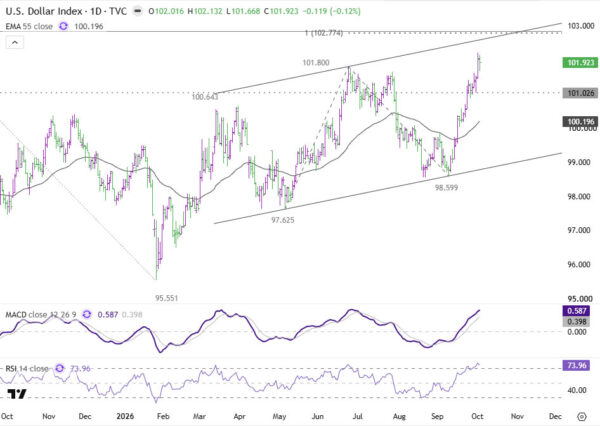
Above, 102.77–102.85 forms a significant resistance cluster. The 100% projection of 97.625–101.800 from 98.599 comes in at 102.774, while the 50% retracement of the broader 110.176–95.551 decline sits in essentially the same region.
A decisive break there would materially strengthen the case that the rise from 95.551 has entered another leg higher.
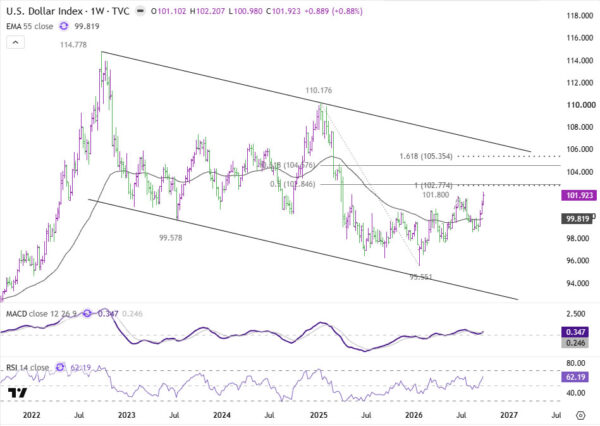
More importantly, Dollar has two separate macro supports underneath that chart.
The first is US rates. October may increasingly look like a skip, but the Fed curve still prices additional tightening and Treasury yields ended Friday higher rather than lower.
The second is Euro weakness. French sovereign stress intensified further this week, with the French-German 10-year spread reaching around 150bp, its widest since the euro-zone debt-crisis period, as investors demanded a larger premium for French fiscal and political risk.
That matters because Dollar strength does not have to depend entirely on an increasingly hawkish Fed. A weaker Euro can support DXY independently.
Dollar does not need October to deliver another hike if December remains alive and Euro continues carrying its own risk premium.
Nasdaq Makes a Record, but Without a Convincing Breakout
Equities remained the clearest market willing to embrace the softer-rate interpretation.
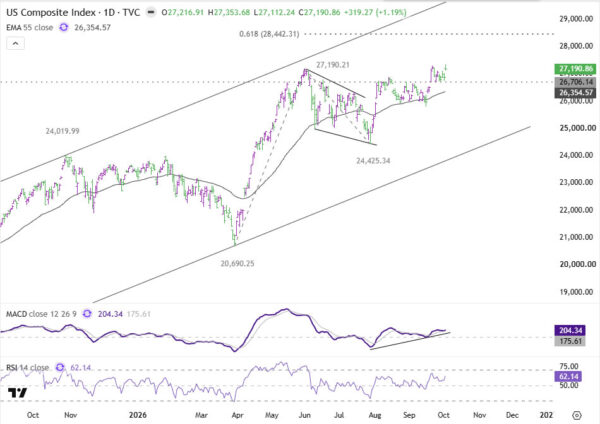
Nasdaq Composite climbed to a fresh intraday record at 27,353.68 on Friday and ended around 27,191. But the index closed slightly below its opening level despite finishing strongly higher from Thursday, producing a less decisive candle than the headline record suggests.
There is no clear bearish reversal signal. The broader structure remains constructive above the rising daily EMA55, while the 28,442 61.8% projection remains the next notable upside target.
But Nasdaq provides a useful qualification to the idea that Friday was a straightforward relief breakout. Equities welcomed lower October tightening risk, yet the bond market had already reversed its dovish reaction by the close.
That divergence is worth carrying into next week.
Inflation Takes Over From Payrolls
September NFP clarified one question without resolving the larger one.
With payroll growth at 29K, unemployment at 4.2% and wage growth slowing, the hurdle for another immediate hike has risen substantially. Williams and Jefferson had already prepared the ground for patience, and Friday’s data reinforced it.
But the market did not extrapolate that patience into a broad retreat from higher rates.
Treasury yields reversed higher. The FedWatch curve still prices further tightening. Oil remains above $100 despite a massive coordinated reserve release. Dollar held its technical structure and retains both a US rates tailwind and a separate Euro-risk channel.
That leaves September CPI and PPI as the next decisive tests. Softer inflation would strengthen the case that October’s pause can extend. Another upside surprise—particularly one showing energy pressure spreading into broader prices—would put December firmly back at the center of the tightening debate.
The week therefore ended with a clearer distinction than it began.
Soft jobs changed when the Fed may move. Inflation still decides how far it ultimately has to go.
Key Takeaways
- September NFP came in at just 29K with unemployment at 4.2%, pushing October rate-pause odds to 77.9%, but Treasury yields reversed higher into Friday’s close anyway.
- The Fed curve still prices a 67.3% probability of one more 25bp hike by December, showing the tightening debate has shifted on timing, not direction.
- A G7-coordinated release of 100M barrels of emergency reserves failed to push Brent below $100, underscoring that the energy-driven inflation shock remains unresolved.
- Dollar Index held structural support at 101.026, backed by two separate tailwinds: a still-hawkish Fed curve and widening French sovereign risk pressuring the Euro.
- September CPI and PPI are now the next decisive catalysts—softer prints support an extended pause, while an energy-driven upside surprise would put December back in focus.