
The Dollar Surged Broadly as Stronger US Core Inflation Forced a Sharp Reassessment of Fed Rate Expectations
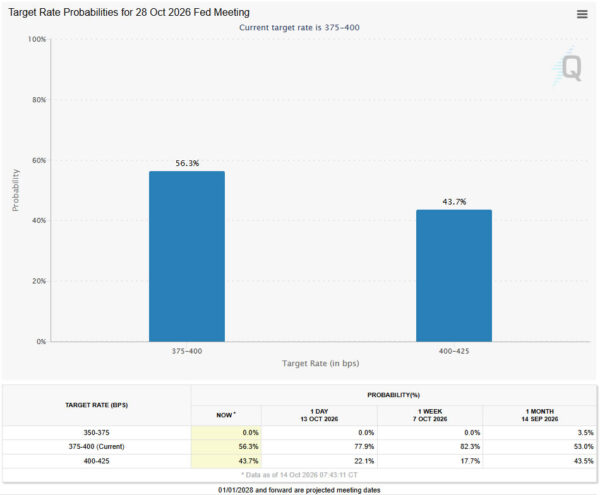
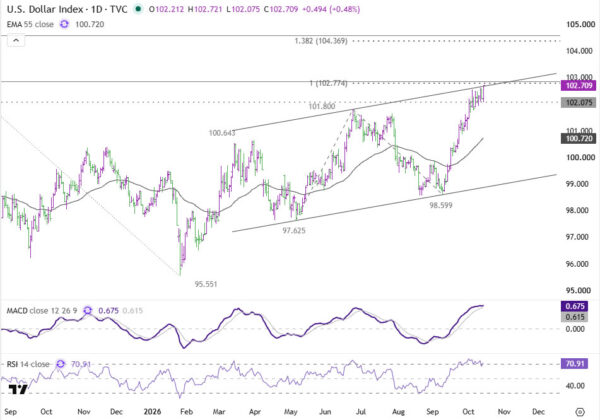
What’s happening: The Dollar surged broadly on Wednesday after September’s US core CPI beat expectations, reversing the recent retreat in Treasury yields. The Dollar Index broke above 102.60 to reach 102.72, the 2-year Treasury yield jumped toward 4.94% and the 10-year yield rebounded above 5.30%. According to CME FedWatch, the probability of a Fed hike at the October 28 meeting surged from 22.1% a day earlier to 43.7%, against 17.7% a week ago.
Why it matters: A hold remains narrowly favored at 56.3%, but the repricing suggests markets are no longer confident that the Fed can afford to pause tightening. The next confirmation points are 102.77 in the Dollar Index, 4.960% in the 2-year yield and 5.365% in the 10-year yield. Sustained breaks would signal that the recent correction in yields has ended and that the Dollar’s broader advance is regaining momentum.
The Dollar surged broadly on Wednesday as stronger-than-expected US core inflation triggered a sharp reassessment of Fed rate expectations. The Dollar Index broke above 102.60 to extend its medium-term uptrend, while the 2-year Treasury yield jumped toward 4.94% and the 10-year yield rebounded above 5.30%. Most notably, the probability of another Fed hike at the October 28 meeting surged from 22.1% a day earlier to 43.7%, according to CME FedWatch, compared with just 17.7% a week ago. Although a hold remains narrowly favored at 56.3%, the repricing suggests markets are no longer as confident that the Fed can afford to pause tightening.
Currency Heat Map.
Core Inflation Surprise Reverses Treasury Yield Retreat
The catalyst was September’s upside surprise in core CPI, which held at 0.3% mom rather than moderating to the expected 0.2%. Annual core inflation accelerated from 2.4% to 2.6%, exceeding forecasts of 2.5%. Headline CPI also strengthened from 3.4% to 3.7% yoy, driven largely by surging gasoline prices. Importantly, firmer underlying price pressures extended across goods and services, making the report more concerning than an energy-driven headline increase alone. For a detailed breakdown, see our US Core CPI Beats Forecasts as Inflation Pressures Broaden Beyond Energy.
September US CPI: Actual vs Forecast
| Measure | Previous | Forecast | Actual |
|---|---|---|---|
| Core CPI (m/m) | 0.3% | 0.2% | 0.3% |
| Core CPI (y/y) | 2.4% | 2.5% | 2.6% |
| Headline CPI (y/y) | 3.4% | 3.60% | 3.7% |
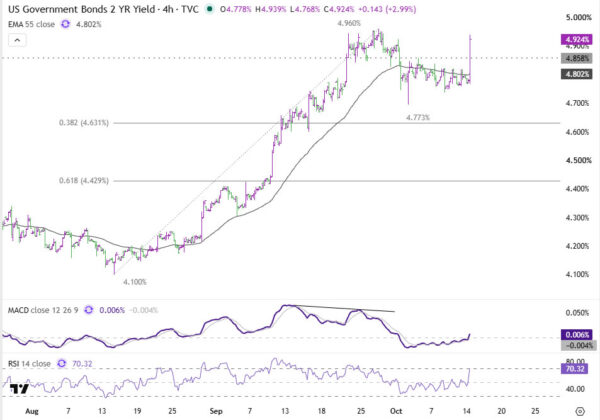
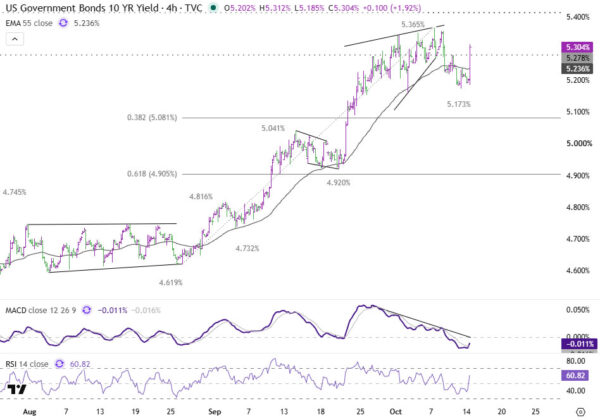
The Treasury market responded by rapidly unwinding the correction that had developed since last week’s yield peaks. The 2-year yield surged as high as 4.939%, approaching the September high of 4.960%. A break above that level would strengthen the case for resumption of the larger uptrend. Meanwhile, the 10-year yield’s rebound through 5.278% suggests its pullback from 5.365% completed at 5.173%, bringing a retest of 5.365% back into focus. The sharp recovery in shorter-term yields is particularly significant, reflecting renewed uncertainty over how much additional monetary tightening will be required.
CME FedWatch: October 28 Fed Hike Probability
| Timing | Probability of a hike |
|---|---|
| A week ago | 17.7% |
| A day earlier | 22.1% |
| Wednesday | 43.7% (hold at 56.3%) |
Dollar Breakout Adds Pressure to Equities and Precious Metals
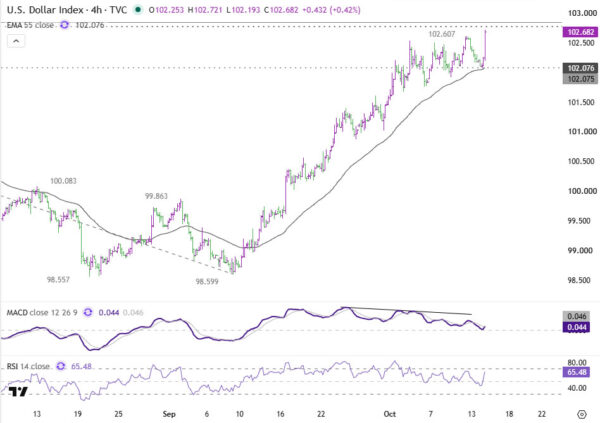
The Dollar Index climbed to 102.72, breaking above its previous 102.607 high and strengthening the case for continuation of the broader advance. Immediate focus is now on the 100% projection at 102.77. A decisive break above that level, accompanied by sustained trading above the rising channel ceiling, would raise the possibility of upward acceleration toward the 138.2% projection at 104.36.
Cross-Asset Moves
- Dollar Index: climbed to 102.72, above its previous 102.607 high
- 2-year Treasury yield: surged as high as 4.939%
- 10-year Treasury yield: rebounded through 5.278% and above 5.30%
- Nasdaq futures: down around 0.67%
- S&P 500 futures: down around 0.31%
- Dow futures: down around 0.18%
- Gold: down around 1%
- Silver: down more than 2%, extending its recent underperformance against Gold
The renewed rise in yields and Dollar also weighed on risk assets and precious metals. Nasdaq futures underperformed S&P 500 and Dow futures, while Silver fell by more than twice as much as Gold. The cross-asset reaction was consistent with investors adjusting to a more restrictive interest-rate outlook, with higher yields and a stronger Dollar adding pressure to non-yielding metals.
Oil and Fiscal Risks Complicate the Bond Outlook
Energy prices provided another source of inflation concern, with Brent holding around $106 as Middle East supply risks persisted. The International Energy Agency warned that constraints in diesel markets could continue well into 2027. Meanwhile, Saudi authorities reported an overnight attack on a Saudi Aramco administrative building in Dhahran, while a Saudi-led coalition reportedly struck Houthi energy facilities in Yemen. No disruption to Saudi oil production was confirmed. These developments cannot explain September’s inflation figures, but they highlight the possibility of continued energy-price pressure in subsequent months.
Separately, IMF Managing Director Kristalina Georgieva warned that economic growth alone would not be sufficient to address America’s mounting debt burden. Speaking at the IMF-World Bank meetings in Bangkok, she said, “Growth of course helps, but it cannot deliver fast enough the necessary adjustments,” arguing that fiscal measures would also be necessary. Her warning contrasts with US Treasury Secretary Scott Bessent’s emphasis on stronger growth as a means of reducing the debt ratio. The IMF projects US growth of 2.3% in both 2026 and 2027, below the administration’s ambition for sustained growth above 3%. While the immediate Treasury rebound was driven by inflation and Fed repricing, persistent deficits and borrowing requirements represent a separate longer-term risk to bond yields.
Inflation Repricing Puts Dollar and Yields Back on an Upward Path
Wednesday’s CPI surprise has shifted the near-term market narrative from a possible extension of the Treasury rally toward renewed risks of higher yields and a stronger Dollar. The change in October Fed pricing is especially revealing: a rate hike is no longer a relatively remote possibility, even though a pause remains marginally more likely.
For now, the Dollar’s break above 102.60 and the 10-year yield’s recovery through 5.278% favor further upside tests. The next confirmation points are 102.77 in Dollar Index, 4.960% in the 2-year yield, and 5.365% in the 10-year yield. Sustained breaks would reinforce the view that the recent correction in yields has ended and that the Dollar’s broader advance is regaining momentum.
Related Coverage
US Inflation, the Fed and Silver
Europe: BoE and ECB
China Trade and Inflation Data
FAQ
Why did the Dollar surge on Wednesday?
Stronger-than-expected US core CPI triggered a sharp reassessment of Fed rate expectations. Core CPI held at 0.3% month-on-month against an expected 0.2%, and annual core inflation accelerated from 2.4% to 2.6%, above the 2.5% forecast. The Dollar Index broke above 102.60 to reach 102.72, while the 2-year Treasury yield jumped toward 4.94% and the 10-year yield rebounded above 5.30%.
How much did the odds of an October Fed hike change?
According to CME FedWatch, the probability of a Fed hike at the October 28 meeting surged from 22.1% a day earlier to 43.7%, compared with 17.7% a week ago. A hold is still narrowly favored at 56.3%, but the repricing suggests markets are no longer as confident that the Fed can afford to pause tightening.
Which levels matter next for the Dollar and Treasury yields?
The next confirmation points are 102.77 in the Dollar Index, 4.960% in the 2-year yield and 5.365% in the 10-year yield. A decisive break above 102.77 with sustained trading above the rising channel ceiling would raise the possibility of a move toward the 138.2% projection at 104.36. Sustained breaks in yields would reinforce the view that the recent correction has ended.
Key Takeaways
- The Dollar surged broadly on Wednesday as stronger-than-expected US core inflation triggered a sharp reassessment of Fed rate expectations.
- September core CPI held at 0.3% m/m against an expected 0.2%, while annual core inflation rose from 2.4% to 2.6% and headline CPI from 3.4% to 3.7%.
- CME FedWatch put the chance of an October 28 Fed hike at 43.7%, up from 22.1% a day earlier and 17.7% a week ago, with a hold still narrowly favored at 56.3%.
- The 2-year yield surged as high as 4.939% and the 10-year yield rebounded through 5.278%, unwinding the correction from last week’s peaks.
- The Dollar Index climbed to 102.72, with 102.77 the immediate focus and 104.36 the next projection if a decisive break follows.
- Higher yields and the stronger Dollar weighed on Nasdaq futures (down around 0.67%), Gold (down around 1%) and Silver (down more than 2%).
- Brent near $106 and the IMF’s warning that growth alone cannot address US debt are separate, longer-term risks to bond yields rather than explanations for Wednesday’s move.
What to Watch Next
The October 28 Fed meeting is the key decision point, and the shift in hike odds from 22.1% to 43.7% shows how quickly pricing can change if inflation data keep surprising to the upside. Watch whether the 2-year yield clears the September high of 4.960% and whether the 10-year yield retests 5.365%.
Beyond inflation, energy and fiscal risks remain in the background. The IEA’s warning that diesel constraints could last well into 2027, Middle East supply risks around Brent’s $106 level and the IMF’s call for fiscal measures could each add to bond-market pressure in the months ahead.