
TL;DR: GBP/USD has rebounded sharply from 1.3135, but with EUR/GBP stalling near a key support level and GBP/CHF still stuck below 1.1105, the move looks more like a Dollar retreat than genuine Sterling strength—even as a November BoE rate hike stays firmly priced.
Why This Matters
GBP/USD has rebounded sharply from 1.3135, but the move still looks more like a Dollar retreat than a broad-based Sterling recovery. Neither the stronger-than-expected UK GDP report nor Bank of England Governor Andrew Bailey’s cautious assessment of inflation spillovers has materially weakened expectations for a November rate hike. Yet EUR/GBP and GBP/CHF have not confirmed renewed Sterling strength. That leaves an important question: how much further can GBP/USD recover before the Pound needs to find momentum of its own?
The rebound from 1.3135, reached on October 14 following the hotter-than-expected US CPI report, accelerated on Thursday and extended into Friday. However, the broader currency picture suggests that Dollar weakness has been the principal driver. While GBP/USD has broken near-term resistance, EUR/GBP has stalled near an important downside target and GBP/CHF is still consolidating below its previous high.
November BoE Hike Still Firmly Priced
The case for a November BoE rate hike remains intact after this week’s developments. The central bank held Bank Rate at 3.75% in September by a 6–3 vote, with Bailey supporting the majority. However, he acknowledged at the time that policy might need to tighten if the risk of second-round inflation effects increased.
Expectations have shifted considerably since then. A Reuters poll published Thursday found that 54 of 63 economists expect a 25bps increase to 4.00% at the November 5 meeting. That contrasts with September’s survey, when approximately 90% expected rates to remain unchanged through year-end.
Market pricing broadly supports the November expectation. The latest supplied implied-rate path places Bank Rate at 3.95% for November, equivalent to an 81.6% probability of a 25bps hike. It then rises to 4.15% in December, 4.48% in March 2027 and 4.79% by September 2027, implying a cumulative 4.17 quarter-point increases by that final meeting.
The distinction is that economists have largely converged on November, but remain divided over subsequent tightening. Only 30 of 61 economists in the Reuters poll anticipated another hike in the first quarter of 2027, while market pricing implies a substantially longer tightening cycle.
Nevertheless, November pricing was slightly higher one and three weeks earlier. This week’s developments have therefore left substantial tightening expectations in place rather than generating a fresh hawkish repricing.
Bailey’s Balanced Remarks and GDP Beat Leave November Case Intact
Bailey’s remarks at an Institute of International Finance meeting in Bangkok on Friday offered a balanced assessment of the inflation outlook.
He acknowledged that evidence of second-round inflation effects from higher energy prices had been “quite subdued” so far, while emphasizing that it was too early to draw firm conclusions. That represents a mildly softer element in his assessment, given that Bailey identified the risk of second-round effects as a potential trigger for tighter policy in September.
However, his observations about business conditions provided an explanation for the limited price transmission. Companies are concentrating on cost-cutting and struggling to pass higher energy expenses on to customers.
Bailey also acknowledged that the UK economy is proving more resilient than the BoE had expected. At the same time, he expressed frustration that inflation stood at 3.1% in August, well above the central bank’s 2% target.
The risk of waiting too long also complicates the policy decision. BoE policymakers have warned that delaying action until second-round pressures become clearly visible, potentially through wage settlements in early 2027, could leave tightening coming too late.
For more detail, see BoE’s Bailey Sees Subdued Second-Round Inflation Despite Growing November Hike Expectations.
Meanwhile, Thursday’s UK GDP report provided further evidence of economic resilience. August GDP rose 0.1% mom, beating expectations for a 0.1% contraction, while growth over the three months to August accelerated to 0.7%.
The underlying performance was uneven. Manufacturing output increased 1.2%, but services stagnated, suggesting that the economy is not experiencing uniformly strong growth.
The detailed figures are covered in UK GDP Beats Forecasts with 0.1% Growth, but Services Stall as Manufacturing Drives August Growth.
Taken together, nothing this week has materially weakened the case for November tightening. Bailey’s subdued assessment of inflation spillovers provides some justification for caution, but economic resilience and persistent above-target inflation continue to support consideration of another hike.
Crucially, however, the absence of a deterioration in the BoE outlook is not the same as a new bullish catalyst for Sterling.
Dollar Weakness Provides the Immediate Support for GBP/USD
Dollar’s renewed weakness offers a more direct explanation for GBP/USD’s recovery. DXY slipped toward 101.80, a ten-day low, as selling pressure continued following its earlier reversal from 102.945.
Federal Reserve Chairman Kevin Warsh declined to signal whether the Fed would raise rates in October or December, saying the central bank would no longer routinely preview its policy decisions. His remarks offered little support for a Dollar rebound, although the currency’s decline was already underway before he spoke.
Treasury yields also stayed under pressure despite Thursday’s much stronger-than-expected PPI report, with the US 10-year yield around 5.09%.
ActionForex’s Technical View
GBP/USD Breaks 1.3274, but 1.3341 Holds the Larger Reversal Test
GBP/USD’s break above 1.3274 resistance confirms short-term bottoming at 1.3135, supported by bullish convergence in the four-hour MACD.
Further recovery is favored toward 1.3341, the 38.2% retracement of the decline from 1.3675 to 1.3135. This level represents the first important test of whether the rebound is developing into a more substantial reversal.
Rejection at 1.3341 would favor the interpretation that the recovery from 1.3135 is merely corrective, with the broader outlook remaining bearish following the decline from 1.3675. Under that scenario, a break below 1.3230 would bring a retest of 1.3135.
Conversely, a decisive break above 1.3341 would raise the possibility that the entire decline from 1.3675 is reversing. That would shift the next upside objective to 1.3469, the 61.8% retracement.
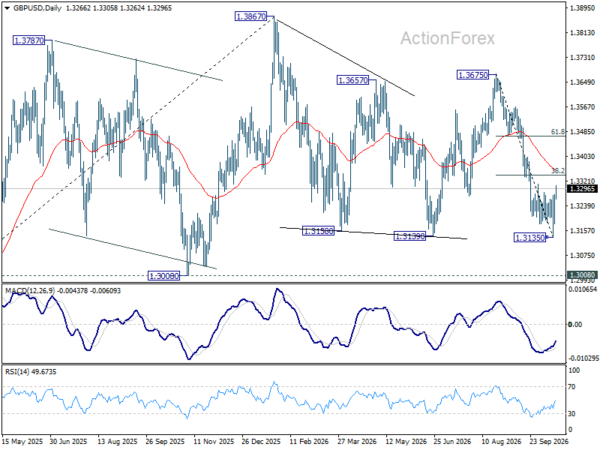
The technical recovery could therefore extend further. However, even a break above 1.3341 would not establish by itself that Sterling is attracting broader buying interest. For that confirmation, the other Sterling crosses become important.
EUR/GBP Near Critical Support as Bearish Momentum Weakens
EUR/GBP’s decline has stalled after reaching 0.8425, leaving Sterling’s recent outperformance against Euro at an important technical juncture.
The low briefly penetrated 0.8441, the 61.8% projection of the decline from 0.8728 to 0.8453, measured from 0.8611.
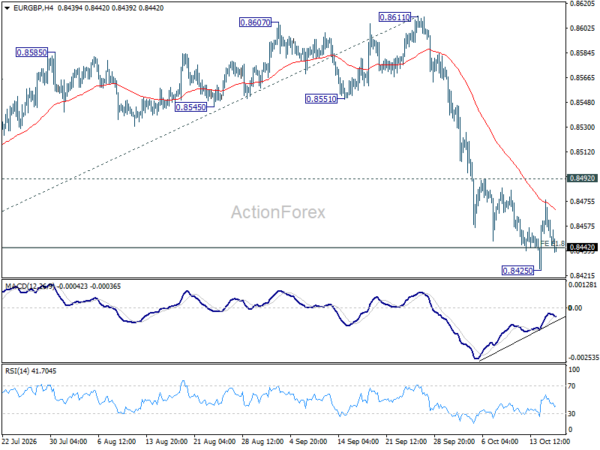
The near-term outlook remains bearish while 0.8492 resistance holds. A break below 0.8425 would extend the larger decline from 0.8863 toward the 100% projection at 0.8336. Such a development would provide fresh evidence of Sterling outperforming Euro.
However, bullish divergence in the four-hour MACD suggests that EUR/GBP’s downward momentum is weakening. A break above 0.8492 would indicate short-term bottoming and shift focus toward the 55-day EMA, currently around 0.8540.
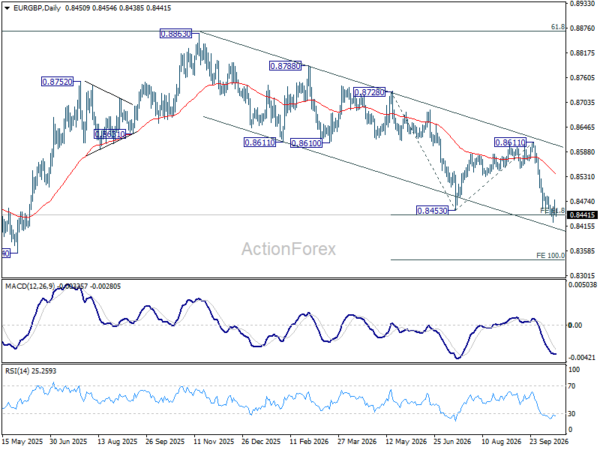
This creates an important qualification for the broader Sterling outlook. Although EUR/GBP has already declined substantially, the latest price action has not confirmed another leg lower.
There is also a potential Euro-specific complication. French and German 10-year government bond yields stand at 4.779% and 3.409% respectively, leaving the OAT–Bund spread around 137bps. That is near the narrow end of the previously observed 138–142bps range, suggesting no fresh widening in French sovereign risk premiums in this snapshot.
A EUR/GBP break below 0.8425 would therefore carry greater significance if French spreads stay stable and other Sterling crosses strengthen simultaneously. Otherwise, Euro-specific weakness could complicate the interpretation.
GBP/CHF Still Constructive, but Break Above 1.1105 Is Missing
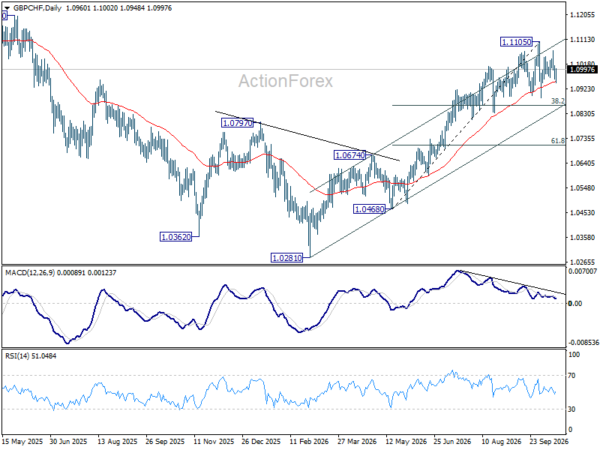
GBP/CHF provides the second important test of Sterling strength, but its technical picture is not yet delivering clear confirmation.
The pair has continued consolidating below 1.1105, despite support from its 55-day EMA.
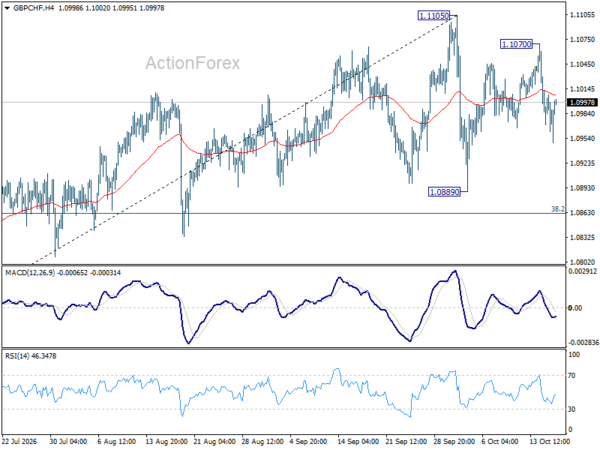
The broader near-term outlook remains bullish while the 38.2% retracement of the advance from 1.0468 to 1.1105 at 1.0862 holds. A firm break above 1.1105 would resume the larger uptrend from 1.0281, providing stronger evidence of renewed upside momentum.
However, the daily MACD shows bearish divergence, with momentum failing to confirm the previous price high. This raises the possibility that the consolidation has further to run before the uptrend can resume.
One potential corrective scenario involves the decline from 1.1105 to 1.0889 as the first leg, followed by a rebound to 1.1070. An equal-length third leg would target approximately 1.0854, close to the 1.0862 retracement and the lower boundary of the rising daily channel. This remains a possible corrective structure rather than a confirmed wave count.
Moreover, with Swiss Franc currently the weakest major currency in the market snapshot, a GBP/CHF breakout would be necessary but not sufficient evidence of a broader Sterling rally. Confirmation would be considerably stronger if accompanied by a fresh EUR/GBP breakdown.
Sterling Recovery Still Needs Cross-Currency Confirmation
GBP/USD has established a short-term bottom, and the November BoE hike expectation remains intact. But the evidence still favors Dollar weakness as the principal driver of the latest recovery.
A more convincing Sterling-specific bullish development would require EUR/GBP to break below 0.8425 and GBP/CHF to clear 1.1105. Such a combination would indicate that Sterling is strengthening beyond its relationship with Dollar, especially if French sovereign spreads remain stable.
Until then, GBP/USD could extend toward 1.3341, or potentially 1.3469 if that resistance gives way, without necessarily signaling a broader shift in Sterling sentiment.
The November BoE outlook provides fundamental support, but EUR/GBP and GBP/CHF will determine whether Sterling’s recovery has momentum of its own.
Key Takeaways
- GBP/USD’s rebound from 1.3135 looks driven mainly by Dollar weakness (DXY near a ten-day low at 101.80) rather than Sterling-specific strength.
- A November BoE hike remains firmly priced (81.6% probability, per market pricing) and economist consensus (54 of 63 in a Reuters poll), unshaken by Bailey’s balanced remarks or the UK’s 0.1% August GDP beat.
- EUR/GBP has stalled near 0.8425 support with bullish MACD divergence, while GBP/CHF remains stuck below 1.1105 resistance—neither cross has confirmed broad Sterling strength.
- GBP/USD’s near-term path points toward 1.3341 and potentially 1.3469, but a true Sterling rally would require EUR/GBP to break below 0.8425 and GBP/CHF to clear 1.1105 simultaneously.
- Stable French OAT–Bund spreads (around 137bps) mean any EUR/GBP breakdown would carry more weight as genuine Sterling strength rather than Euro-specific weakness.