
TL;DR: Gold is struggling to hold above $4,100 as Brent tests $110 and the US 10-year yield attempts to recover. Whether $4,000 comes under threat depends on a tug-of-war between oil-driven inflation pressure pushing yields higher and lingering AI-related financial stress keeping defensive Treasury demand alive.
Why This Matters
Gold is struggling to sustain a recovery above $4,100, with its near-term technical structure keeping the $4,000 psychological level relevant. Brent crude is testing $110 as Middle East supply risks persist, while the US 10-year Treasury yield is attempting to recover from its recent pullback. If higher oil prices revive inflation concerns and push yields toward fresh highs, Gold could face another test of 4,066 support, with a decisive break bringing $4,000 into focus.
However, the relationship is not straightforward. Last week’s AI-driven equity selloff brought renewed demand for Treasuries, pulling yields lower and temporarily supporting Gold despite elevated oil prices. With AI-related financial concerns showing signs of stabilization but not yet fully resolved, the next direction will depend on whether oil-driven tightening expectations regain control or defensive demand for bonds continues to restrain yields.
Oil and Treasury Yields Have Dominated Gold’s Direction
Gold has struggled against a backdrop of persistently elevated oil prices and expectations for tighter US monetary policy. Since the Middle East conflict intensified, rising energy costs have frequently reinforced inflation concerns, supporting Fed tightening expectations and Treasury yields while weighing on the precious metal. The relationship has been reflected in several episodes of falling Gold prices alongside renewed oil strength, although the transmission through interest rates and Dollar has not been uniform.
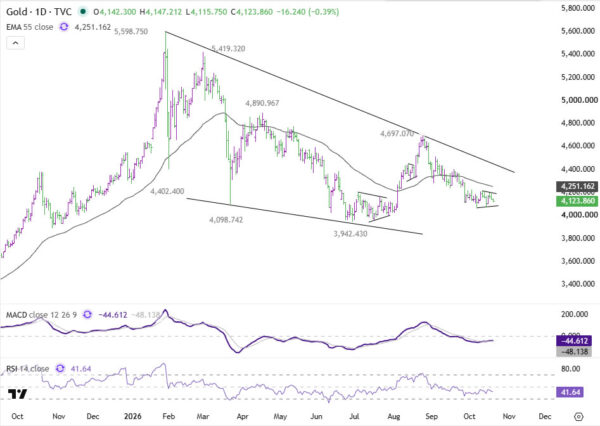
The pressure has been substantial. Gold has lost approximately 26% from its January peak of 5,598.75, with attempts to recover repeatedly encountering selling interest. The decline reflects an environment in which the traditional geopolitical safe-haven appeal of Gold has often been outweighed by concerns over inflation, interest rates and the opportunity cost of holding a non-yielding asset.
Last week’s AI-driven selloff temporarily interrupted that pattern. As concerns over technology valuations and financing risks intensified, investors sought safety in US Treasuries, pushing yields sharply lower. The 10-year yield fell approximately 12–15bps during Thursday’s bond rally, while Gold gained around 1.6%, demonstrating that the metal was responding more directly to falling yields than to elevated oil prices.
The relief proved limited. Gold failed to extend its rebound convincingly on Friday as Brent surged 3.7% and Treasury yields recovered. The episode reinforced the importance of the interest-rate channel, while showing that oil is not the only force capable of driving yields and Gold in opposite directions.
Can AI-Related Stress Keep Restraining Yields as Brent Tests $110?
Financial markets have shown tentative stabilization following last week’s AI-related turbulence, but the recovery remains limited. Nasdaq gained 1.11% on Monday, recovering only a modest portion of its earlier decline. Treasury yields have also retraced just a fraction of their recent pullback, suggesting that confidence has improved without fully reversing the defensive positioning established during the selloff.
Concerns remain particularly visible in companies exposed to AI infrastructure financing. Elevated borrowing costs for CoreWeave and widening credit-default swap spreads for Oracle have highlighted investors’ growing sensitivity to leverage and funding requirements. However, broader high-yield credit spreads have not shown comparable deterioration, suggesting that the stress has yet to develop into a generalized credit-market disruption.
The distinction matters for Gold because a renewed deterioration in AI-related financial conditions could revive demand for Treasuries and restrain yields. Conversely, continued stabilization would reduce that defensive support and leave markets more exposed to inflation pressures from elevated energy prices.
Brent is now testing the $110 level after settling at $109.55 on Monday. Persistent disruptions around the Strait of Hormuz, threats to Saudi energy infrastructure and continued attacks on Russian energy facilities are sustaining concerns about global oil supplies.
However, Brent has struggled to establish a sustained break above $110, while expectations for additional Russian crude supply have provided some counterweight. The immediate question is therefore whether oil can hold above the threshold rather than merely trade through it intraday.
For Gold, sustained oil strength would become more significant if it feeds into firmer Fed tightening expectations, higher Treasury yields and Dollar appreciation. The October 19 CME snapshot still assigned only around 17% probability to an October Fed hike, but expectations for additional tightening later in the year remained substantial. A renewed repricing toward faster or more extensive tightening would increase pressure on Gold.
ActionForex’s Technical View: US 10-Year Yield, Correction or Renewed Advance?
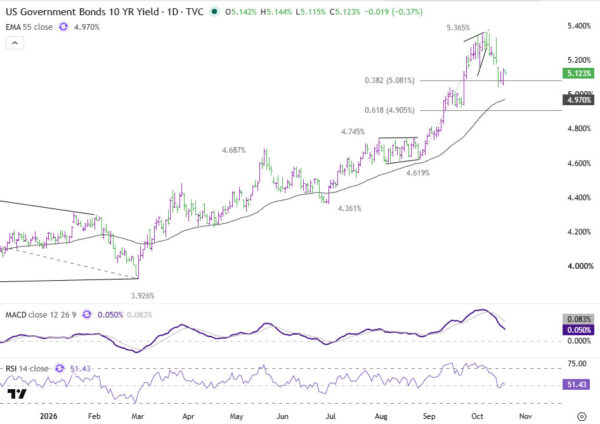
Technically, the US 10-year Treasury yield’s pullback from 5.365% has stabilized after reaching 5.039%. The low briefly undercut the 38.2% retracement of the rise from 4.619% to 5.365%, located at 5.081%, but remained above the 5.000% psychological level and well above the rising 55-day EMA, currently around 4.970%.
The development is consistent with the decline from 5.365% being a correction within the advance from 4.619%, rather than the beginning of a sustained bearish reversal in yields. The subsequent recovery toward 5.12%, accompanied by improving four-hour MACD, adds tentative support to that interpretation.
Decisive break above the four-hour 55 EMA, currently near 5.162%, will strengthen the corrective-pullback scenario. Such a move would raise the possibility of a retest of the 5.365% high, although it would still be premature to conclude that the larger yield uptrend has resumed.
Conversely, another decline through 5.039% would weaken the near-term correction view and expose the rising daily 55 EMA. Sustained break below that average would suggest a larger-scale correction is developing, potentially retracing more of the advance from 4.361% to 5.365%.
ActionForex’s Technical View: Gold Consolidates Above 4,066, but Downside Risk Persists
Gold’s technical structure remains less constructive. Rebound attempts from 4,066.21 have been limited below 4,227.85 resistance, well beneath the 38.2% retracement of the decline from 4,697.07 to 4,066.21 at 4,307.19. Price also remains below the falling daily 55 EMA, currently around 4,251.
This suggests that price action from 4,066.21 is developing as a consolidation within the decline from 4,697.07, rather than a convincing bullish reversal. The repeated inability to overcome nearby resistance, together with subdued daily and four-hour momentum, reinforces that interpretation.
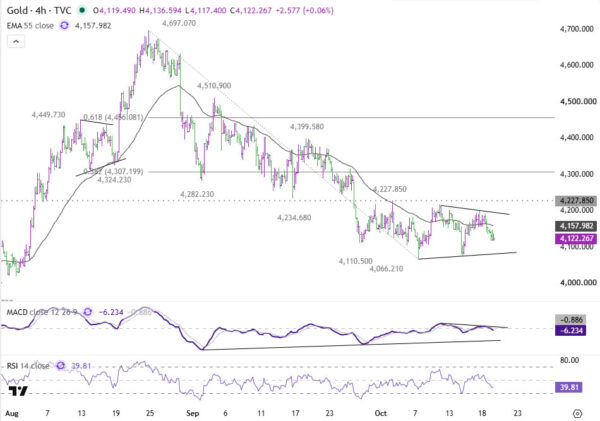
Near-term risk will remain on the downside as long as 4,227.85 resistance holds. Firm break below 4,066.21 would indicate that the consolidation has completed and extend the decline from 4,697.07 toward the 3,942.43 low, with the psychological $4,000 threshold standing in between.
Nevertheless, it is premature to conclude that the fall from 4,697.07 represents a resumption of the larger downtrend from 5,598.75. The decline has not developed a clearly impulsive structure, and the momentum of the next downward leg, should one materialize, will require close monitoring.
A sustained break above 4,227.85 would weaken the immediate bearish outlook and suggest that consolidation is extending. Stronger recovery toward the daily 55 EMA and 4,307.19 Fibonacci resistance would provide a more meaningful challenge to the current downside bias.
What Would Put Gold’s $4,000 Floor in Danger?
The most significant bearish scenario involves a sustained rise in oil prices accompanied by renewed upward pressure on Treasury yields. If Brent establishes itself above $110, persistent energy inflation concerns could reinforce expectations for further Fed tightening and push the US 10-year yield back toward its early-October peak.
However, a retest of 5.365% alone may not be sufficient to drive Gold below $4,000. The metal previously held around 4,066 when the 10-year yield reached that high. A more convincing bearish catalyst would involve Treasury yields breaking decisively above 5.365%, stronger-than-previously-priced Fed tightening expectations, or a meaningful recovery in Dollar.
The technical confirmation would then come from Gold itself. A firm break of 4,066.21 would expose $4,000, while sustained trading below that psychological threshold would strengthen the case for a deeper fall toward 3,942.43.
Conversely, the bearish scenario would lose credibility if Brent retreats materially below $110, particularly toward $108, while AI-related financial stress renews defensive demand for Treasuries. A 10-year yield decline below 5.039% would further challenge expectations for renewed upward pressure on rates.
For Gold, recovery above 4,227.85 would be the first technical warning that the anticipated downside extension is failing to develop. The $4,000 scenario therefore requires confirmation from both the macro transmission mechanism and Gold’s own price action, rather than simply another rise in crude oil.
AI Earnings, Treasury Auctions and the Fed Decision Lie Ahead
The coming sessions offer several opportunities for the competing forces to develop. Netflix earnings after Tuesday’s close will provide another reading on technology-sector sentiment, followed by Tesla, Meta and IBM results on Wednesday. Investors will be watching whether corporate developments help stabilize confidence or revive concerns about technology valuations and financing.
Treasury supply will also be important. Wednesday’s 20-year bond auction and Thursday’s five-year TIPS auction could offer additional evidence of investor demand for duration and inflation protection. Thursday’s US jobless claims will provide another economic input, although movements in real yields and inflation expectations will need to be assessed alongside the auction results.
The broader policy test arrives with the October 28 Fed decision. Updated market expectations for the timing and extent of further tightening will be particularly important if Brent remains close to $110 and Middle East supply risks persist.
For now, Gold’s failure to sustain a recovery above 4,227.85 leaves the near-term technical outlook vulnerable, while the Treasury yield correction may be approaching an important decision point. A renewed rise in yields driven by persistent oil inflation risks could bring Gold’s 4,066 support under pressure and expose $4,000. But unresolved AI-related financial stress remains capable of interrupting that transmission through renewed demand for Treasuries.
The next decisive signal will be whether oil-driven inflation concerns push Treasury yields beyond their previous highs while Gold loses 4,066. Until that combination develops, a break below $4,000 remains a meaningful risk rather than a confirmed outcome.
Key Takeaways
- Gold is down roughly 26% from its January peak of 5,598.75, and remains capped below 4,227.85 resistance despite last week’s AI-driven haven bid.
- Last week’s AI-related equity selloff pulled the 10-year yield down 12–15bps and lifted Gold 1.6%, proving yields—not oil—are currently Gold’s dominant driver.
- Brent is testing $110 on persistent Strait of Hormuz and Russian-energy supply risks, but has yet to sustain a break above that level.
- Gold’s key technical level is 4,066.21 support: a firm break exposes the $4,000 psychological threshold and then 3,942.43, while recovery above 4,227.85 would be the first warning the downside case is failing.
- The October 28 Fed decision, alongside this week’s AI earnings (Netflix, Tesla, Meta, IBM) and Treasury auctions, will help determine whether oil-driven tightening expectations or defensive Treasury demand wins out.