
TL;DR: Global risk aversion is the dominant driver pushing AUD/JPY lower, with the Yen in demand and the Aussie under pressure, and 105.22 is the next downside target. The expected narrowing of the RBA–BoJ rate gap is already priced, so risk appetite, starting with Nvidia’s earnings, is likely to set the near-term direction.
Why Is AUD/JPY Falling Despite Australia’s Rate Advantage?
AUD/JPY extended its decline on Tuesday, trading around 107.33 after breaking below key Fibonacci projection level at 107.63. Risk aversion remains the dominant near-term driver, with Yen benefiting from defensive demand while Australian Dollar struggles against a backdrop of falling global equities and growing concerns over AI-related investments. The weekly currency heat map showed Yen outperforming all seven major peers, while Aussie ranked second weakest, with AUD/JPY trading below last week’s low. Beyond the immediate market turbulence, OIS-implied expectations point to a narrowing RBA–BoJ interest rate differential through 2027, although much of that prospective convergence is already reflected in market pricing.
Global Risk Aversion Keeps AUD/JPY Under Pressure
The latest decline in AUD/JPY follows a broadening global equity selloff, initially centered on AI-related technology companies but increasingly affecting other sectors. US stocks suffered substantial losses on Monday, with Nasdaq Composite plunging 2.49%, S&P 500 falling 1.92%, and Dow Jones Industrial Average declining 1.41%. VIX surged 18.7% to 22.90, reflecting a sharp increase in market volatility.
- Nasdaq Composite: −2.49%; S&P 500: −1.92%; Dow Jones: −1.41%
- VIX: +18.7% to 22.90
Technology shares remained at the center of the selling. Nvidia dropped 4.12% ahead of its closely watched earnings announcement on Tuesday, as investors continued to assess the implications of the company’s leadership upheaval and the outlook for AI investment. However, weakness spread beyond the technology sector, with consumer staples the only S&P 500 sector recording gains during the afternoon session.
Selling pressure continued into Asian markets on Tuesday. Around 04:30 UTC, Nikkei 225 was down 1.28%, KOSPI had lost 1.91%, and Hang Seng was trading 0.77% lower. The declines followed Monday’s particularly sharp losses in Asian semiconductor stocks, including Japan’s Advantest, Tokyo Electron, and SoftBank.
The currency market response reinforced the defensive shift. Monday’s daily heat map showed Yen strengthening against all seven major currencies, while Australian Dollar weakened across the board. The weekly heat map continued to place Yen at the top, with Aussie near the bottom. AUD/JPY has consequently become a clear expression of the prevailing risk-off environment, combining the vulnerability of a growth-sensitive currency with the defensive appeal of Yen.
Notably, Yen strength persisted despite Japan’s disappointing Q3 GDP figures, which showed an annualized contraction of 0.1% against expectations for 0.3% growth. That divergence suggests global risk sentiment has been more influential than Japan’s near-term economic performance in driving the currency.
Australian Dollar also faces additional pressure from China, where October industrial production, retail sales, and investment all disappointed expectations. These developments provide a separate explanation for Aussie’s underperformance, although the immediate weakness in AUD/JPY remains closely aligned with deteriorating equity sentiment.
Tuesday’s currency movements have been less uniformly defensive than Monday’s, with Aussie recovering some ground against other commodity currencies. Nevertheless, AUD/JPY has continued to weaken, indicating that the relative strength of Yen remains important for the cross.
Follow AUD/JPY’s slide toward 105.22 and the risk-sentiment signals behind it on the ActionForex Telegram channel.
RBA–BoJ Rate Gap Expected to Narrow Through 2027
Beyond the immediate risk-off pressure, the medium-term interest rate outlook offers diminishing support for AUD/JPY.
The RBA’s cash rate currently stands at 4.85%, compared with BoJ’s policy rate of 1.25%, leaving a substantial 360bps interest rate advantage for Australian Dollar. However, OIS-implied pricing suggests that the differential is more likely to narrow than widen over the coming year.
Current pricing assigns just a 4.0% probability to another RBA rate hike in December, while implying a modest 6.2bps decline in the Australian policy rate over the next 12 months. By contrast, the probability of a BoJ hike in December stands at 83.6%, with approximately 66.1bps of tightening implied over the same period.
Taken together, these expectations point to a narrowing of the RBA–BoJ policy-rate gap by around 72bps over 12 months. By the end of 2027, the differential is projected to shrink by approximately 80bps to 280bps, with the Australian cash rate implied at 4.76% and the Japanese rate at 1.96%.
- RBA cash rate 4.85% vs BoJ policy rate 1.25%: 360bps gap
- December: 4.0% probability of an RBA hike; 83.6% probability of a BoJ hike
- Next 12 months: RBA about −6.2bps; BoJ about +66.1bps (gap narrows by around 72bps)
- End of 2027: gap about 280bps (RBA at 4.76%, BoJ at 1.96%)
The important qualification is that this convergence is already reflected in OIS pricing. It therefore represents a medium-term fundamental backdrop rather than a new catalyst for AUD/JPY selling. Further downward pressure from policy divergence would require expectations to shift more decisively toward BoJ tightening or away from RBA tightening.
The RBA’s November meeting minutes reinforced the uncertainty surrounding Australia’s policy outlook. The Board voted 6–3 to raise the cash rate to 4.85%, with the majority judging that inflation risks warranted additional restraint. However, three dissenting members preferred to wait for the effects of previous tightening, warning that the economy could be approaching a “materially sharper downturn.”
The minutes also highlighted competing pressures from persistent inflation, elevated oil prices, and strong AI-related investment on one side, and weakening housing conditions and rising unemployment on the other. With unemployment at 4.7% and the housing market experiencing a substantial downturn, the scope for further Australian tightening may be increasingly constrained by economic weakness.
Importantly, OIS-implied RBA expectations showed little reaction to the minutes, with December hike pricing remaining at 4.0%. The release therefore provided limited evidence of a fresh shift in monetary policy expectations.
For BoJ, the principal uncertainty is whether Japan’s economy can sustain the degree of tightening currently priced. The disappointing Q3 GDP reading and pressure from elevated energy import costs could eventually weigh on policy normalization. A reduction in expected BoJ tightening would help preserve Australia’s rate advantage, potentially limiting medium-term downside pressure on AUD/JPY.
ActionForex’s Technical View: AUD/JPY, 105.22 Next as Correction Deepens
AUD/JPY’s fall from 114.95 continued this week and broke through 61.8% projection of 114.95 to 108.62 from 111.55 at 107.63. There is no sign of bottoming yet, despite oversold condition in 4H RSI. Current decline should continue to 100% projection at 105.22 next.
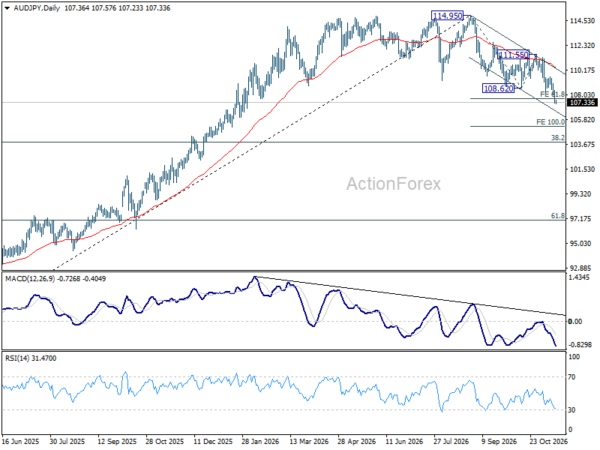
On the upside, above 108.62 support turned resistance will bring consolidations first. But near term outlook will stay bearish as long as 111.55 resistance holds, in case of recovery.
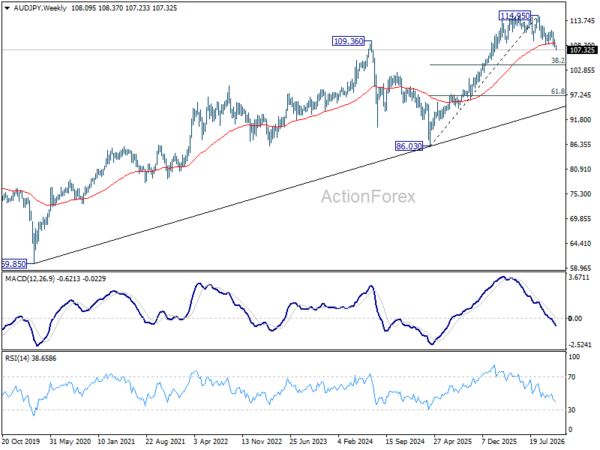
In the bigger picture, decline from 114.95 is seen as correcting the uptrend from 86.03 (2025 low). The break below 55 W EMA supports this. The correction could extend to 38.2% retracement 86.03 to 114.95 at 103.90 before completion.
Nvidia Earnings and Economic Data to Test the Downtrend
Near-term attention will center on Nvidia’s earnings announcement after Tuesday’s US market close. A reassuring report could help stabilize technology shares and reduce defensive demand for Yen, potentially allowing AUD/JPY to consolidate after its recent decline. A disappointment would risk extending the equity selloff and reinforcing pressure on the cross.
Australia’s Q3 Wage Price Index, due Wednesday, will provide further evidence on domestic inflation pressures, with quarterly wage growth expected at 0.9%. Japan’s October trade figures will follow, offering another indication of how external demand and elevated import costs are affecting the economy.
Further ahead, the RBA’s December 8 decision and BoJ’s December 18 meeting will test the policy-rate paths currently implied by markets.
For now, the near-term direction of AUD/JPY remains closely tied to global risk appetite, while the expected narrowing in the RBA–BoJ rate differential reduces the prospect of additional support from Australia’s interest rate advantage. With the technical breakdown already in place, 105.22 remains the immediate downside objective, while 103.90 represents a possible deeper correction target if selling persists.
Key Takeaways
- AUD/JPY traded around 107.33 after breaking the 107.63 projection level, with risk aversion the dominant driver as Yen outperformed all seven majors.
- US stocks fell sharply on Monday (Nasdaq −2.49%, VIX +18.7% to 22.90), and Asian markets extended the weakness on Tuesday, ahead of Nvidia’s earnings after the US close.
- Australia’s 360bps rate advantage over Japan is expected to narrow by around 72bps over 12 months, but that convergence is already priced and is a backdrop rather than a fresh catalyst.
- The decline should continue to the 105.22 projection, with 103.90 a deeper correction target, while 108.62 and 111.55 are the resistance levels for the bearish view.
- Australia’s Q3 Wage Price Index (Wednesday), Japan’s October trade figures, the RBA on December 8 and the BoJ on December 18 are the next tests.
Stay ahead of AUD/JPY’s slide toward 105.22 and the risk signals that could decide it—join the ActionForex Telegram channel for regular market updates and analysis.