
TL;DR: NZD/USD is sliding toward its 2020 low even as RBNZ rate hike expectations rebuild, which points to global risk aversion rather than New Zealand policy as the driver. A decisive break of the 0.5467 2020 low would confirm the long-term downtrend is resuming.
Why Is NZD/USD Falling Even as RBNZ Hike Expectations Rise?
NZD/USD extended its decline this week to 0.54832, its lowest level since 2020, approaching the critical support area surrounding the 2020 low of 0.5467. The weakness comes despite a recovery in RBNZ rate hike expectations over the past week, with markets pricing substantial additional tightening through 2027. The divergence suggests New Zealand’s monetary policy outlook is not the principal explanation for Kiwi’s decline. Instead, broader risk aversion and defensive currency demand appear to be exerting greater influence, leaving NZD/USD vulnerable to a long-term technical breakdown even as domestic interest rate expectations become more supportive.
RBNZ Rate Hike Expectations Rebuild After October Hold
The RBNZ held its Official Cash Rate at 2.75% on October 28 in a narrow 4–3 decision, with three policymakers preferring an immediate increase to 3.00%. The hold surprised markets that had almost fully priced a hike beforehand, although Governor Anna Breman subsequently indicated that further increases were likely, potentially taking policy into restrictive territory.
OIS-implied pricing has since recovered. As of Tuesday morning, the December 9 meeting implied a policy rate around 2.96%, while subsequent meetings pointed to 3.11% in February, 3.24% in March and 3.45% by June 2027. The implied rate rises further to 3.64% in October 2027 and approximately 3.69% by year-end.
- December 9: about 2.96%
- February: 3.11%; March: 3.24%
- June 2027: 3.45%; October 2027: 3.64%; year-end 2027: about 3.69%
The curve has shifted higher over the past week, but remains below levels prevailing before October’s surprise hold. December tightening is largely anticipated, although the precise probability of a 25bps hike depends on the relationship between OIS pricing and its underlying reference rate. Westpac Senior Economist Satish Ranchhod also expects an increase in December, citing firm underlying inflation pressures and the prospect of higher fuel costs lifting headline inflation.
The direction of recent repricing is important for NZD/USD. The market has added expected RBNZ tightening rather than reduced it, making domestic rate expectations an unlikely primary driver of the latest currency weakness.
Follow NZD/USD’s test of the 2020 low and the RBNZ outlook on the ActionForex Telegram channel.
RBNZ Survey Reinforces Near-Term Inflation Concerns
The RBNZ’s November Survey of Expectations offered little evidence of a fresh dovish shift. One-year inflation expectations rose from 2.60% to 2.92%, while two-year expectations edged up from 2.34% to 2.36%. However, longer-term measures moved in the opposite direction, with five-year expectations falling from 2.31% to 2.17% and ten-year expectations easing from 2.20% to 2.13%.
The combination indicates greater concern over near-term inflation without a corresponding deterioration in longer-term expectations. Survey respondents also raised their one-year OCR expectation from 3.21% to 3.40%, while the expected rate for the end of December stood at 3.05%, compared with 2.75% currently.
- One-year inflation expectations: 2.60% to 2.92%; two-year: 2.34% to 2.36%
- Five-year: 2.31% to 2.17%; ten-year: 2.20% to 2.13%
- One-year OCR expectation: 3.21% to 3.40%; end-December expectation: 3.05% (OCR currently 2.75%)
The survey was conducted between October 23 and 30, spanning the RBNZ’s October decision and preceding this week’s market repricing. Its findings therefore provide context for the tightening outlook rather than evidence of a reaction to the latest currency decline. The one-year OCR expectation also implies somewhat less tightening than current OIS pricing, although the survey and market horizons are not identical.
Separately, the RBNZ’s Financial Stability Report described New Zealand’s financial system as resilient, while warning of risks from geopolitical tensions, higher government bond yields and stretched valuations, particularly among AI-related companies. Domestic housing conditions remained subdued, and financial pressures continued to affect smaller businesses and discretionary-spending sectors.
The report underscores New Zealand’s exposure to external financial shocks, but contains no direct monetary policy signal capable of explaining the latest NZD/USD decline.
Global Risk Aversion Outweighs Relative Rate Support
The broader currency and equity market picture offers a more plausible explanation for Kiwi’s weakness. The weekly currency heat map showed Yen, Dollar and Swiss Franc outperforming, while Australian and New Zealand Dollars ranked at the bottom. NZD/USD traded below the previous week’s low, consistent with the pressure facing growth-sensitive currencies.
Monday’s sharp US equity selloff reinforced the defensive environment. Nasdaq Composite plunged 2.49%, S&P 500 dropped 1.92%, and Dow Jones Industrial Average lost 1.41%, while VIX reached 22.90. Concerns surrounding AI-related investment and technology valuations also weighed on Asian semiconductor shares. Disappointing Chinese retail sales, industrial production and investment figures added another headwind for currencies exposed to regional growth.
Relative interest rate expectations do not offer a compelling alternative explanation. CME FedWatch pricing indicated approximately 26bps of expected Fed tightening in December, slightly less than the roughly 27bps implied a week earlier. Over the same period, RBNZ tightening expectations increased. The changes suggest that the near-term relative rate outlook moved modestly in NZD’s favor rather than against it, although the comparison involves different pricing instruments and reference rates. Both central banks are nevertheless expected to tighten, leaving the absolute December rate outlook far from unambiguously supportive of Kiwi.
Nevertheless, the risk-aversion argument is stronger on the weekly horizon than in Tuesday’s intraday trading, when USD ranked weakest on the daily currency heat map. That distinction suggests the broader defensive environment has contributed to NZD/USD weakness without establishing that every move in the pair has been driven by Dollar demand.
AUD/NZD provides a useful cross-check. The cross has fallen approximately 2.8% from its October 28 peak near 1.2600, indicating that NZD has outperformed AUD since the RBNZ’s hold. That relative strength is consistent with a more supportive RBNZ rate outlook, particularly as markets assign only a small probability to another RBA hike in December.
The comparison reinforces the view that NZD/USD weakness is not primarily a New Zealand-specific monetary policy story. Kiwi has retained some relative support against Aussie even as both currencies have struggled in the broader risk-averse environment.
Risk Sentiment and US Data Remain the Immediate Tests
Attention now turns to US retail sales and Nvidia’s earnings announcement later Tuesday. Retail sales could influence the Dollar through expectations for US economic resilience and Fed policy, while Nvidia’s results may determine whether pressure on AI-related equities intensifies or begins to ease.
A sustained recovery in global equities accompanied by a NZD/USD rebound would support the interpretation that risk aversion has been the dominant driver. Continued Kiwi weakness despite stabilizing equities would instead put greater emphasis on Dollar demand, Treasury yields or other US-specific influences.
Further ahead, the RBNZ’s December 9 Monetary Policy Statement and the Fed’s decision later the same day will test whether relative rate expectations remain supportive of NZD.
ActionForex’s Technical View: NZD/USD,
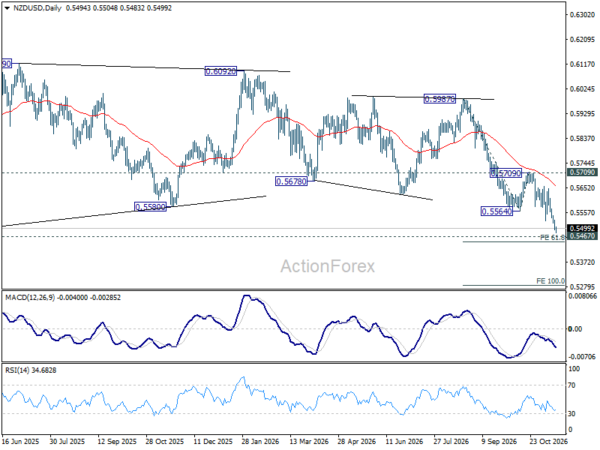
NZD/USD’s decline from 0.5987 continued this week and hit the lowest level since 2020. It’s now entering an important zone, including 0.5484 (2025 low), 0.5467 (2020 low), and 61.8% projection of 0.5987 to 0.5564 from 0.5709 at 0.5447.
Some support could be seen around this zone to bring recovery. However, outlook will stay bearish as long as 0.5709 resistance holds, and risk will remain heavily on the downside.
Decisive break of this zone will confirm long term downtrend resumption. In this case, the next near term target will be 100% projection of 0.5987 to 0.5564 from 0.5709 at 0.5286.
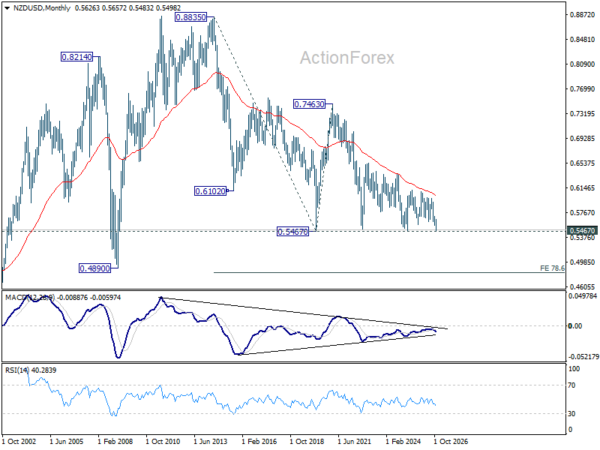
In the monthly chart, outlook stays firmly bearish as NZD/USD continues to stay well below the falling 55 M EMA. Sustained break of 0.5467 would resume the whole downtrend from 0.8835 (2014 high). That would set up deeper medium to long term fall to 78.6% of 0.8835 to 0.5467 from 0.7463 at 0.4815, which is slightly below 0.4890 (2009 low).
Key Takeaways
- NZD/USD fell to 0.54832, its lowest since 2020, approaching the 2020 low at 0.5467, despite RBNZ rate hike expectations rebuilding after October’s 4–3 hold.
- OIS pricing implies about 2.96% for December 9 and about 3.69% by year-end 2027, so New Zealand policy is unlikely to be the main driver of the decline.
- Global risk aversion is the more plausible explanation, with Nasdaq down 2.49% on Monday, VIX at 22.90 and the Aussie and Kiwi the weakest on the weekly heat map.
- The support zone includes 0.5484, 0.5467 and 0.5447, and a decisive break would open the 0.5286 projection, while 0.5709 is the resistance for the bearish view.
- US retail sales and Nvidia’s earnings (Tuesday) and the RBNZ and Fed decisions on December 9 are the next tests.
Stay ahead of NZD/USD’s test of the 2020 low and the risk signals that could decide it—join the ActionForex Telegram channel for regular market updates and analysis.