Dollar is softer across the board today as its recent rebound appears to be losing momentum. The move lacks a single defining trigger, instead reflecting a convergence of sentiment shifts and near-term positioning adjustments. One important backdrop is the stabilization in risk appetite. After markets spent much of last week grappling with AI-related disruption fears and concerns over surging capital expenditure, those anxieties have eased. Equity markets, particularly in the US, have steadied, reducing the need for defensive Dollar exposure.
Another factor may be growing caution ahead of the delayed January non-farm payroll report. Following a string of softer labor market signals last week, some traders appear to be hedging against the risk of a downside surprise in headline job creation. Adding to the pressure are reports suggesting Chinese regulators have encouraged financial institutions to scale back holdings of US Treasuries due to heightened market volatility. While the immediate impact is unclear, the headlines add to broader uncertainty surrounding foreign demand for US assets.
Despite these pressures, the Dollar’s pullback remains orderly. Many market participants appear reluctant to commit to larger directional trades, at least until the payroll data provides clearer guidance on the Fed’s policy path.
Meanwhile, Sterling is also under pressure today, particularly against Euro and Swiss Franc, as domestic political risk resurfaces sharply. UK Prime Minister Keir Starmer’s government is facing its most severe crisis yet following the back-to-back resignations of two senior aides. Chief of Staff Morgan McSweeney resigned on Sunday, followed less than 24 hours later by Director of Communications Tim Allan, intensifying scrutiny around leadership stability.
The resignations are tied to a widening scandal surrounding the appointment of Peter Mandelson as UK ambassador to the US, amid revelations about the depth of his past relationship with the late convicted sex offender Jeffrey Epstein. The issue has quickly escalated from reputational risk to a full-blown political liability.
Reports suggest Downing Street is bracing for a delegation of Cabinet ministers to urge Starmer to step aside. Names such as Health Secretary Wes Streeting and former Deputy Prime Minister Angela Rayner are already being floated as potential successors, injecting fresh uncertainty into the UK political outlook.
In Japan, the so-called “Takaichi trade” partially resurfaced after Prime Minister Sanae Takaichi secured a historic supermajority in the Lower House, delivering the LDP its strongest result since World War Two. The result significantly strengthens her legislative authority.
While Nikkei surged to new record highs on the back of the election outcome, Yen did not collapse as some had expected. Instead, it staged a modest recovery as a chorus of senior Japanese officials stepped up verbal intervention, warning against one-sided FX moves. Still, this should not be mistaken for a structural Yen reversal. The currency is merely retracing a portion of recent losses as traders adopt a wait-and-see stance, likely looking for better levels to re-establish short positions.
For the day so far, Dollar sits at the bottom of the performance table, followed by Kiwi and Sterling. Swiss Franc leads gains, with Euro and Yen also firmer, while Loonie and Aussie are trading in the middle of the pack.
In Europe, at the time of writing, FTSE is down -0.12%. DAX is up 0.44%. CAC is up 0.09%. UK 10-year yield is up 0.049 at 4.562. Germany 10-year yield is up 0.009 at 2.853. Earlier in Asia, Nikkei rose 3.89%. Hong Kong HSI rose 1.76%. China Shanghai SSE rose 1.41%. Singapore Strait Times rose 0.54%. Japan 10-year JGB yield rose 0.059 to 2.294.
Eurozone Sentix jumps to 4.2, growth hope without inflation alarm
Eurozone investor confidence showed notable improvement in February, with the Sentix Investor Confidence Index rising from -1.8 to 4.2, above expectations of -0.2 and marking the highest reading since July 2025. The improvement was broad-based. Current Situation Index climbed from -13.0 to -6.8, its strongest level since April 2023. Meanwhile, Expectations Index rose from 10.0 to 15.8, also the highest since last summer, pointing to growing belief that the worst of the downturn has passed.
Sentix described the data as a “silver lining” for the Eurozone economy, arguing that the recession phase has likely ended and an upturn is beginning. While private investors remain somewhat cautious, institutional investors appear to be turning decisively more optimistic, with professional expectations reportedly rising to +24 points.
Inflation concerns have not re-emerged despite volatility in commodity markets and firmer oil prices. Investors surveyed see little risk of renewed inflation pressure, a backdrop that should allow the ECB to maintain its current policy stance. Markets continue to expect monetary policy to remain mildly supportive, and “definitely do not anticipate a restrictive phase.”
Japan’s nominal pay accelerates to 2.4% in December, but real wages still negative
Japan’s real wages fell -0.1% yoy in December, marking the 12th consecutive monthly decline, though the contraction was the smallest seen in 2025. While the pace of erosion is clearly slowing, the data underline how inflation continues to outpace pay gains for households.
Nominal wages rose 2.4% yoy, extending a 48-month streak of increases, but the outcome fell short of expectations for a 3.0% rise. The acceleration from November’s 1.7% growth points to improving momentum, but not yet at a pace sufficient to deliver sustained real income gains.
Breaking down the components, base salaries rose 2.2% yoy, picking up from November’s 1.7% yoy. Overtime pay increased 0.9%, slightly slower than the prior month’s 1.2%. Special payments, largely winter bonuses, rose 2.6% up from 1.5%.
Attention now shifts firmly to the upcoming spring wage negotiations. The key questions are whether large firms can again deliver pay hikes above 5% for the third straight years, and whether those gains finally spill over to smaller companies.
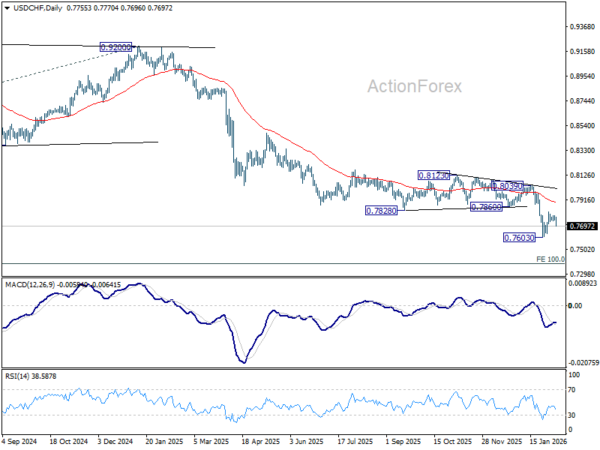
USD/CHF Mid-Day Outlook
Daily Pivots: (S1) 0.7746; (P) 0.7767; (R1) 0.7782; More….
USD/CHF’s break of 0.7713 support suggests that corrective rebound from 0.7603 has already completed at 0.7816. Intraday bias is back on the downside for retesting 0.7603 first. Firm break there will resume larger down trend to 0.7382 projection level next.
In the bigger picture, larger down trend from 1.0342 (2017 high) is still in progress. Next target is 100% projection of 1.0146 (2022 high) to 0.8332 from 0.9200 at 0.7382. In any case, outlook will stay bearish as long as 55 W EMA (now at 0.8152) holds.