Japan remained the focal point of the Asian session as the Nikkei surged to yet another record high, extending gains fueled by post-election political optimism. What stood out, however, was that Yen extended its recovery alongside rising equities, a notable shift from its usual role as a pure risk proxy. The currency’s resilience suggests a temporary decoupling from risk sentiment, with positioning and policy expectations playing a larger role.
Intervention risk remains a key anchor. Japanese officials have maintained a steady stream of verbal warnings, keeping traders cautious about aggressively selling the yen. That deterrent effect has limited speculative momentum, even as global equity markets push higher.
Beyond intervention, there are additional forces at play. Some investors are now reassessing the fiscal outlook, arguing that a supermajority could allow Takaichi’s government to act more decisively and, paradoxically, with greater discipline by removing the need for compromise spending. Those perceptions were reinforced after Finance Minister Satsuki Katayama suggested that surplus reserves could be used to help fund proposed food sales-tax cuts. Some economists interpreted that as a signal that the government remains mindful of funding sources, rather than relying solely on deficit expansion.
That said, the bigger picture for Yen remains unchanged. Over time, fiscal policy is still expected to loosen under a more assertive Takaichi administration, implying renewed downward pressure on the currency at a later stage. For now, though, sellers lack conviction, allowing Yen to enjoy a corrective recovery phase.
Elsewhere, Dollar stayed broadly soft as markets held back ahead of a heavy US data calendar. December retail sales today are seen as a warm-up, with January non-farm payrolls as the main event, followed by January CPI later in the week. Barring repeated large downside surprises, the base case remains that the Fed stays on hold until June, after Kevin Warsh takes over as Fed Chair in mid-May.
For the week so far, Yen leads gains, followed by Swiss Franc, while Dollar and Kiwi lag. Euro and Aussie trade mid-pack.
In Asia, Nikkei rose 2.28%. Hong Kong HSI is up 0.44%. China Shanghai SSE is up 0.14%. Singapore Strait Times is down -0.07%. Japan 10-year JGB yield fell -0.052 to 2.242. Overnight, DOW rose 0.04%. S&P 500 rose 0.47%. NASDAQ rose 0.90%. 10-year yield fell -0.008 to 4.198.
Australia Westpac consumer sentiment dips -2.6% mom after RBA hike, but impact contained
Australia’s Westpac Consumer Sentiment Index fell -2.6% mom to 90.5 in February, reflecting the immediate impact of the RBA’s first rate hike in more than two years. However, Westpac noted that the overall hit to confidence was “relatively mild” by historical standards. The February decline was smaller than the average fall typically seen after rate hikes, and sentiment remains well above the extreme lows recorded through much of 2022–2024.
Looking ahead, Westpac expects the RBA to remain cautious. While another hike at the March meeting cannot be ruled out, the more likely outcome is a pause as policymakers wait for additional data, particularly quarterly inflation updates.
With the RBA placing greater weight on trimmed-mean inflation and the next quarterly CPI report due in late April, Westpac continues to see May as the more probable window for a follow-up 25bp rate hike if inflation remains uncomfortably high.
Australia NAB business confidence rises to 3, costs ease as activity momentum holds
Australia’s NAB Business Conditions index slipped modestly from 9 to 7 in January, while Business Confidence edged up from 2 to 3. For the RBA, the report showed a clear easing in inflation pressures. Measures of labor and input costs both softened during the month, while quarterly growth in retail prices slowed sharply to 0.3%, down from 0.5% in December.
NAB economist Michael Hayes noted that cost and price indicators have now fallen to “new post-pandemic lows”, reinforcing the view that underlying inflation dynamics are continuing to cool.
At the same time, the survey indicates that the broader economy has not lost much traction. Hayes highlighted that activity has “retained most of its momentum gained through the past year” , even as capacity utilization eased slightly.
Lagarde, Nagel reinforce ECB pause as medium-term inflation anchors hold
ECB President Christine Lagarde reiterated overnight that the Governing Council remains comfortable with its current policy stance, telling European lawmakers that inflation is still expected to stabilise at the 2% target over the medium term. In an environment marked by elevated uncertainty, Lagarde stressed that a “data-dependent, meeting-by-meeting approach to monetary policy serves us well.”
That message was reinforced by Bundesbank President Joachim Nagel, who said “many factors” point to the current level of interest rates being appropriate. Nagel downplayed recent inflation softness, arguing that the shortfall is “small, temporary deviations”, while medium-term inflation dynamics remain firmly aligned with the ECB’s target.
Nagel emphasised that policy action would only be warranted if medium-term inflation expectations deviated “sustainably and noticeably” from target — something he said is clearly not happening.
USD/JPY Daily Outlook
Daily Pivots: (S1) 155.05; (P) 156.36; (R1) 157.19; More…
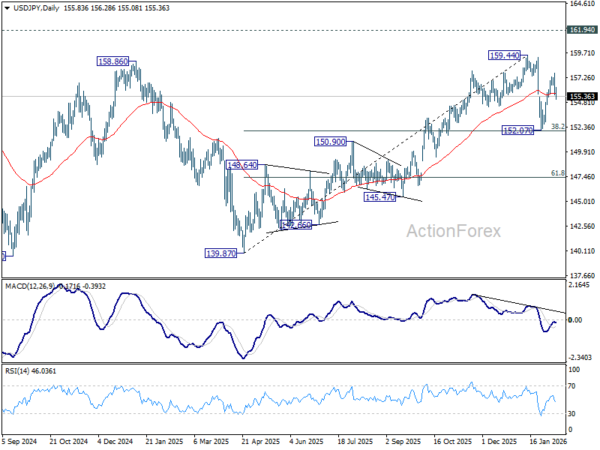
USD/JPY’s break of 155.51 minor support suggests that rebound from 152.07 has already completed at 157.65. Intraday bias is back on the downside for 152.07. Overall, price actions from 159.44 are seen as a correction to the rally from 139.87, rather than reversal. Downside should be contained by 38.2% retracement of 139.87 to 159.44 at 151.96 to bring rebound.
In the bigger picture, outlook is unchanged that corrective pattern from 161.94 (2024 high) should have completed with three waves at 139.87. Larger up trend from 102.58 (2021 low) could be ready to resume through 161.94. This will remain the favored case as long as 55 W EMA (now at 151.68) holds. However, sustained break of 55 W EMA will argue that the pattern from 161.94 is extending with another falling leg.