Dollar trades slightly firmer as investors position ahead of FOMC minutes from January meeting. The hold decision itself is old news; what markets want to understand is how far policymakers are from resuming rate cuts. The dissent from Governors Christopher Waller and Stephen Miran was expected, given their dovish leanings. The more critical insight lies in the broader tone. Did others express openness to future cuts, or does the majority now see policy as appropriately calibrated?
March expectations are unlikely to shift meaningfully. June pricing, however, could move at the margin depending on how confident officials sound about disinflation progress. Any cautious or hawkish nuance would reinforce Dollar’s relative strength.
Sterling, meanwhile, is steady on the day but remains among the weakest performers this week. UK CPI confirmed that headline inflation is slowing quickly, reinforcing expectations of a BoE rate cut in March. If inflation continues trending lower, a couple of 25bps cuts from 3.75% this year appear plausible, with some forecasts pointing toward 3.00% by December.
However, much of the Sterling weakness was already priced following disappointing jobs data earlier this week. The more visible reaction has been in equities. FTSE touched a new record high on expectations of lower borrowing costs.
Kiwi softened mildly after RBNZ left OCR unchanged. While projections showed a slightly higher future rate path, the hawkish tilt was not strong enough to impress markets. Traders had anticipated firmer signals. Governor Anna Breman struck a measured tone, acknowledging the possibility of a rate hike by year-end but stressing that policymakers are not planning to tighten until stronger inflationary pressures and clearer economic recovery emerge. The message was one of patience.
In Europe, unconfirmed media reports suggested that ECB President Christine Lagarde is considering leaving her post before the 2027 French presidential election. The speculation follows the early resignation announcement by Bank of France Governor Francois Villeroy de Galhau, raising questions about broader leadership transitions within the Eurozone’s monetary framework.
The broader concern centers on the political backdrop in France. Lagarde’s term runs until October 2027, but with the French presidential election scheduled for spring that year — and rising support for far-right parties — there is growing sensitivity around who will influence the selection of her successor. According to reports, Lagarde may prefer that current French President Emmanuel Macron and German Chancellor Friedrich Merz retain decisive influence over the appointment process, rather than leaving the choice to a potentially more Eurosceptic administration.
So far this week, Dollar tops performance, followed by Aussie and Euro. Kiwi is the weakest, trailed by Yen and Sterling. Swiss Franc and Loonie sit in middle.
US durable goods orders fall -1.4% mom on transport drag, core demand firm
US durable goods orders fell -1.4% mom in December to USD 319.6B, slightly better than expectations for a -1.6% decline. The headline weakness was largely driven by transportation equipment, which dropped -5.3% mom to USD 113.5B and has now fallen in two of the past three months.
Stripping out transportation, however, the picture was stronger. Orders excluding transport rose 0.9% mom to USD 206.2B, well above expectations of 0.3%.
At the same time, orders excluding defense fell -2.5% mom to USD 298.4B, reflecting some softness in private-sector investment categories.
UK CPI slows to 3.0% in January as goods prices ease, services sticky
UK CPI slowed from 3.4% yoy to 3.0% yoy in January, matching expectations and marking the lowest annual rate since March 2025. On a monthly basis, prices fell -0.5% mom, reflecting broad-based easing in several categories.
Core inflation, which excludes energy, food, alcohol and tobacco, edged down from 3.2% yoy to 3.1% yoy — the lowest level since late 2021. Goods inflation cooled more decisively, with the annual rate falling from 2.2% to 1.6%. However, services inflation — a key focus for the BoE — eased only marginally from 4.5% to 4.4%.
ONS Chief Economist Grant Fitzner noted that petrol prices were a major driver of the decline, alongside lower airfares and softer food prices, particularly bread, cereals, and meat. These were partly offset by higher costs for hotel stays and takeaways.
The data reinforce the disinflation trend, but sticky services inflation may keep policymakers cautious despite strengthening expectations for a March rate cut.
RBNZ holds at 2.25%, lifts rate track slightly
RBNZ left the Official Cash Rate unchanged at 2.25%, in line with expectations, but delivered a slightly hawkish tilt through updated projections. While policymakers reiterated that monetary policy would remain “accommodative for some time,” the forward track now implies a marginally higher future rate path.
The central bank’s official projections see the OCR rising to 2.52% by March 2027, up from the previous estimate of 2.34%. That adjustment aligns with a broadly shared economist view that there is scope for one 25bps hike by late 2026 or early 2027, even as the near-term stance remains steady.
In its statement, RBNZ maintained confidence that inflation is likely returning to within the 1–3% target band this quarter. Officials expect inflation to move back toward the 2% midpoint over the next 12 months, supported by spare capacity, modest wage growth, and core measures already within target.
Taken together, the decision reinforces a steady policy stance in the near term while keeping the door open to eventual tightening. The slightly higher rate track signals that the next move remains upward, but timing will depend on how the recovery and inflation dynamics evolve.
Australia Westpac leading index falls, “on again, off again” year in 2026
Australia’s Westpac Leading Index slowed in January, falling from 0.44% to 0.02%, pointing to fading growth momentum at the start of 2026. Westpac noted that the slightly above-trend pace seen in the second half of 2025 has lost traction, adding that the earlier improvement was never particularly convincing and stalled mid-year.
The bank warned that with growth stalling again and further rate increases still possible, 2026 may shape up as another “on again, off again” year for the economy. Even so, Westpac continues to expect GDP growth of around 2.5% this year — broadly in line with trend and consistent with the Leading Index signal.
For monetary policy, the near-term focus is inflation. While a March hike cannot be ruled out, Westpac expects RBA to pause and wait for more evidence. The decisive moment is likely Q1 CPI at end-April. If inflation remains stubbornly high, another 25bps increase at the May meeting appears likely despite signs that tighter financial conditions are beginning to weigh on activity.
Japan exports surge 16.8% yoy in January as China demand rebounds
Japan’s exports jumped 16.8% yoy in January to JPY 9,187B, marking the fastest growth since November 2022. The increase was well above December’s 5.1% yoy rise and exceeded expectations of 12.0%, pointing to a sharp acceleration in external demand at the start of the year.
Shipments to China, Japan’s largest trading partner, surged 32% yoy, accelerating strongly from December’s 5.6% increase despite lingering diplomatic tensions following Prime Minister Sanae Takaichi’s remarks on Taiwan. In contrast, exports to the U.S. fell -5% yoy after an -11.1% drop in December. Transport equipment, accounting for more than 20% of export growth, rose modestly by 0.8% yoy.
Imports declined -2.5% yoy to JPY 10,340B, reversing December’s 5.1% rise and undershooting expectations of a 3.0% increase. As a result, Japan posted a trade deficit of JPY 1,153B.
USD/CHF Mid-Day Outlook
Daily Pivots: (S1) 0.7679; (P) 0.7709; (R1) 0.7732; More….
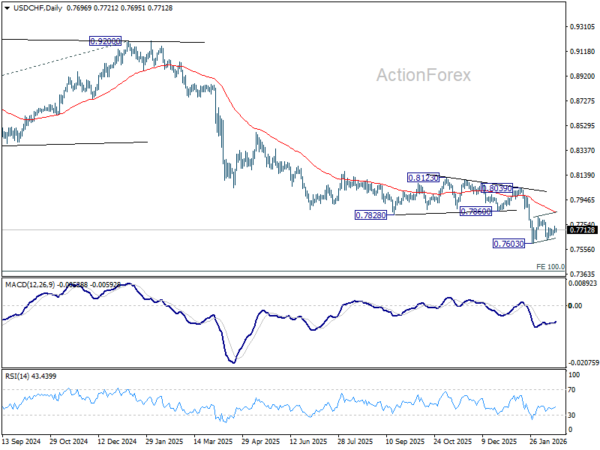
USD/CHF recovers mildly today as consolidation pattern from 0.7603 continues. Intraday bias stays neutral for the moment. Stronger rebound cannot be ruled out but upside should be limited by 55 D EMA (now at 0.7849) to complete the pattern. On the downside, break of 0.7603 will resume larger down trend, and target 0.7382 projection level next.
In the bigger picture, down trend from 1.0342 (2017 high) is still in progress. Next target is 100% projection of 1.0146 (2022 high) to 0.8332 from 0.9200 at 0.7382. In any case, outlook will stay bearish as long as 0.8123 resistance holds.