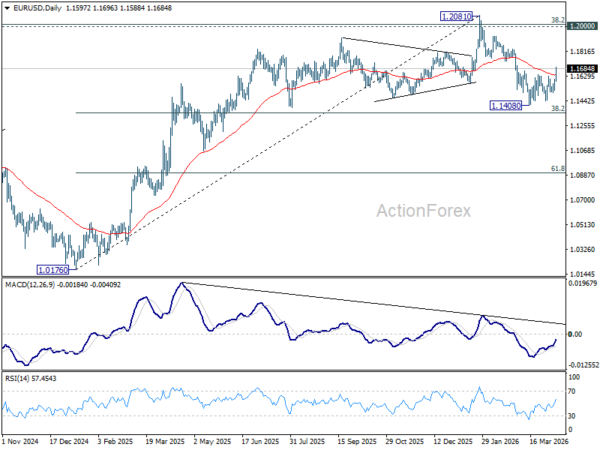
Dollar’s sharp slide as oil price drops below $100 on the US-Iran ceasefire is raising a critical question for FX markets: whether the unwinding of war premium is now enough to push EUR/USD back toward the 1.20 psychological level. The move reflects a rapid shift from pricing disruption to pricing partial normalization—but the path forward remains conditional.
The turnaround was triggered just 90 minutes before the U.S. deadline for a major strike, when President Donald Trump announced a “double sided CEASEFIRE”. This followed days of extreme rhetoric, including warnings that “a whole civilization will die tonight”. The agreement also includes a safe reopening of Hormuz, allowing tanker flows to resume. This is triggering supply normalization, alongside an insurance premium collapse that had effectively frozen shipments over the past weeks.
Markets reacted with a powerful risk-on rotation. Equities surged across Asia, with South Korea’s KOSPI jumping around 6.5% and Japan’s Nikkei rising close to 5%.
The easing in energy markets feeds directly into macro expectations. Lower oil prices reduce inflation pressure, weakening the case for prolonged restrictive monetary policy. The result is an inflation shock unwind. This is where the Fed narrative comes into play. If oil continues to fall and inflation pressures ease, markets may begin to price a renewed Fed pivot toward a more dovish stance. That would further erode the Dollar’s, reversing its rally since late January.
That would provide the macro foundation for EUR/USD to extend higher, with prospect of retesting the key psychological and technical level at 1.20.
However, the move toward 1.20 for EUR/USD is not automatic. It hinges on whether current progress evolves into something more durable. Oil moving toward $90—and especially toward $80—would signal deeper normalization and strengthen the case for a sustained Dollar reversal.
Here, geopolitics becomes critical. The involvement of Pakistani Prime Minister Shehbaz Sharif and Field Marsh Asim Munir signals the emergence of a viable mediation channel. Additionally, Trump himself acknowledged Iran’s proposal as a “workable basis” for negotiation, suggesting a path toward resolution.
Yet, the situation remains fluid. Iranian Foreign Minister Abbas Araghchi emphasized that passage through Hormuz is currently “via coordination with Iran’s Armed Forces.” Any “misunderstandings” or skirmishes during this two-week window could quickly bring back war premium and halt the current rally.
The next major milestone is the Islamabad talks scheduled for Friday. If a formal U.S. delegation—potentially led by Vice President JD Vance—participates, the probability of oil moving toward $80 rises significantly. That would be a key signal that markets are transitioning from relief to genuine normalization.
In the currency markets, Kiwi is currently the leader for the day, additionally supported by RBNZ’s hawkish hold. Aussie is the second strongest, and then Swiss Franc. Dollar is the runaway loser at the bottom, followed by Loonie which is apparently pulled down by oil prices. Euro is the third worst. Sterling and Yen are positioning in the middle.
In Asia, at the time of writing, Nikkei is up 5.19%. Hong Kong HSI is up 3.16%. China Shanghai SSE is up 2.03%. Singapore Strait Times is up 0.81%. Japan 10-year JGB yield is down -0.046 at 2.364. Overnight, DOW fell -0.18%. S&P 500 rose 0.08%. NASDAQ rose 0.10%. 10-year yield rose 0.008 to 4.343.
Oil Drops Below $100 on US-Iran Ceasefire, But $80 Seen as Floor Without Peace Deal
RBNZ Holds, Warns of “Decisive” Hikes if Inflation Expectations De-Anchor
EUR/USD Daily Outlook
Daily Pivots: (S1) 1.1546; (P) 1.1575; (R1) 1.1627; More….
EUR/USD’s extended rally and break of 1.1666 cluster resistance (38.2% retracement of 1.2081 to 1.1408 at 1.1665) now suggests that whole decline from 1.2081 high has completed at 1.1408. The is also supported by the strong break of 55 D EMA. Intraday bias is back on the upside for 61.8% retracement of 1.2081 to 1.1408 at 1.1824. Firm break there will pave the way to retest 1.2081 high. For now, risk will stay on the upside as long as 1.1503 support holds, in case of retreat.
In the bigger picture, the strong support from 38.2% retracement of 1.0176 to 1.2081 at 1.1353 suggests that the pullback from 1.2081 is more likely a corrective move. Strong support was also found in 55 W EMA (now at 1.1505). Focus is back on 1.2 key cluster resistance level. Decisive break there will carry long term bullish implications. Nevertheless, break of 1.1408 support will revive the case of medium term bearish trend reversal.