Markets were whipsawed today by a dramatic but ultimately false headline—and the reaction says everything about current risk conditions. Reports that Iranian missiles had struck a US Navy vessel near the Strait of Hormuz sent oil surging and triggered an immediate rush into the Dollar as a panic hedge.
The logic was straightforward. A confirmed hit on a US warship would almost certainly have sparked a powerful military response and raised the risk of a full closure of the Strait. That scenario would have sent oil sharply higher and shaken global markets. Within minutes, traders moved to price that risk.
But the story unraveled just as quickly. US Central Command flatly denied the reports, stating that no ships had been hit and that any missiles launched “didn’t even come close” to US assets. As reality replaced speculation, Brent crude pulled back to around $110, unwinding much of the spike.
Yet the bigger picture has not changed. The United States has launched “Project Freedom,” actively escorting merchant ships and oil tankers out of the Persian Gulf. This is not a de-escalation—it is a sign that risks to shipping routes are rising.
Iran’s response was equally firm, warning that all vessels must coordinate with its military and pushing back against US involvement in the Strait. The standoff is becoming more structured, with both sides asserting control over one of the world’s most critical energy corridors.
And crucially, the risk is not hypothetical. The UAE confirmed that an ADNOC tanker was hit by two drones today. While the incident did not cause casualties, it confirms that the Strait remains a live conflict zone, where attacks on commercial shipping are already happening.
The market reaction, even after the denial, reinforces this reality. The Dollar continues to trade stronger as investors maintain defensive positioning. Yen is also firm, while commodity-linked currencies like the Aussie and Loonie lag. Swiss Franc is notably weaker, with Euro and Sterling largely neutral.
AUD/USD Awaits Hawkish RBA to Clear 0.72 Hurdle Decisively
ECB Survey Shows Higher Inflation, Weaker Growth as Energy Shock Bites
Eurozone Sentix Improves to -16.4, But Germany Signals Deeper Trouble
Eurozone PMI Manufacturing at Multi-Year High as War Triggers Record Cost Pressures
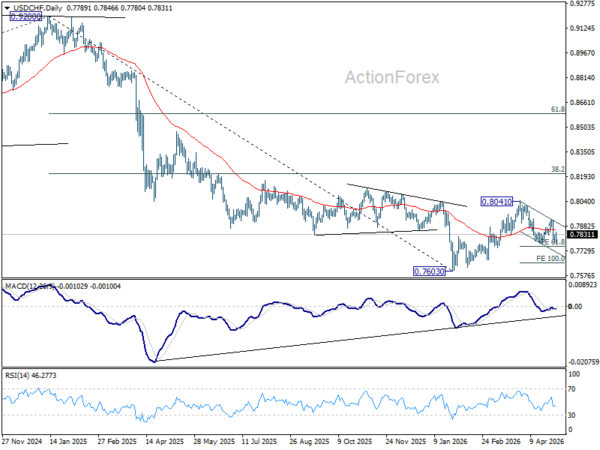
USD/CHF Mid-Day Outlook
Daily Pivots: (S1) 0.7787; (P) 0.7810; (R1) 0.7841; More….
USD/CHF recovered ahead of 0.7774 support and intraday bias is turned neutral first. Risk will remain on the downside as long as 0.7923 resistance holds. Firm break of 61.8% projection of 0.8041 to 0.7774 from 0.7923 at 0.7758 will extend the fall from 0.8041 to 100% projection at 0.7656.
In the bigger picture, rebound from 0.7603 medium term bottom is seen as correcting the fall from 0.9200 only. Rejection by 55 W EMA (now at 0.8042) will affirm this bearish case, and setup down trend resumption to 100% projection of 1.0146 (2022 high) to 0.8332 from 0.9200 at 0.7382 at a later stage. Though, sustained break of 55 W EMA will suggest that it’s probably correcting the larger scale down trend from 1.0146 (2022 high).