Just as investors were becoming comfortable with the idea of a US-Iran agreement, oil markets received a sharp reminder of how fragile that assumption remains. Reports from Iran’s state-affiliated Tasnim news agency indicated that Tehran will suspend negotiations with Washington until Israeli operations in Gaza and Lebanon cease. The report also warned that Iran could move to fully block the Strait of Hormuz while opening additional pressure points through the Bab el-Mandeb Strait, one of the world’s most important shipping routes.
The reaction in crude markets was immediate. Brent rallied sharply above $97 a barrel as traders rushed to reprice geopolitical risk. For the most of last week, markets had unwound the Middle East risk premium on expectations that a ceasefire extension and eventual diplomatic framework would restore stability to regional energy flows. The latest headlines suddenly force investors to reconsider whether that optimism moved too far, too fast.
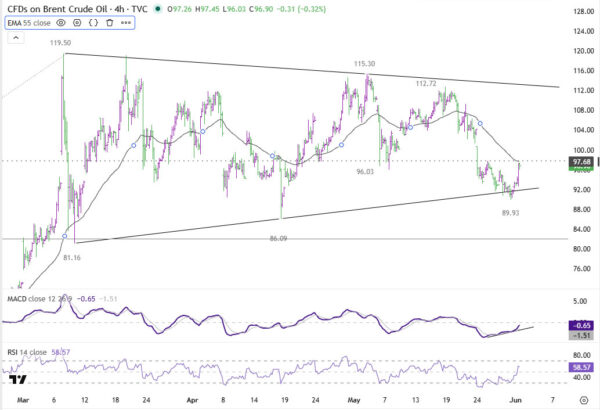
Technically, Brent is now approaching a decisive test. Resistance at 97.81 sits near 55 4H EMA (now at 97.66) and represents the key barrier separating a temporary rebound from a broader bullish reversal. Supporting the recovery case is the bullish convergence pattern on 4H MACD, suggesting bearish momentum has been weakening despite recent price declines.
Sustained break above 97.81 would likely confirm that Brent established a short-term bottom at 89.93 after successfully defending the lower boundary of the large converging triangle pattern that has dominated price action since March. In that scenario further rally would be seen toward the upper trendline near 113.00 as markets begin rebuilding the geopolitical premium that had largely disappeared.
Failure at 97.81 would tell a very different story. It would suggest traders still view the latest escalation as part of a negotiating process rather than the start of a more dangerous breakdown. In that case, the broader bearish structure would remain intact and another move below 89.93 could eventually follow.
The peace trade has not collapsed yet. But Brent’s test of 97.81 may determine whether it survives.