Usually, rising oil prices have generally been a source of support for Canadian Dollar. This week, however, that relationship is breaking down. Despite Brent crude climbing back above $95 per barrel as US-Iran negotiations remain deadlocked, Canadian Dollar has weakened sharply against its US counterpart. The key reason is a new threat from Washington that could prove far more damaging to Canada’s economy than higher oil prices are supportive.
The catalyst is the U.S. Trade Representative’s proposal to impose tariffs of up to 12.5% on imports from 60 economies over forced-labor enforcement concerns. While the measure targets a broad group of countries, the implications for Canada are particularly severe. Unlike traditional trade disputes, the proposal relies on supply-chain compliance rather than trade deficits or national-security arguments, potentially bypassing many of the protections Canada normally enjoys under USMCA. Markets have long viewed Canada’s free-trade status as a shield against major US protectionist actions. This proposal challenges that assumption and introduces additional uncertainty just as the Canadian economy is already struggling to gain momentum.
The timing could hardly be worse. Canada’s economy was already showing signs of recession before even the Middle East conflicts. GDP contracted by -0.2% in both Q2 and Q4 of last year before flatlining at 0.0% in Q1 2026. At the same time, elevated oil prices are raising inflation risks across the economy. Under normal circumstances, a central bank might respond with tighter policy. However, the Bank of Canada faces a difficult dilemma. Raising rates to combat inflation could further weaken growth and place additional strain on heavily indebted households and the housing market. Cutting rates to support activity risks accelerating the decline in Canadian Dollar and importing even more inflation. The result is an increasingly uncomfortable stagflationary backdrop.
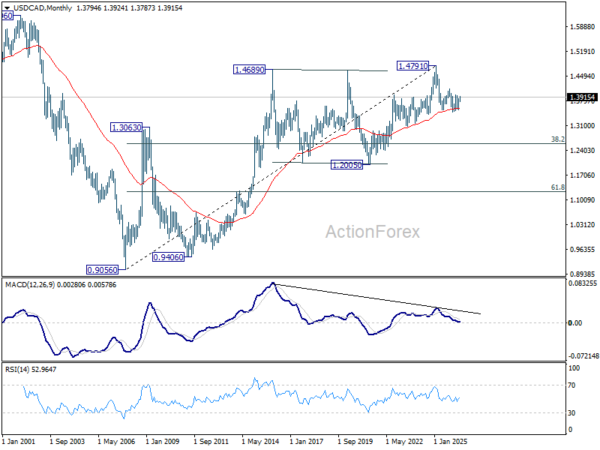
The technical picture is beginning to reflect these concerns. USD/CAD’s rally from 1.3549 is accelerating and is rapidly approaching the 38.2% retracement of the decline from 1.4791 to 1.3480 at 1.3981. This area, effectively the 1.40 psychological level, could prove decisive for the longer-term outlook. Rejection there would keep the medium term down trend from 1.4791 intact and suggest the current advance is merely corrective.
However, a decisive break above 1.40 would tell a very different story. Such a move would argue that the entire decline from the 2025 high at 1.4791 has already completed and that strong support from the 55 M EMA has held. More importantly, it would signal that markets are reassessing Canada’s medium-term outlook in a much more negative light. In that scenario, a retest of 1.4791 (2025 high) could become a realistic objective over the coming quarters.