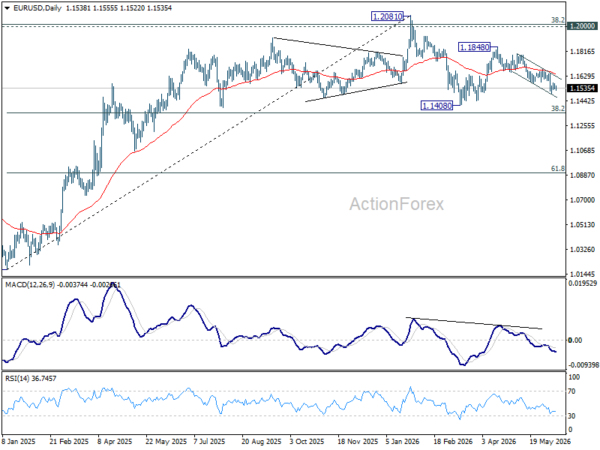
The Euro was broadly steady after the ECB delivered its widely anticipated 25 basis point rate hike, as traders quickly shifted their attention back to the Middle East. While the central bank raised inflation forecasts and lowered growth projections, the decision largely matched expectations. More importantly, policymakers offered no guidance on what comes next, leaving markets with little reason to substantially reprice the outlook for Eurozone interest rates.
The most important sentence in the statement may have been the ECB’s acknowledgment that “the war in the Middle East is generating inflation pressures.” Policymakers also warned that higher energy costs are expected to feed into food, goods and services prices over time. That represents a clear recognition that the current inflation shock is no longer confined to oil markets and could eventually become more deeply embedded across the economy.
Yet despite that concern, ECB avoided any hint of a future rate path. The Governing Council repeated that it would follow a “data-dependent and meeting-by-meeting approach” and stressed that it is “not pre-committing to a particular rate path.” Given the rapidly changing geopolitical environment, such caution was hardly surprising. The economic outlook now depends heavily on developments in energy markets and the trajectory of the conflict itself.
With the ECB event risk removed, markets are back focused on the next phase of the US-Iran confrontation. US President Donald Trump significantly escalated rhetoric today, declaring that the US military would hit Iran “VERY HARD TONIGHT” and promising to take control of key Iranian oil infrastructure, including Kharg Island. He also stated that an operation to assume “total control” of Iran’s oil and gas markets would take place in the near future.
Those comments came after an already dangerous escalation over recent days. The US military launched strikes that it described as “self-defense” operations, while Iranian media reported fresh explosions at multiple locations. Kuwait and Bahrain remained on heightened alert following missile and drone attacks linked to the broader conflict. The situation continues to evolve rapidly, with markets struggling to assess whether the latest developments represent temporary escalation or the beginning of a more prolonged confrontation.
For investors, the key question is whether geopolitical developments will trigger another surge in oil prices. Currency markets currently reflect that uncertainty. Dollar is the strongest performer of the day, followed by Yen and Euro. At the other end of the spectrum, Kiwi leads losses, followed by Loonie and Aussie. The positioning suggests a cautious, risk-off environment where investors are seeking safety while remaining alert to the possibility that the next major market move comes from the Middle East.
ECB Hikes, Sees Higher Inflation, Lower Growth as Middle East Conflict Deepens
US PPI Jump 6.5%, Highest Since 2022, as Oil Shock Spreads
US Jobless Claims Rise to 229k, Continuing Claims Climb
GBP/CHF’s Head-and-Shoulders Bottom Points to Bigger Gains as BoE and SNB Diverge
Trump, Iran and Hormuz: Brent Oil’s Double Bottom Could Be the Real Warning
EUR/USD Daily Outlook
Range trading continues in EUR/USD above 1.1499 and intraday bias remains neutral. Risk will stay on the downside as long as 1.1685 resistance holds. Break of 1.4992 will resume the fall from 1.1848 to retest 1.1408 low next.
In the bigger picture, the strong support from 38.2% retracement of 1.0176 to 1.2081 at 1.1353 suggests that the pullback from 1.2081 is more likely a corrective move. Strong support was also found in 55 W EMA (now at 1.1547). Focus is back on 1.2 key cluster resistance level. Decisive break there will carry long term bullish implications. Nevertheless, break of 1.1408 support will revive the case of medium term bearish trend reversal.