
Key takeaways
- The S&P 500 ended Q2 2026 on a strong note, but technical momentum is showing signs of fatigue. A two-day rally lifted the index to its best quarterly performance since Q2 2020, although prices are now approaching a key technical resistance zone.
- Quarter-end institutional positioning and easing geopolitical tensions fuelled the rebound. Window dressing by fund managers and a further reduction in the US-Iran geopolitical risk premium drove renewed buying in AI, semiconductor, and mega-cap technology stocks.
- A stronger US dollar is emerging as the key macro headwind. The US Dollar Index has broken out to a 13-month high following the June FOMC meeting, with historical precedents showing that sustained dollar strength has coincided with meaningful corrections in US equities.
- Attention now turns to Fed Chair Kevin Warsh and US labour market data. Any hawkish policy signals from Warsh or another resilient non-farm payrolls report could reinforce expectations of higher interest rates, strengthening the dollar further and increasing the risk of a near-term pullback in the S&P 500.
The S&P 500 snapped out of a five-day losing streak to finish Q2 2026 with a robust two-day surge, climbing 1.98% over June 29 and June 30 to close at 7,499. This capped off a stellar quarterly gain of 14.9%, the index’s best single-quarter performance since Q2 2020.
Institutional window dressing effect and geopolitical relief
The late-June reversal was heavily supported by structural “window dressing” as portfolio managers reallocated capital, shedding monthly losers to add exposure to winning mega-cap tech and AI benchmarks before sending out quarterly reports.
The final 48 hours of June saw classic mechanical inflows. Institutional mandates required trimming lagging individual names from earlier in the month and aggressively reloading into core AI, semiconductor, and secular tech structural compounders (the PHLX Semiconductor index, SOX, rose 3.9% on Tuesday, 30 June, surpassing the S&P 500 +0.8% and Nasdaq 100 +1.7% by a wide margin).
This systematic flow effectively insulated a technology cohort that had been briefly bruised by mid-June data centre margin fears and personnel rotations.
In addition, weekend hostilities between the US and Iran eased, reinforcing the June 17 interim ceasefire memorandum of understanding, as both nations’ subsequent adherence to the memorandum and the scheduled diplomatic talks in Doha dramatically lowered the near-term crude oil shock premium.
Continuation of the US dollar strength may be the bearish reversal trigger
Since the conclusion of the 17 June 2026 FOMC meeting, led by new Fed Chair Kevin Warsh, the global macro landscape has undergone a significant shift. In sharp contrast to the tentative consolidation seen in the US dollar between April and May 2026, the US Dollar Index has staged a decisive bullish breakout above its long-standing range resistance at 100.54, which had capped gains since May 2025. The greenback has since advanced to a 13-month high of 101.37 at the close of Friday’s US session on 26 June 2026.
In terms of intermarket analysis, the weekly MACD trend indicator of the US Dollar Index staged a significant bullish breakout the week of 1 June 2026, moving above the zero line and continued to trend upwards at this time of writing. Two similar bullish breakouts were seen in the weeks of 4 November 2024 and 20 September 2021, which led to significant prior corrective declines of 22%- 17% and 35%- 25%, respectively, on the US Nasdaq 100 CFD and US SPX 500 (see Fig. 1).
All eyes and ears will now shift to Fed Chair Kevin Warsh’s public speech today at the Sintra policy panel of the ECB forum on central banking at 1 pm GMT, and also US non-farm payrolls and unemployment rate data for June out on Thursday, 2 July at 12.30 pm GMT
Any further hint of a hawkish Fed on rate hikes from Warsh is likely to trigger another bout of US dollar strength, which, in turn, may soften the prior bullish tone in the US stock market.
Let’s now focus on the short-term trajectory (1 to 3 days) of the US SPX 500 CFD (a proxy of the S&P 500 E-mini futures) from a technical analysis perspective.
Potential bull trap below 7,545 key short-term resistance
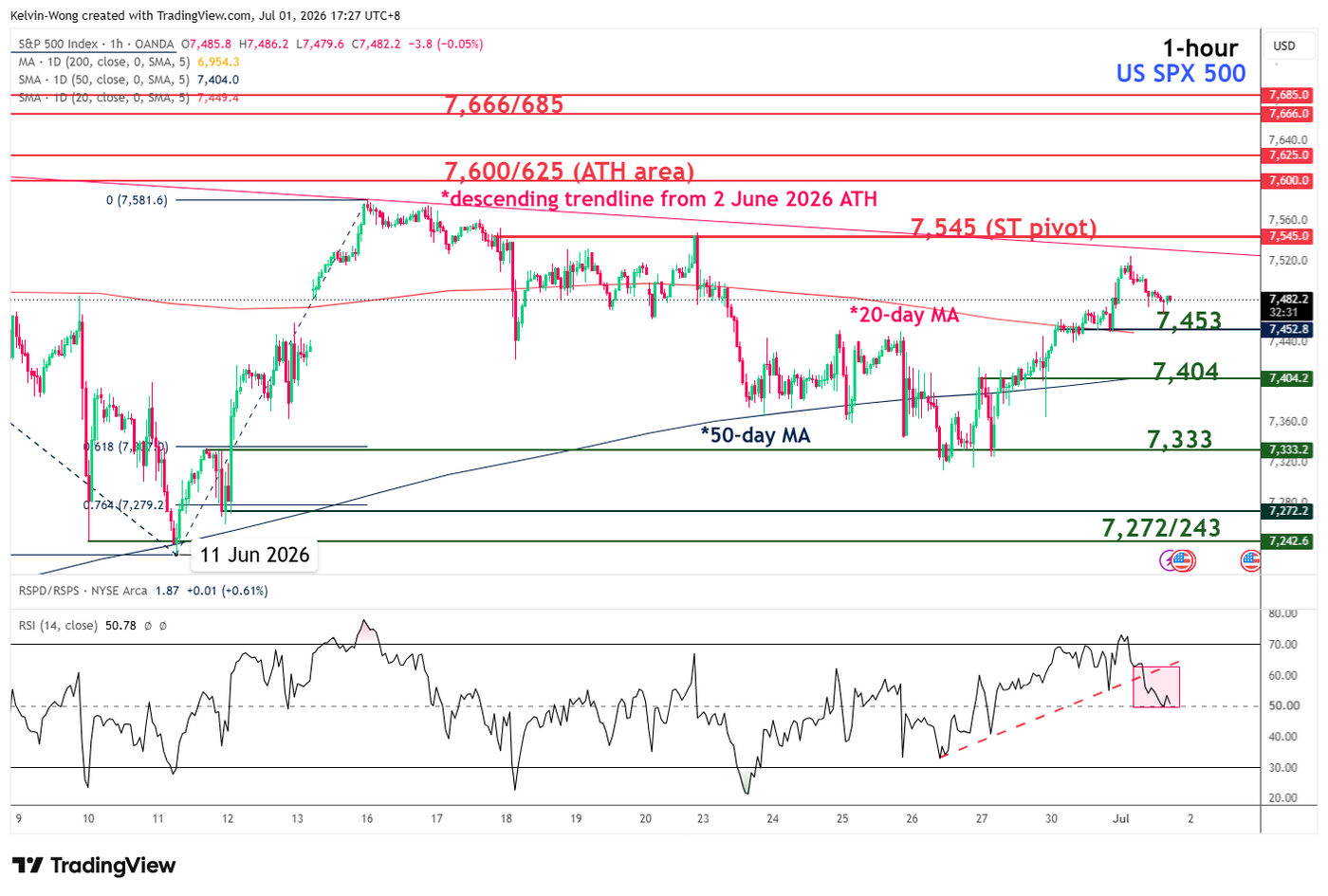
Trend bias: Minor bearish reversal below 7,545 key short-term pivotal resistance within medium-term range configuration
Supports: 7,453 (downside trigger, also the 20-day MA), 7,404 (also the 50-day MA), 7,333 (26/29 Jun 2026 minor lows) (see Fig. 1).
Next resistances: 7,600/625 (all-time high area), 7,666/685 (Fibonacci extension cluster)
Key elements to support the short-term bearish bias on the US SPX 500 CFD
- The last three sessions of bullish price actions have stalled at the descending trendline resistance in place since the 2 June 2026 all-time high.
- The hourly RSI momentum indicator has staged a bearish breakdown from its ascending support after it hit an overbought reading on Tuesday, 30 June 2026.
Opinions are the authors’; not necessarily that of OANDA Business Information & Services, Inc. or any of its affiliates, subsidiaries, officers or directors. The provided publication is for informational and educational purposes only.
If you would like to reproduce or redistribute any of the content found on MarketPulse, an award winning forex, commodities and global indices analysis and news site service produced by OANDA Business Information & Services, Inc., please refer to the MarketPulse Terms of Use.
Visit https://www.marketpulse.com/ to find out more about the beat of the global markets.
© 2026 OANDA Business Information & Services Inc.