The June non farm payrolls report did not prove the US economy is breaking. It did something more important for markets: it showed the labor market is not hot enough to force the Fed’s hand. Non-Farm Payrolls rose just 57k, far below expectations of 114k, while May was revised down from 172k to 129k. That was enough to push Dollar sharply lower and reduce the market-implied chance of a September hike from about 65% to 52%.
The details were mixed, but the policy message was clear. Unemployment slipped from 4.3% to 4.2%, while wage growth stayed robust at 0.3% mom and rose from 3.4% to 3.5% yoy. Those figures prevent the report from being a clean dovish signal. Still, weak headline hiring gives the Fed more room to wait, especially with oil prices now far below their Q2 highs. If lower energy prices pull inflation down naturally, Chair Kevin Warsh’s Fed may decide that the current 3.50-3.75% policy rate is already restrictive enough.
Yen’s rally added a second major theme to the session. There is no official confirmation of Japanese intervention, but the reported shift toward surprise “ambush” tactics appears to have done what verbal warnings could not: it made traders afraid of holding crowded short-yen positions. The timing was especially effective, coming just before NFP and creating a buffer for Yen before the data. With payrolls then disappointing, Japan may have needed no actual intervention at all.
Currency performance now reflects two different repricings. Dollar has become the week’s weakest major currency as Fed tightening pressure fades, followed by Loonie and Aussie. Sterling leads, followed by Kiwi and Swiss Franc, helped by resilient risk sentiment and relatively firmer domestic policy expectations. Euro and Yen sit in the middle, but for different reasons: Euro is still weighed by softer ECB expectations, while Yen has been support
US NFP Miss Sharply With 57k Growth, Participation Falls and Wage Growth Holds Firm
USD/JPY’s 150 Pips Fall: A Tactical “Intervention” Masterclass by Japan Ahead of NFP
EUR/GBP Accelerates Through Key Support as ECB/BoE Yield Convergence Trade Reverses
Swiss CPI Slows to 0.6% as Imported Price Pressures Fade Further
Australia Posts Biggest Trade Deficit Since 2015 as Gold, Iron Ore Exports Slump
USD/JPY Daily Outlook
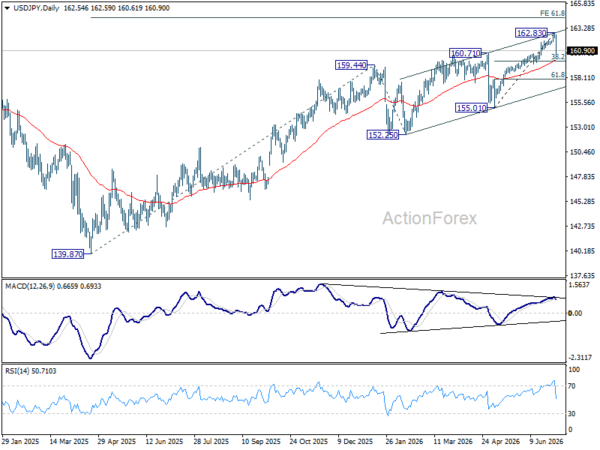
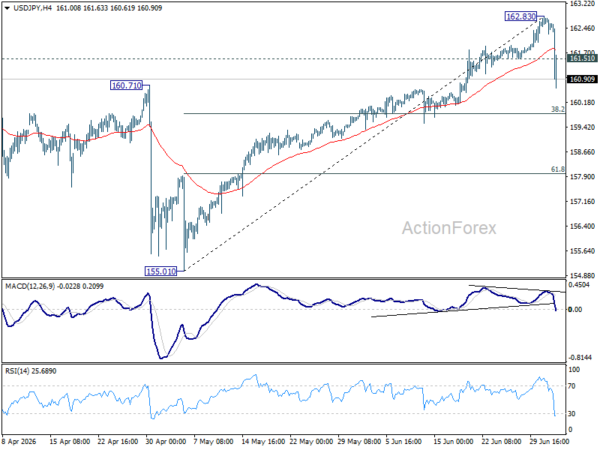
USD/JPY’s steep decline and strong break of 161.51 support confirms short term topping at 162.83, on bearish divergence condition in 4H MACD. Intraday bias is back on the downside for 38.2% retracement of 155.01 to 162.83 at 159.84. Since this level is close to 55 D EMA (now at 159.95), strong support should be seen from there to bring rebound. But overall, consolidations should continue below 162.83 for a while.
In the bigger picture, rise from 139.87 (2025 low) is seen as another rising leg of the long term up trend. Next target is 61.8% projection of 139.87 to 159.44 from 152.25 at 164.34. For now, outlook will remain bullish as long as 155.01 support holds, even in case of deep pullback.