
What’s happening: DXY has reached 101.30 and is testing 101.63–101.80 resistance near a two-month high, but the rally’s momentum is flattening as two of its immediate tailwinds fade, the 10-year Treasury yield has retreated after testing the 5.24% area Monday, and oil has also pulled back. Neither move reverses the broader inflation-and-rates story, but both remove the marginal support that had been pushing Fed expectations and the Dollar higher.
Why it matters: With around 70% probability of an October Fed hike already priced, the hurdle has shifted. This week’s data, core PCE Wednesday, ISM Manufacturing Thursday, and nonfarm payrolls Friday, now need to validate the tightening already embedded in markets rather than simply keep the possibility alive. The Dollar enters that sequence in an unusual position: the Fed trade remains supportive, but yields and oil have stopped providing additional momentum, and DXY is sitting right beneath resistance that needs fundamental confirmation to break.
Dollar Bulls Lose Their Immediate Tailwinds
The Dollar remains firm near a two-month high, but the latest leg of the rally is beginning to lose momentum. DXY has reached 101.30 and is pressing into the 101.63–101.80 resistance zone, where the June and July highs sit, while shorter-term momentum has started to flatten.
The pause is not difficult to explain. Two forces that helped propel the Dollar higher have stopped intensifying. Treasury yields have retreated from Monday’s surge, with the 10-year consolidating after testing the 5.24% area, while oil prices have also pulled back. Neither development amounts to a reversal of the broader inflation-and-rates story, but both remove some of the marginal support that had been pushing Fed expectations and the Dollar higher.
At the same time, traders have little reason to chase fresh positions immediately before a concentrated run of U.S. data. Core PCE arrives Wednesday, ISM Manufacturing on Thursday and nonfarm payrolls on Friday. With around 70% probability of another Fed hike in October already priced, the hurdle has shifted. The data now need to validate the tightening expectations already embedded in markets rather than merely keep the possibility alive.
Today’s DXY Setup
- DXY: 101.30, testing 101.63–101.80 resistance (the June and July highs).
- 10-year Treasury yield: retreated after testing around 5.24% Monday.
- Oil: pulled back.
- October hike odds: around 70% already priced.
- This week’s data: core PCE (Wednesday), ISM Manufacturing (Thursday), nonfarm payrolls (Friday).
The Rally Is Pausing, Not Yet Reversing
The 10-year Treasury yield remains close to its multi-decade highs despite the latest retreat. That means the basic rate differential remains supportive for the Dollar even if the impulse has temporarily faded.
Oil tells a similar story. Its pullback eases one of the immediate sources of inflation anxiety that had helped drive yields and Fed expectations higher. But it would take a more sustained decline to materially change the inflation outlook rather than simply reduce the pressure at the margin.
This leaves the Dollar in an increasingly balanced position. The macro backdrop that drove the rally remains intact, but the marginal catalysts have weakened just as DXY has reached major resistance.
That is also why recent FX moves should not all be attributed to the Dollar itself. Yen has remained unusually resilient amid Japan-specific intervention rhetoric, while AUD continues to carry its own post-RBA weakness after Governor Michele Bullock declined to validate a continuing tightening path. The Dollar is broadly firm, but idiosyncratic forces are increasingly determining how individual currencies respond.
Wednesday: PCE Starts With an Already-Hawkish Bar
The first major test comes with August PCE inflation on Wednesday.
Consensus expects core PCE inflation to accelerate from 0.2% to 0.3% m/m and from 3.3% to 3.4% y/y. Headline PCE is expected to rise from 0.2% to 0.4% m/m, while the annual rate is seen unchanged at 3.7%.
That creates an important asymmetry.
Because the market already expects inflation to accelerate, a 0.3% monthly core reading would not constitute a fresh upside surprise. But neither would it be neutral. It would confirm the persistence of inflation already reflected in elevated October hike odds and make it harder for the market to unwind the tightening trade.
The genuine dovish surprise would be a return toward July’s slower 0.2% core pace or below. A stronger-than-expected print would instead give Treasury yields and the Dollar exactly the fresh catalyst currently missing.
The July data also contained an important complication. Real PCE growth slowed from 0.4% in June to 0.0% in July, even as the PCE price index moved from -0.1% to +0.2%.
That distinction matters. Rising inflation does not necessarily mean that real consumer demand is accelerating. The Fed could instead be facing a more awkward combination of sticky price pressure and softer real spending growth.
Wednesday will therefore test inflation persistence more directly than economic overheating.
August PCE Expectations
- Core PCE: 0.2% to 0.3% m/m consensus; 3.3% to 3.4% y/y.
- Headline PCE: 0.2% to 0.4% m/m; annual rate unchanged at 3.7%.
- Dovish surprise threshold: a return toward July’s 0.2% core pace or below.
- July detail: real PCE growth slowed from 0.4% (June) to 0.0% (July), even as the price index moved from -0.1% to +0.2%.
ADP Offers an Early Labor-Market Cross-Check
ADP employment will arrive alongside PCE, with consensus looking for 70K after 38K in August.
It should not be treated as a substitute for Friday’s payroll report, but it will provide the first indication of whether employment momentum is stabilizing after the choppier readings seen over recent months.
A materially stronger reading alongside hot PCE would give the Dollar a particularly clean combination: persistent inflation with enough labor resilience to tolerate further tightening.
A weak ADP number would complicate that picture before the more authoritative payroll release on Friday.
Thursday: ISM Could Look Stronger Than Its Internals
Thursday brings a different test.
ISM Manufacturing is expected to rise from 54.6 to 55.0 in September, extending what has already become a nine-month run in expansion territory.
But the headline needs to be read alongside the internals.
The Prices Paid index is expected to edge from 71.1 to 72.0, which remains extremely elevated. Yet the direction is less alarming than the absolute level might imply. Prices Paid peaked at 82.1 in May and has since stabilized around the low 70s.
So the better description is elevated but no longer accelerating sharply.
At the same time, August showed some softer demand signals beneath the strong headline. New Orders fell 3.0 points and Backlog of Orders dropped 3.2 points, suggesting that the manufacturing expansion was not strengthening uniformly.
That makes Thursday less about whether the PMI prints above 50 and more about whether headline growth, prices and forward demand tell the same story.
September ISM Expectations
- ISM Manufacturing: 54.6 to 55.0 consensus, a ninth straight month in expansion.
- Prices Paid: 71.1 to 72.0 consensus; peaked at 82.1 in May, has since stabilized in the low 70s.
- August internals: New Orders fell 3.0 points, Backlog of Orders fell 3.2 points.
Manufacturing Employment Is the Cleaner Positive
One part of the manufacturing picture has improved more convincingly: employment.
ISM’s Employment Index returned to expansion in July after two months of contraction, while separate payroll data showed manufacturing employment increasing 16K in August and by 58K from its December 2025 low.
The agreement between the two measures makes this a more useful signal than a single survey movement.
If September ISM shows continued employment strength alongside elevated prices and a firm headline, it would reinforce the argument that manufacturing can absorb tighter monetary conditions.
But if New Orders and Backlogs continue to deteriorate, the data would still leave questions about how durable the expansion is.
- ISM Employment Index: returned to expansion in July after two months of contraction.
- Manufacturing payrolls: +16K in August, +58K from the December 2025 low.
Friday: 90K Payrolls Would Be Normalization, Not Collapse
Friday’s payroll report has perhaps the most misleading headline comparison.
Consensus expects nonfarm payrolls of 90K, down sharply from 162K in August, with unemployment unchanged at 4.1% and average hourly earnings expected to rise 0.3% m/m.
Looking only at the monthly change makes 90K appear weak.
But August itself was unusually strong relative to the recent employment trend. The 162K increase was more than five times the trailing 12-month average of roughly 31K, while July was initially reported as a 23K decline before being revised to a 21K gain.
Against that background, 90K looks less like an abrupt deterioration and more like a partial normalization after an unusually strong August.
That changes the surprise threshold.
A print close to 90K should not automatically be treated as evidence that the labor market is rolling over. Much of that slowdown is already assumed.
The larger dovish risk would be a meaningful undershoot of 90K, particularly if accompanied by higher unemployment or softer wages. That would suggest employment conditions are returning toward the weakness initially indicated by July rather than merely correcting from August’s outlier.
Conversely, another materially strong payroll number would make it harder to dismiss August as a one-off.
August vs. September NFP Expectations
- NFP consensus: 90K, down from 162K in August.
- Unemployment: unchanged at 4.1% expected.
- Average hourly earnings: +0.3% m/m expected.
- Context: August’s 162K was more than five times the trailing 12-month average (roughly 31K); July was revised from -23K to +21K.
- Larger dovish risk: a meaningful undershoot of 90K, especially with higher unemployment or softer wages.
DXY Needs Data to Break 101.80
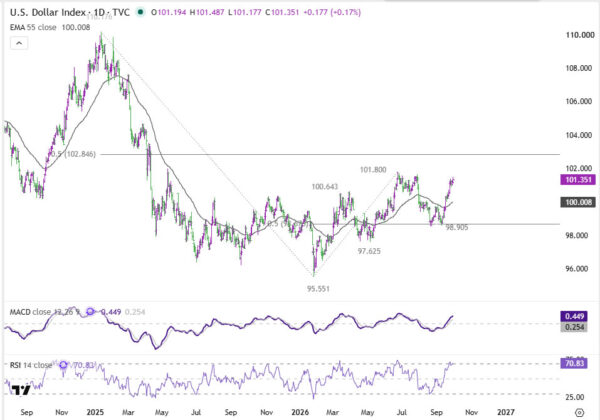
The technical setup reinforces the sense that the Dollar now needs another catalyst.
DXY is testing 101.63–101.80 resistance, covering the June and July highs. Daily RSI is around 70, while shorter-term momentum has begun flattening.
A convincing break above 101.80 would reopen the rally toward 102.87, followed by 104.59.
But the downside levels are becoming equally relevant if the data fail to validate current Fed pricing.
The first significant warning would be a retreat toward 100.70, where the four-hour and daily 55 EMAs converge. A break below there would expose 100.00, followed by the more substantial 98.60–98.68 support area.
For now, the structure remains bullish while DXY stays near the highs. But with momentum already stretched, 101.80 increasingly needs fundamental confirmation rather than another extension based on positioning alone.
Key Technical Levels
- Resistance: 101.63–101.80 (June/July highs); RSI around 70.
- Break above 101.80 targets: 102.87, then 104.59.
- First downside warning: 100.70 (four-hour and daily 55 EMA convergence).
- Break below 100.70 exposes: 100.00, then 98.60–98.68.
Three Releases, One Fed Trade
The next three sessions should be viewed as one sequence rather than three separate event risks.
Wednesday’s PCE asks whether inflation can meet an already-hawkish consensus and keep the October hike case intact.
Thursday’s ISM asks whether firm manufacturing growth and elevated price pressure are corroborated by the underlying demand indicators.
Friday’s payrolls then determine whether employment is merely normalizing from August’s unusually strong reading or slipping back toward the weaker trend seen before it.
The Dollar enters that sequence in an unusual position: the Fed trade remains supportive, but yields and oil have stopped providing additional momentum, while DXY is already sitting beneath important resistance.
Dollar bulls have largely priced the Fed.
Now the data have to deliver.
Three Releases, Three Surprise Thresholds
| Release | Consensus | Dollar-Bullish Surprise | Dollar-Bearish Surprise |
|---|---|---|---|
| Wed: Core PCE | 0.3% m/m, 3.4% y/y | A hotter print, confirms persistence | A return to July’s 0.2% pace or below |
| Thu: ISM Manufacturing | 55.0 headline, Prices Paid 72.0 | Continued employment strength alongside a firm headline | Further deterioration in New Orders and Backlogs |
| Fri: Nonfarm Payrolls | 90K, down from 162K | Another strong beat, makes August look less like an outlier | A meaningful undershoot of 90K, especially with rising unemployment or soft wages |
Related Coverage
RBA & AUD Deep Dive
RBA Hiked Unanimously—Then Bullock’s “Hope” Sent Aussie Through 0.7000 Support — the RBA decision behind today’s post-hike AUD weakness.
RBA Hikes Unanimously as Inflation Risks “Materialise,” Keeps Further Tightening in Play — the full policy statement and why further tightening remains firmly on the table.
Australia Spending Flat in August, but Fuel Surge Hides 0.3% Underlying Drop — the consumption backdrop the RBA is weighing against its inflation concerns.
Fed Voices & US Data
Fed’s Cook Says Labor Market Can Handle Higher Rates as AI Inflation Broadens — another hawkish Fed voice ahead of this week’s data run (full speech here).
Global Data Watch
Canada GDP Stalls in July, but August Estimate Points to 0.2% Rebound — why the July weakness doesn’t look broad-based.
Eurozone Business Confidence Improves, but Consumers and Hiring Turn Softer — an increasingly uneven recovery signal out of Europe.
Switzerland KOF Barometer Jumps to 109.1, Outlook Remains Favorable — a broad-based beat across manufacturing, services and construction.
Precious Metals Watch
Silver Has More Premium to Lose Than Gold as Yields Rise and Industrial Tightness Eases — how the same yield backdrop pressuring Dollar’s rally is hitting precious metals unevenly.
FAQ
Why is the Dollar rally pausing if the Fed outlook hasn’t changed?
Two of its immediate tailwinds have faded: Treasury yields retreated after testing 5.24% Monday, and oil has pulled back, removing marginal support even though the broader inflation-and-rates story is intact and October hike odds remain around 70%.
Would a 90K payrolls print on Friday be a bad sign for the Dollar?
Not necessarily. August’s 162K was more than five times the trailing 12-month average, so 90K looks more like a partial normalization than a collapse. The bigger dovish risk would be a meaningful undershoot of 90K, especially alongside higher unemployment or softer wages.
What would it take for DXY to break above 101.80 resistance?
Fundamental confirmation from this week’s data rather than further positioning alone: a hot core PCE print Wednesday, a firm ISM with stable employment internals Thursday, or another strong payrolls beat Friday. A clean break would open 102.87 and then 104.59.
Key Takeaways
- DXY is testing 101.63-101.80 resistance near a two-month high, but momentum is flattening as Treasury yields retreat from Monday’s test of 5.24% and oil pulls back.
- With October Fed hike odds already around 70% priced, this week’s data, core PCE Wednesday, ISM Manufacturing Thursday, nonfarm payrolls Friday, need to validate the tightening already embedded in markets rather than just keep the possibility alive.
- Core PCE is expected to accelerate to 0.3% m/m and 3.4% y/y; the genuine dovish surprise would be a return toward July’s slower 0.2% core pace.
- September ISM Manufacturing is expected to rise to 55.0 with Prices Paid at 72.0, but August’s softer New Orders and Backlog of Orders readings leave questions about how durable the expansion is; manufacturing employment is the cleaner positive signal, up 16K in August and 58K since December 2025.
- Friday’s consensus of 90K nonfarm payrolls, down from August’s unusually strong 162K, looks more like a normalization than a collapse; the bigger dovish risk is a meaningful undershoot alongside rising unemployment or softer wages.
What to Watch Next
Wednesday’s core PCE for whether inflation confirms the persistence already priced into October hike odds. Thursday’s ISM Manufacturing for whether headline growth, elevated prices and forward-demand indicators like New Orders and Backlogs finally tell the same story. Friday’s payrolls for whether 90K represents a normalization from August’s outlier or the start of a slide back toward the softer trend seen before it. And whether DXY can convert any of that into a fundamental break of 101.80 resistance.