
The First Real Data Test of Q4 Broke the Q3 Script in Yields and the Dollar, but Not the Euro’s France Problem
What’s happening: September’s US employment report was almost the cleanest dovish combination markets could have received. Payrolls rose just 29K against a 90K consensus, unemployment edged up to 4.2%, wages undershot and prior months were revised lower again. Treasury yields fell, October Fed hike expectations collapsed into the low teens and the Dollar Index was knocked back below 102. The Euro, however, failed to join the Dollar’s retreat as France’s sovereign-risk premium kept widening.
Why it matters: Friday split the market into two stories. For the Dollar and US rates, the relentless Q3 climb in yields was interrupted and an October hike left the base case. For the Euro, lower US yields, a weaker Dollar and falling oil removed the usual explanations for its weakness, yet the France-specific risk discount remained. The next tests are the Fed’s October decision and whether the OAT-Bund spread keeps widening.
September’s US employment report delivered almost the cleanest dovish combination markets could have received. Payroll growth slowed sharply, unemployment edged higher, wages undershot expectations and previous months were revised down again. Treasury yields fell, expectations for an October Fed hike collapsed into the low teens, and US equity futures rallied. The Dollar Index, which had been threatening a breakout toward 103, was knocked back below 102. Yet the Euro failed to participate meaningfully in the broader Dollar retreat, as France’s sovereign-risk premium continued to widen.
NFP Delivers Neither Jobs Nor Wage Pressure
US nonfarm payrolls slowed from a revised 133K in August to just 29K in September, far below the 90K consensus. Unemployment rose from 4.1% to 4.2%, while average hourly earnings slowed from 0.3% to just 0.1% m/m and stood at 3.0% y/y.
September Jobs Data
- Nonfarm payrolls: 29K in September, down from a revised 133K in August and far below the 90K consensus
- Unemployment rate: rose from 4.1% to 4.2%
- Average hourly earnings: slowed from 0.3% to 0.1% m/m
- Average hourly earnings: 3.0% y/y
- July payrolls: revised from +21K to -10K
- August payrolls: revised from 162K to 133K
- Two-month revisions: another 60K lower in total
- Participation rate: rose from 61.6% to 61.8%
- Household employment: increased by 406K
The revisions made the deterioration more significant. July payrolls were cut from +21K to -10K, while August was revised from 162K to 133K. Together, the prior two months were marked down by another 60K.
There was some resilience in the household survey, meaning the increase in unemployment was not simply the result of widespread job destruction. But for markets, the establishment survey and wage data delivered the important message: hiring momentum has slowed substantially, and labor costs did not provide the hawkish counterweight that had been possible after Thursday’s surge in ISM Prices Paid.
Two Surveys, Two Messages
| Survey | Reading | Message for markets |
|---|---|---|
| Establishment survey and wages | Payrolls at 29K, prior two months revised 60K lower, hourly earnings up 0.1% m/m | Hiring momentum has slowed substantially, and labor costs gave no hawkish counterweight |
| Household survey | Participation up from 61.6% to 61.8%, household employment up 406K | The rise in unemployment was not simply widespread job destruction, but this was not the market’s focus |
That leaves this week’s inflation picture more clearly divided. Factory input costs remain hot, but labor demand and wage pressure are cooling.
October Fed Hike Falls Out of the Base Case
The immediate rates reaction showed how decisively markets interpreted the report.
Rates and Futures Reaction
- US 2-year Treasury yield: fell toward 4.72%
- US 10-year Treasury yield: dropped back toward 5.18%
- October hold probability: jumped to around 86%
- October hike odds: fell into the low teens, from more than 60% only a week earlier
- S&P 500 futures: up around 0.8%
- Dow futures: up roughly 0.9%
- Nasdaq-100 futures: up about 1.0%
That does not mean markets have abandoned further Fed tightening altogether. December remains the more plausible window for another move. But NFP materially reinforces the argument already made by New York Fed President John Williams that there is no need for urgency, and by Minneapolis Fed President Neel Kashkari and Fed Vice Chair Philip Jefferson that the October decision can wait for more evidence.
The distinction is important: Friday did not end the tightening cycle. It pushed the next likely decision further down the calendar.
US equity futures welcomed that distinction. The reaction was classic “bad news is good news”: investors treated the weak jobs report primarily as relief from near-term Fed tightening rather than as evidence of an immediate growth shock.
Dollar Rally Is Capped Before the 103 Test
The Dollar Index provided an equally clear response.
Dollar Index Levels
- DXY intraday high: around 102.115, after breaking 101.800
- DXY after the NFP headline: pushed sharply back toward 101.70
- Resistance not reached: 102.774 projection and channel ceiling
- Key downside support: 101.026
- Rising structure: intact from 98.599 while 101.026 holds
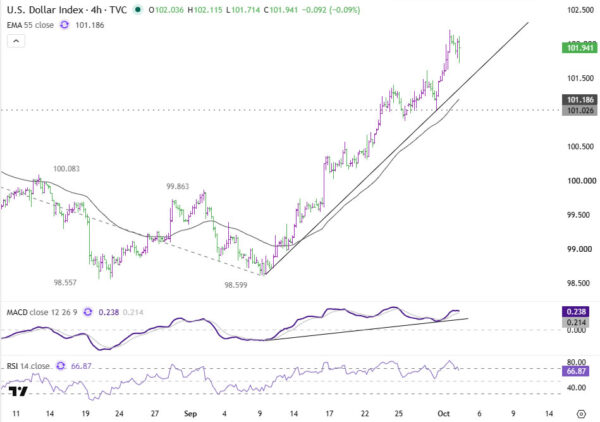
DXY had entered the session pressing higher after breaking 101.800 and reached an intraday high around 102.115. But the NFP headline pushed it sharply back toward 101.70, preventing the index from even reaching the 102.774 projection and channel-ceiling resistance highlighted ahead of the release.
That makes Friday a cleaner version of the softer-NFP scenario than anticipated. The payroll miss alone was Dollar-negative. The wage miss strengthened that reaction because it removed the inflation-specific signal that could have kept an October hike alive even with weaker employment growth.
Still, the technical conclusion should remain restrained.
NFP has capped the Dollar rally; it has not yet reversed it.
The important downside level remains 101.026. As long as that support holds, the broader rising structure from 98.599 remains intact and another attempt toward 103 can still develop later. A sustained break below 101.026 would be needed to turn Friday’s rejection into something more consequential.
Falling Oil Gives Bonds a Second Source of Relief
NFP was not the only force working against yields.
Oil and Emergency Stocks
- WTI: fell around 4%
- Brent: retreated more than 3%
- France: has asked European partners to release additional diesel reserves
- Emergency release: no final coordinated release announced at the time of writing
Oil prices fell sharply as Europe discussed releasing emergency fuel stocks. French President Emmanuel Macron moved to coordinate a broader response with G7 leaders after discussions with US President Donald Trump. The drop gave global bond markets some relief from the energy-inflation shock that had helped drive yields sharply higher through Q3 and into the opening of Q4.
But the mechanism needs to be kept in perspective. Emergency stock releases can mechanically increase near-term supply and suppress prices. They do not remove the underlying geopolitical risks surrounding Middle Eastern exports, refining capacity and shipping routes.
Friday therefore brought relief from the energy premium, not resolution of the energy problem.
European Bonds Rally—But France Falls Further Behind
That distinction becomes especially useful in Europe.
German Bunds joined the global bond rally as oil prices fell and US yields retreated. But French debt significantly underperformed.
French-German Spread
- OAT-Bund 10-year spread: widened beyond 150bp
- OAT-Bund 10-year spread: more than 154bp at one stage, its widest since the eurozone sovereign-debt crisis
- France 10-year yield: declined only slightly
- Germany 10-year yield: fell much more sharply
Rather than narrowing with the general relief in rates, the spread widened as France’s yield barely moved while the German yield dropped. That is an important development. Lower oil prices can alleviate a region-wide inflation problem, and soft US payrolls can pull global yields lower, but neither resolves concerns over France’s fiscal trajectory.
The OAT-Bund spread therefore continues to isolate the France-specific part of the story. If anything, Friday made that distinction cleaner: the global rates backdrop improved, yet investors continued demanding a larger premium to hold French debt rather than Bunds.
Euro Is the Exception to Broad Dollar Weakness
FX told the same story.
The Dollar softened after NFP against most major currencies as Treasury yields fell and October Fed tightening was repriced. Yet the Euro struggled to benefit to the same extent. Even before the payroll release, it was headed for its fourth consecutive weekly fall against the Dollar as French fiscal concerns weighed on sentiment.
That makes the Euro’s relative weakness more interesting than the broad Dollar move itself. Earlier in the week, Euro weakness could still be partly explained through higher US yields, a stronger Dollar and Europe’s exposure to expensive energy. Friday removed some of those pressures.
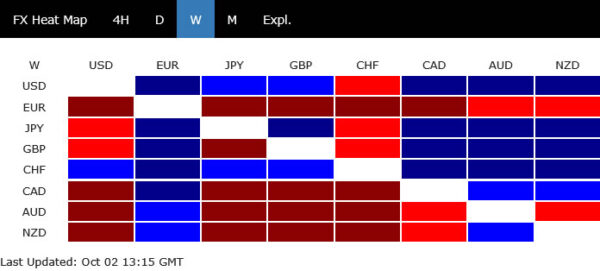 Current Heat Map.
Euro Headwinds: Earlier in the Week vs Friday
| Headwind | Friday’s development | Status |
|---|---|---|
| Higher US yields | US yields fell | Eased |
| Stronger Dollar | The Dollar retreated | Eased |
| Expensive energy | Oil fell | Eased |
| France fiscal risk | OAT-Bund spread widened beyond 150bp | Persisted |
Yet the France risk discount remained.
This leaves EUR/CHF and the OAT-Bund spread as the cleaner gauges heading into next week. If the spread keeps widening and EUR/CHF resumes its decline even after oil-driven yield pressure eases, the evidence for a durable France-specific repricing becomes considerably stronger.
Q4 Gets Its First Break in the Script
Thursday’s opening message for Q4 was that the calendar had changed but the market regime had not. Friday finally challenged part of that regime.
Soft payrolls and softer wages interrupted the relentless rise in Treasury yields, pushed an October Fed hike out of the market’s base case and stopped the Dollar before its 103 breakout test. Stocks welcomed the relief. But the move was not universal. France’s risk premium widened even as core European yields fell, and the Euro remained unable to exploit a broadly softer Dollar.
The next tests are therefore split in two: Fed officials must decide whether September’s labor cooling is enough to justify an October pause, while Europe must determine whether emergency fuel measures can contain the energy shock without masking the separate deterioration in French sovereign risk.
For the Dollar, Friday broke the momentum.
For the Euro, the problem is increasingly its own.
Related Coverage
US Jobs and the Dollar
Fed Officials and the October Decision
France, Eurozone and Global Inflation
FAQ
Why did an October Fed hike fall out of the base case after the September jobs report?
Payrolls slowed from a revised 133K in August to 29K in September, against a 90K consensus. Unemployment rose to 4.2%, average hourly earnings rose just 0.1% m/m, and the prior two months were revised down by 60K. The wage miss mattered because it removed the inflation-specific signal that could have kept an October hike alive. The implied probability of an October hold jumped to around 86%, with hike odds in the low teens, though December remains the more plausible window for another move.
Why didn’t the Euro benefit when the Dollar retreated after NFP?
Lower US yields, a weaker Dollar and falling oil removed several of the pressures that had explained Euro weakness earlier in the week. The France-specific risk premium remained. The French-German 10-year spread widened beyond 150bp and touched more than 154bp, its widest since the eurozone sovereign-debt crisis, because France’s 10-year yield fell only slightly while Germany’s fell much more sharply. The Euro was also headed for its fourth consecutive weekly fall against the Dollar even before the payroll release.
Has NFP ended the Dollar’s rally?
Not yet. NFP capped the rally but has not reversed it. DXY reached around 102.115 and fell back toward 101.70, short of the 102.774 projection and channel-ceiling resistance. As long as the 101.026 support holds, the rising structure from 98.599 stays intact and another attempt toward 103 can still develop. A sustained break below 101.026 would be needed to make Friday’s rejection more consequential.
Key Takeaways
- September payrolls rose just 29K against a 90K consensus, unemployment rose to 4.2%, hourly earnings slowed to 0.1% m/m and the prior two months were revised down by 60K.
- The US 2-year yield fell toward 4.72% and the 10-year toward 5.18%, while the implied probability of an October hold jumped to around 86%.
- Friday did not end the tightening cycle. It pushed the next likely Fed decision further down the calendar, with December the more plausible window.
- NFP capped the Dollar rally without reversing it: DXY fell back toward 101.70 and 101.026 remains the key support.
- Falling oil gave bonds a second source of relief, but emergency stock releases are relief from the energy premium, not resolution of the energy problem.
- The OAT-Bund 10-year spread widened beyond 150bp, reaching more than 154bp, even as Bunds rallied with global yields.
- The Euro failed to benefit from the broader Dollar retreat, which points to a France-specific risk discount rather than a Dollar-driven move.
What to Watch Next
On the US side, Fed officials must decide whether September’s labor cooling justifies an October pause, with December the more plausible window for another move. For the Dollar Index, watch 101.026 support: a hold keeps the rising structure from 98.599 intact and leaves another attempt toward 103 possible, while a sustained break below it would make Friday’s rejection more consequential.
On the European side, the OAT-Bund spread and EUR/CHF are the cleaner gauges for next week. If the spread keeps widening and EUR/CHF resumes its decline even after oil-driven yield pressure eases, the case for a durable France-specific repricing becomes considerably stronger. Also watch whether the emergency fuel measures France is pushing for are finalized and whether they contain the energy shock without masking the separate deterioration in French sovereign risk.