
TL;DR: A hot US CPI briefly sent the 10-year yield to 5.329% and DXY to 102.945, but both reversed sharply as AI financing fears hit CoreWeave, Oracle and Asian tech stocks—with the Dollar notably failing to catch a haven bid as yields retreated toward 5.10% and 101.285 becomes the next technical level to watch.
Why This Matters
Concerns over financing risks in the AI investment boom are currently overshadowing US inflation as the dominant force driving financial markets. Wednesday’s stronger-than-expected CPI initially sent Treasury yields sharply higher, with the 10-year yield reaching 5.329% and Dollar Index surging to 102.945. But both subsequently reversed as selling intensified in US technology stocks and spread across Asian markets. The 10-year yield retreated to around 5.19% by Wednesday’s close before extending its decline toward 5.10% in Asia. Meanwhile, Dollar Index slipped to around 101.93, weakening against six of its seven major peers despite the sharp deterioration in risk sentiment. The reversal suggests that concerns about AI financing and potential financial-market spillovers are outweighing the immediate implications of persistent inflation.
AI Financing Concerns Move to the Forefront
The emerging concern is shifting from whether demand for AI infrastructure will continue growing to whether companies can finance the enormous investment required to support that demand. Warnings about financing constraints have been building, with Broadcom Chief Executive Hock Tan and Intel’s leadership highlighting funding challenges earlier this week. The IMF’s latest Global Financial Stability Report also identified an AI-related market correction as a potential source of sharply tighter financial conditions. The Fund noted that hyperscalers have become increasingly important borrowers in investment-grade credit markets, highlighting the growing connection between AI capital expenditure and broader financial conditions. What previously appeared primarily as a question of technology valuations is increasingly becoming a question of financing costs, leverage and the sustainability of investment spending.
CoreWeave has become a particularly visible example of these concerns. Its shares plunged approximately 15.5% on Wednesday, while yields on its outstanding 2031 and 2032 bonds climbed toward 15%. The simultaneous weakness in its equity and debt highlights investor anxiety about financing risks among highly leveraged AI infrastructure providers. With large upfront investment requirements, companies in this segment are particularly exposed to rising borrowing costs and concerns over their ability to fund continued expansion. The pressure also extended to larger technology names, with Oracle falling 8.8% and Nvidia losing 3.2%. Nasdaq Composite declined 1.88%, compared with a 1.11% drop in S&P 500 and a relatively modest 0.09% fall in Dow Jones.
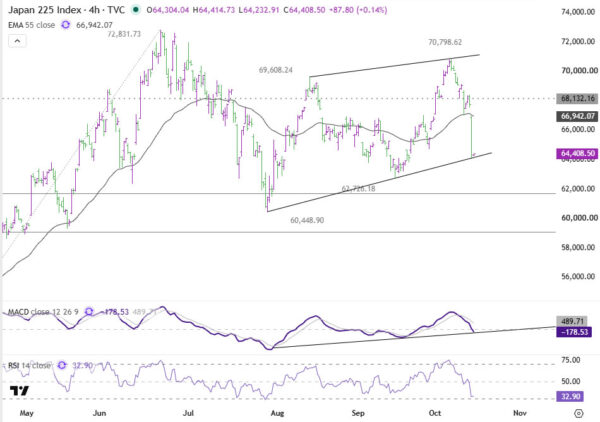
The selloff extended into Asia on Thursday, reinforcing concerns that investors are reassessing exposure across the AI investment chain. South Korea’s KOSPI plunged over 7.15%, while Japan’s Nikkei dropped over 4.50%. Semiconductor and technology-related shares were among the hardest hit, including SK Hynix, Samsung Electronics, SoftBank and Japanese chip-equipment manufacturers. The geographical spread matters because the AI infrastructure boom connects US technology companies with semiconductor producers, equipment suppliers and financing markets worldwide. Moreover, the failure of technology shares to recover as Treasury yields retreated suggests that the selling was not simply a mechanical response to higher interest rates. Investors appear increasingly concerned about the financial structure supporting AI expansion itself.
Credit Warning Signs Are Not Yet Evidence of an AI Demand Collapse
Nevertheless, financing pressure at individual companies should not be confused with evidence that the broader AI investment cycle is breaking down. CoreWeave’s management has argued that its substantial order backlog supports its debt obligations, while technology analyst Dan Ives has distinguished financing concerns from weakening underlying demand. More decisive evidence of a deteriorating investment cycle would include reductions in hyperscaler capital expenditure, contract cancellations or sustained declines in GPU rental prices.
The current evidence remains concentrated in several highly leveraged or AI-sensitive companies. Without confirmation from broader investment-grade and high-yield credit spreads, it would be premature to characterize the episode as a systemic credit-market crisis. However, the market reaction demonstrates how quickly concerns about financing can affect sentiment across the technology sector. Even if AI demand remains strong, uncertainty over the cost and availability of capital can still trigger significant equity repricing and tighter financial conditions. That distinction is central to understanding why the latest selloff has become a broader macro concern.
Treasury Yields Reverse as Financial Risks Eclipse Inflation
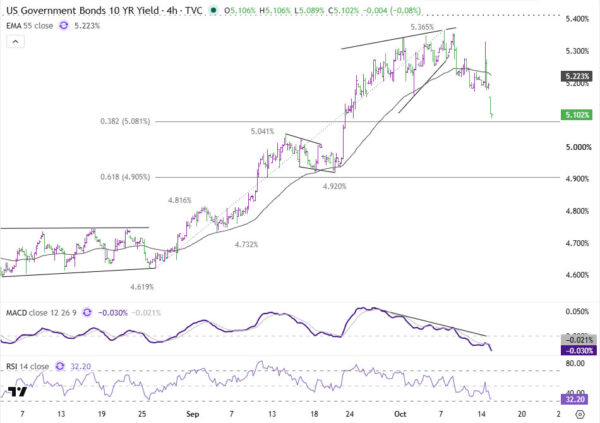
The shift in market priorities is particularly visible in Treasuries. September’s US CPI report showed headline inflation accelerating from 3.4% to 3.7% yoy, while core inflation rose from 2.4% to 2.6%, exceeding expectations. The initial reaction was consistent with renewed inflation concerns, pushing the 2-year yield as high as 4.952% and the 10-year yield to 5.329%.
Yet those increases proved short-lived. By Thursday’s Asian session, the 2-year yield had fallen toward 4.73%, below its pre-CPI level, while the 10-year yield was trading near 5.10%. Safe-haven demand for Treasuries amid equity-market stress appears to have become an important counterweight to inflation-driven selling. Meanwhile, Fed officials’ preference for gathering more evidence before another hike helped temper the initial surge in October tightening expectations. The additional decline in yields during Asian trading, alongside steep equity losses, suggests that broader risk aversion was also playing a significant role.
Dollar Follows Yields Lower Instead of Attracting Haven Demand
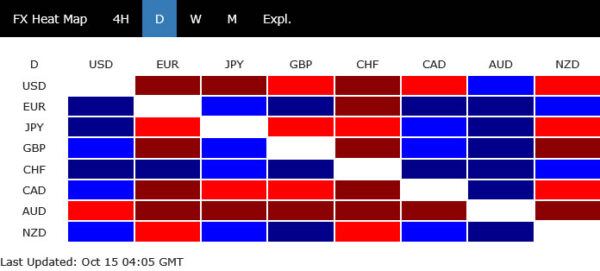
The Dollar’s failure to benefit from the equity selloff is another notable feature of the current market environment. Despite substantial losses in US and Asian equities, the currency weakened against six of its seven major peers in Thursday’s Asian session. The Swiss Franc showed particularly broad strength, while the Australian Dollar was the main exception following Australia’s disappointing September employment report.
Currency Heat Map.
The pattern suggests that declining US yields are exerting a stronger influence on the Dollar than conventional safe-haven demand. The fact that the immediate source of market anxiety is concentrated in US technology and AI-related financing may also be limiting the Dollar’s defensive appeal. This does not establish a permanent change in its safe-haven characteristics, but it highlights an important distinction in the current episode: investors are seeking protection in Treasuries without delivering a corresponding broad-based bid for the US currency.
ActionForex’s Technical View: Dollar Index Rejected at Critical Resistance, 101.285 Comes Into Focus
Technically, Dollar Index’s reversal from 102.945 is particularly significant because it occurred at a convergence of major resistance levels. The peak slightly exceeded the 100% projection at 102.774 and the 50% retracement of the decline from 110.176 to 95.551 at 102.846, while also testing the upper boundary of the rising medium-term channel.
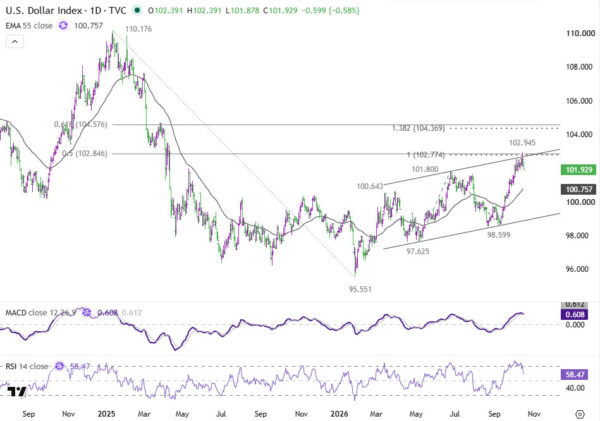
The subsequent decline through 102.07 support, accompanied by bearish divergence in the 4-hour MACD, suggests that a short-term top has formed. Near-term bias has turned downward toward the 38.2% retracement of the advance from 98.599 to 102.945 at 101.285. Strong support there could produce a rebound on the first attempt.
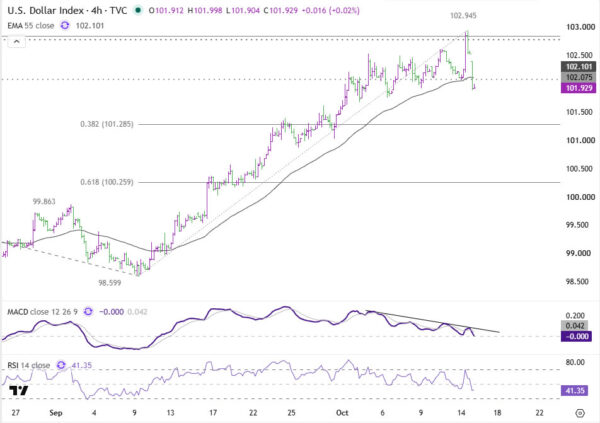
However, a firm break below 101.285 would shift attention toward the 55-day EMA, currently near 100.76. A further break below that moving average would raise more serious questions about whether the broader advance from 95.551 has completed. Conversely, recovery above 102.10, followed by a break of 102.945, would undermine the immediate bearish scenario.
The next question is whether AI financing concerns remain confined to a relatively small group of leveraged companies or begin affecting broader credit conditions and investment plans. Further pressure on technology shares and credit markets could sustain Treasury demand and keep the Dollar under pressure. Stabilization in financing conditions, on the other hand, could allow persistent inflation concerns to regain influence over yields.
For now, AI-related credit anxiety is challenging the market’s inflation-driven interest-rate narrative, and Dollar Index’s response around 101.285 will help determine how far that shift extends.
Key Takeaways
- A hotter-than-expected US CPI initially pushed the 10-year yield to 5.329% and DXY to 102.945, but both reversed as AI financing fears triggered a broader tech selloff.
- CoreWeave fell 15.5% with its bond yields near 15%, while Oracle (-8.8%) and Nvidia (-3.2%) also dropped; the selloff spread to Asia, with South Korea’s KOSPI down over 7.15% and Japan’s Nikkei down over 4.50%.
- Financing stress at individual leveraged companies isn’t yet evidence of a broader AI demand collapse—watch hyperscaler capex, contract cancellations and GPU rental prices for confirmation of a real slowdown.
- The Dollar notably failed to catch a safe-haven bid despite the equity rout, weakening against six of seven major peers as falling US yields outweighed conventional haven demand.
- DXY’s rejection at 102.945 points toward 101.285 next, with a break below shifting focus to the 100.76 55-day EMA and raising doubts about the broader advance from 95.551.