
TL;DR: Australia’s September employment contracted by 39,300 and unemployment held at 4.7%, driving interest-rate markets to price less than one more 25bp RBA hike through mid-2027—sending AUD/NZD and AUD/USD both lower, with October 28’s quarterly CPI now the key test of whether that repricing has gone too far.
Why This Matters
Australian Dollar fell broadly on Thursday after September’s unexpectedly weak employment report reinforced a significant retreat in expectations for further RBA tightening. Employment contracted by 39,300 against forecasts for a 20,000 increase, while unemployment stood at 4.7%, its highest level in the post-pandemic period. The surprise added to concerns that restrictive monetary policy is beginning to weigh more heavily on the labour market. Yet the more important development is that interest rate markets are now pricing less than one additional 25bp RBA hike through mid-2027, even as economists remain divided over whether another increase is needed in November. With global risk aversion amplifying the pressure, Aussie weakened against all seven major peers, while AUD/NZD reversed sharply and AUD/USD broke near-term support.
Jobs Shock Reinforces Labour Market Cooling, but Underlying Trend Holds Up
Australia’s September employment decline was driven entirely by part-time positions, which fell by 73,700, overwhelming a 34,400 increase in full-time employment. Labour force participation declined from 67.0% to 66.8%, while the employment-to-population ratio dropped from 63.9% to 63.6%. Although the headline unemployment rate held at 4.7% following an upward revision to August, the combination of falling employment and participation suggests labour demand is weakening more than the unchanged jobless rate alone indicates.
However, the underlying picture was less alarming. ABS trend estimates showed employment increasing by 15,700, while trend unemployment remained unchanged at 4.6%. The ABS also cautioned that survey methodology changes could have affected September’s seasonally adjusted figures. These qualifications argue against interpreting one month’s sharp employment decline as confirmation of a sustained downturn. Nevertheless, the September-quarter unemployment rate averaged 4.63%, already above the RBA’s forecast of 4.5% for the December quarter, strengthening the case that labour market conditions are cooling faster than previously anticipated.
Markets Price Less Than One More Hike, but Economists Remain Divided
The employment shock has accelerated an RBA repricing that was already developing over the preceding three weeks. The central bank raised its cash rate by 25bp to 4.60% in September, its fourth increase this year. Yet overnight indexed swap pricing, as of 04:00 GMT on Thursday, implied a substantially shallower remaining tightening path.
The implied policy rate stood at approximately 4.64% for November, 4.70% for December and 4.75% for February. It reached a projected peak of just 4.81% in June 2027, only 21bp above the current cash rate and therefore less than one additional standard 25bp increase.
The broader repricing is even more revealing. Indicative market pricing placed the expected peak near 5.08% three weeks earlier and around 4.91% a week ago, compared with 4.81% now. These historical levels are approximate chart readings, but they illustrate how considerably expectations have shifted. Importantly, the decline reflects several developments, not simply Thursday’s employment figures, including previous inflation releases, the September RBA decision and changing global financial conditions.
Economists, however, remain divided. Westpac continues to anticipate a November hike to 4.85%, subject to the upcoming quarterly CPI report. EY and BetaShares also see further tightening as possible or likely. Commonwealth Bank expects a November hold while acknowledging that the meeting remains live, and JPMorgan anticipates no additional increases.
The divergence reflects different assessments of the balance between persistent inflation and a cooling labour market. The September RBA meeting minutes retained a hawkish tone, with policymakers particularly concerned about domestic capacity pressures. But the employment figures raise questions about how much more tightening the economy can absorb.
Australian Q3 CPI on October 28 is therefore the next decisive test. A stronger underlying inflation reading could challenge the market’s limited expectations for further hikes, while softer inflation would reinforce the case for patience ahead of the November 3 meeting.
Aussie Weakness Reflects Domestic Repricing and Global Risk Aversion
The Australian Dollar’s broad decline reflects this shift in the domestic interest rate outlook, compounded by deteriorating global risk sentiment.
The daily Currency Heat Map showed AUD weakening against all seven major counterparts, with particularly pronounced losses against NZD, JPY and several European currencies. Notably, AUD/USD also declined despite a broader retreat in Dollar Index, suggesting that Australian-specific selling pressure was an important part of the move.
The technology-led equity selloff and growing concerns over AI infrastructure financing have added another source of pressure. As a risk-sensitive currency, Aussie is vulnerable when investors reduce exposure to equities and other growth-sensitive assets.
However, global risk aversion should be viewed as an amplifier rather than the sole explanation. The repricing of RBA expectations was already under way, while the latest employment figures provided a fresh domestic catalyst.
AUD/NZD is a particularly useful expression of that weakness, with Kiwi outperforming Aussie. The cross therefore provides a relatively clear illustration of the pressure on Australian interest rate expectations, although the New Zealand Dollar’s own strength is also contributing.
ActionForex’s Technical View
AUD/NZD Corrective Decline Could Extend Toward 1.2274 Support
AUD/NZD’s sharp reversal from 1.2493 suggests that the consolidation from 1.2489 has entered another downward leg. The initial decline from 1.2489 to 1.2315 was followed by a rebound to 1.2493. The subsequent selloff could therefore represent the third leg of a three-wave corrective structure.
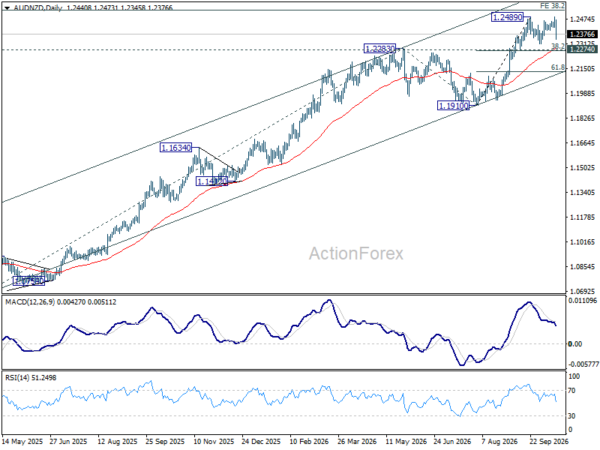
The break below the 4-hour 55 EMA, accompanied by bearish divergence in MACD, reinforces the near-term downside bias. Immediate focus is on 1.2315 support, with scope for a further decline toward the 1.2283–1.2268 support region, where the 38.2% retracement of 1.1910 to 1.2489 (1.2274), the daily 55 EMA and former 1.2283 resistance-turned-support all converge.
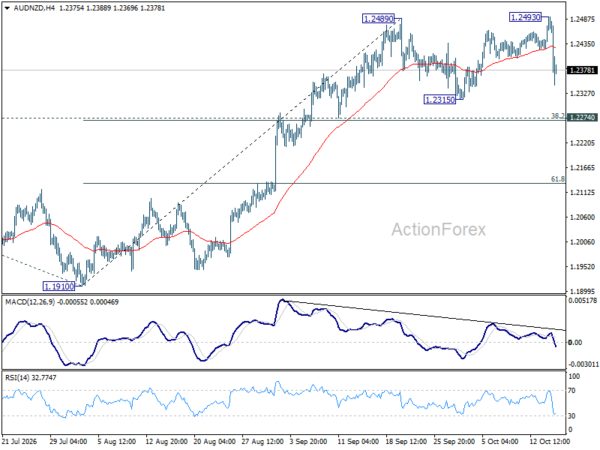
This region combines former resistance and retracement support within the broader rising structure. Strong buying interest is expected there to bring the correction to an end and allow another advance through 1.2489/2493 to extend the larger uptrend.
However, a decisive break below 1.2274 would suggest that a larger correction is developing, shifting attention toward the 61.8% retracement at 1.2131.
For now, the daily uptrend remains intact, despite the sharp deterioration in near-term momentum.
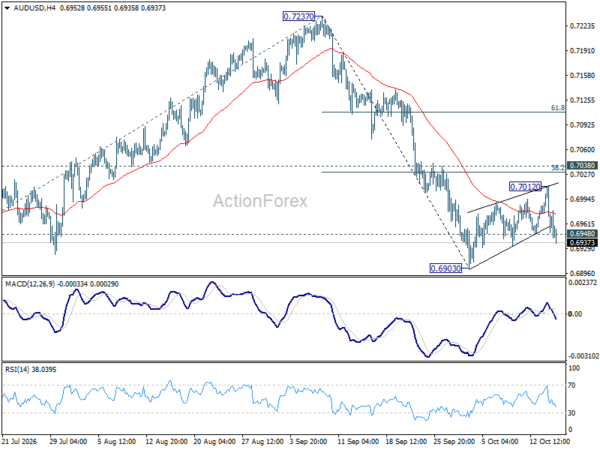
AUD/USD: Break Below 0.6948 Opens Another Downward Leg
AUD/USD presents a more immediately bearish technical picture after breaking below 0.6948 support. The rebound from 0.6903 stalled at 0.7012, below the 38.2% retracement of the preceding decline from 0.7237. The subsequent reversal suggests that this corrective recovery has completed and that the decline from 0.7237 is resuming.
Immediate focus returns to 0.6903 support. A break would target 0.6864, followed by the 100% projection of 0.7277 to 0.6864 from 0.7237 at 0.6824.
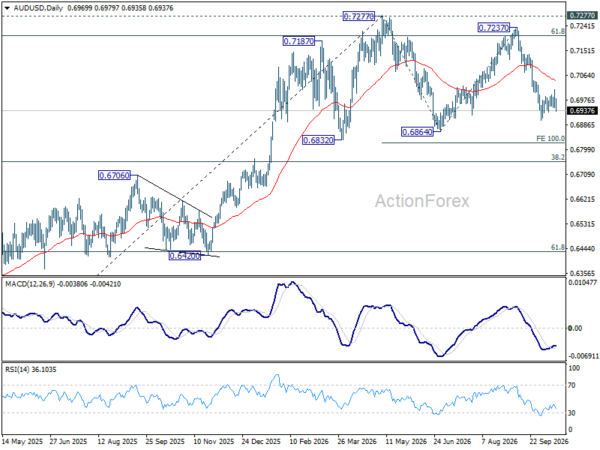
The larger structure can still be interpreted as a three-wave correction from 0.7277 rather than a confirmed reversal of the broader uptrend.
Strong support is expected around 0.6756, the 38.2% retracement of the advance from 0.5913 to 0.7277. A rebound from this region would preserve the possibility of renewed medium-term upside.
Conversely, a firm break below 0.6756 would raise the risk of a more substantial bearish reversal.
October CPI Holds the Key to the Next Aussie Move
The Australian Dollar’s weakness reflects a market that has substantially reduced its expectations for further RBA tightening, even though economists have not reached a consensus that the tightening cycle is finished.
Thursday’s employment shock strengthens the case for monetary policy patience, while global risk aversion has added momentum to the currency’s decline. Yet the relatively stable ABS trend estimates and persistent inflation concerns mean that the case for further tightening has not disappeared.
The next important catalyst is October 28’s Australian quarterly CPI report, which will test whether markets have moved too far in reducing rate hike expectations.
Technically, 1.2274 in AUD/NZD and 0.6903 in AUD/USD are the immediate levels to watch. AUD/NZD could still find support and resume its larger uptrend, while AUD/USD faces a more immediate risk of extending its decline toward 0.6824 and potentially 0.6756.
Key Takeaways
- Australian employment contracted by 39,300 in September versus a forecast 20,000 gain, with unemployment at 4.7%—its highest post-pandemic level—driven entirely by a 73,700 drop in part-time jobs.
- Rate markets now price a peak RBA cash rate of just 4.81% by June 2027, down from roughly 5.08% three weeks ago, implying less than one more 25bp hike; economists remain split between Westpac’s expected November hike and JPMorgan’s no-further-hikes call.
- ABS trend data (employment +15,700, unemployment steady at 4.6%) is less alarming than the headline, but the September-quarter jobless average of 4.63% already exceeds the RBA’s 4.5% Q4 forecast.
- AUD weakened against all seven major peers; AUD/NZD’s near-term bias points toward 1.2274 support (with the uptrend intact above it), while AUD/USD’s break below 0.6948 opens a path toward 0.6864 and 0.6824.
- October 28’s Q3 CPI is the next decisive test of whether markets have priced too few, or correctly few, remaining RBA hikes ahead of the November 3 decision.