
US Producer Inflation Surged Far Beyond Expectations, but Treasury Yields Kept Falling and the Dollar Struggled to Recover
What’s happening: US producer inflation surged far beyond expectations on Thursday, retail sales beat forecasts and layoffs remained contained, yet Treasury yields continued falling and the Dollar struggled to recover. The AI-related selloff that hit Nasdaq on Wednesday extended into Asia, sending South Korea’s KOSPI down 7.57% and Japan’s Nikkei down 4.90%, even as TSMC reported record third-quarter profit.
Why it matters: Investors appear more concerned about the financing of the AI investment boom than about another round of strong US data. Nasdaq Composite is approaching a critical technical support level near 26,586, while the US 10-year Treasury yield has already broken below 5.081%. Together they are the two tests of whether the AI credit scare is developing into a deeper market correction.
US producer inflation surged far beyond expectations, retail sales beat forecasts, and layoffs remained contained. Yet Treasury yields continued falling and Dollar struggled to recover. With AI financing concerns spreading across global technology markets, investors appear more concerned about financial risks than another round of strong US economic data. The selloff that hit Nasdaq on Wednesday extended into Asia on Thursday, sending South Korea’s KOSPI down 7.57% and Japan’s Nikkei down 4.90%. Even TSMC’s record third-quarter profit failed to stabilize sentiment. Meanwhile, Nasdaq Composite is approaching a critical technical support level, while the US 10-year Treasury yield has already broken important support, raising the question of whether the AI credit scare is developing into a deeper market correction.
AI Financing Fears Spread Across Global Technology Markets
The dominant concern is increasingly about how the AI infrastructure boom will be financed, rather than whether demand for AI technology remains strong. Heavy capital expenditure requirements, rising borrowing costs and the debt obligations of highly leveraged infrastructure providers have become important sources of investor anxiety.
CoreWeave has emerged as a particularly visible example. Its shares plunged approximately 15.5% on Wednesday, while yields on its outstanding 2031 and 2032 bonds reportedly approached 15%. The simultaneous pressure on equity and debt prices highlights concerns about financing risks among companies undertaking capital-intensive AI infrastructure expansion.
AI Selloff: Key Moves
- CoreWeave shares: plunged approximately 15.5% on Wednesday
- CoreWeave 2031 and 2032 bonds: yields reportedly approached 15%
- Oracle: dropped 8.8% on Wednesday
- Nvidia: lost 3.2% on Wednesday
- Nasdaq Composite: declined 1.88% on Wednesday
- South Korea’s KOSPI: down 7.57% on Thursday
- Japan’s Nikkei: down 4.90% on Thursday
- Nasdaq futures: down 1.25% (at the time of writing)
- S&P 500 futures: down 0.3%
- Dow futures: up 0.4%
Those concerns have spread beyond individual borrowers. The subsequent selloff across Asian semiconductor and technology shares demonstrated how concerns over AI investment financing can affect the broader supply chain. TSMC’s record third-quarter profit failed to reverse the selling, illustrating how little reassurance investors are currently drawing from strong operating performance. The distinction is important: healthy demand and earnings at a semiconductor manufacturer do not necessarily eliminate concerns about the financial sustainability of infrastructure investment elsewhere in the sector.
Nevertheless, financing stress among individual AI-related companies is not yet evidence of a systemic credit crisis. Broader credit-market deterioration or reductions in hyperscaler investment plans would provide stronger confirmation that the financing scare is developing into something more consequential. For now, the global equity reaction suggests investors are reassessing financial risks associated with the AI investment cycle, even without clear evidence that underlying demand has deteriorated.
Hot US Data Fail to Reverse Treasury Rally
Thursday’s US economic releases provided little obvious reason for a further decline in Treasury yields.
September headline PPI accelerated from 0.5% to 1.3% mom, substantially exceeding expectations of 0.5%. Core PPI also surprised higher, jumping from 0.2% to 0.7% against forecasts of 0.3%. Annual producer inflation increased from 5.6% to 6.3%, reinforcing concerns about persistent price pressures beyond the immediate energy shock.
Retail sales also exceeded forecasts, rising 0.8% mom against expectations of 0.6%. However, sales excluding gasoline increased just 0.2%, as higher gasoline station receipts accounted for approximately 71% of the headline increase. Meanwhile, initial jobless claims edged up to 199K, indicating little change in layoff conditions.
The PPI surprise reportedly lifted the probability of an October Fed hike slightly to around 33%, but Dollar showed little reaction and remained the second-weakest major currency, outperforming only Australian Dollar.
More strikingly, Treasury yields continued declining despite the inflation surprise. The yield reversal was already underway before the releases, making it inappropriate to attribute the decline to the economic data themselves. Instead, the muted market response suggests that defensive Treasury demand amid technology-sector selling is outweighing the upward pressure on yields normally associated with stronger inflation figures. The market has not necessarily become less concerned about inflation. Rather, financial-market risks have become the more immediate driver of positioning.
Nasdaq Tests 55-Day EMA as Medium-Term Topping Risk Builds
Nasdaq Composite is approaching a potentially decisive technical threshold after reversing from its recent 27,722.75 peak. The index has fallen to approximately 26,693, putting immediate focus on its 55-day EMA near 26,586. Bearish divergence in the daily MACD adds to concerns that upside momentum had already weakened before the latest AI-related selloff.
A sustained break below the 55-day EMA would strengthen the case that Nasdaq has formed a medium-term top at 27,722.75. Such a development would suggest that the decline is becoming more substantial than another brief pullback within the existing uptrend. The immediate downside objective would be 26,063.08, the 23.6% retracement of the advance from 20,690.25 to 27,722.75. A decisive break below 26,063.08 would provide stronger confirmation that Nasdaq is correcting the broader advance from 20,690.25, exposing the 38.2% retracement at 25,036.33. In other words, a sustained loss of the moving average would put the 26,000 region in focus, while a subsequent break below that support would raise the prospect of a decline toward 25,000 during Q4.
However, the bearish scenario is not yet confirmed. A strong rebound from the 55-day EMA would preserve the near-term bullish outlook, suggesting that the latest selloff remains a correction within the broader advance. Under that scenario, a retest of 27,722.75 could follow sooner rather than later. The significance of this technical test extends beyond Nasdaq itself: a sustained breakdown would provide stronger evidence that concerns about AI financing are translating into a more consequential reassessment of equity-market risk.
Treasury Yield Break Points to Deeper Correction Toward 5%
The US 10-year Treasury yield has already delivered a more significant technical warning, breaking below 5.081% as its retreat from 5.365% accelerates. The 5.081% level represents the 38.2% retracement of the advance from 4.619% to 5.365%. The break suggests that the decline from 5.365% is not merely correcting the final leg of the preceding rally from 4.619%. Instead, it increasingly appears to be retracing a larger portion of the advance from 4.361%.
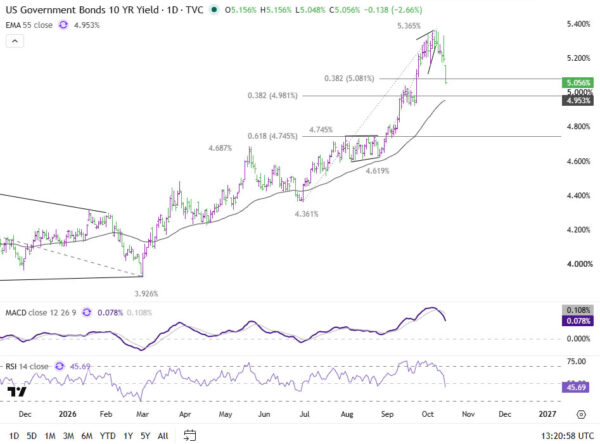
That shifts the next downside objective to 4.981%, the 38.2% retracement of the broader rise from 4.361% to 5.365%. The importance of this level is reinforced by its proximity to the 5.00% psychological threshold and the 55-day EMA, currently around 4.953%. Together, these references form an important support region around 4.95–5.00%. Further decline is favored as long as the yield stays below 5.177%, the upper boundary of the recent downward gap.
A decisive break below the 4.95–5.00% region would suggest that Treasury buying is extending beyond a relatively shallow correction, consistent with intensifying concerns over financial-market conditions. Conversely, strong support around 4.981% and the 55-day EMA could trigger a rebound, suggesting that the latest flight into Treasuries is approaching a technical limit.
BoE November Hike Becomes Consensus, but Economists Question What Follows
In the UK, a Reuters poll showed a substantial shift toward expectations for monetary tightening. A strong majority of 54 out of 63 economists now expect BoE to raise Bank Rate by 25bps to 4.00% in November. That represents a sharp reversal from September’s survey, when approximately 90% expected rates to remain unchanged for the rest of the year.
However, economists remain divided over what happens beyond November. Only 30 of 61 respondents anticipated another increase in the first quarter of 2027, highlighting continued uncertainty over the extent of additional tightening. The shift reflects growing concern about persistent inflation and the prospect of further price acceleration. Reuters’ survey projected inflation averaging 3.6% in the fourth quarter and 3.8% in the first quarter of 2027.
Meanwhile, UK GDP grew 0.1% mom in August, exceeding expectations for a 0.1% contraction. Manufacturing output increased 1.2%, although services stagnated. Three-month GDP growth strengthened to 0.7%, indicating that the broader economy retains some resilience despite uneven monthly performance. The combination leaves economists increasingly convinced that another hike is approaching, but considerably less united over whether a sustained tightening cycle will follow.
Aussie Hit by Jobs Shock and Global Risk Aversion
Australian Dollar faced simultaneous pressure from domestic rate repricing and deteriorating global risk sentiment. Australia’s September employment unexpectedly fell by 39.3K, reinforcing expectations that the RBA may have limited room for additional tightening.
OIS pricing as of 04:00 GMT implied a policy-rate peak of approximately 4.81% in June 2027, compared with the current cash rate of 4.60%. That represents around 0.83 of another 25bp hike, even as economists remain divided over whether further tightening is necessary. The combination of weaker domestic employment and global AI-related risk aversion weighed on both AUD/NZD and AUD/USD.
For the detailed RBA repricing and technical outlook, see AUD/NZD and AUD/USD Turn Lower as Markets Price Less Than One More RBA Hike After Jobs Shock.
Two Critical Market Tests for the AI Credit Scare
The immediate question is whether AI financing concerns remain concentrated in individual leveraged companies or begin affecting broader credit conditions and investment decisions. Technically, Nasdaq’s 55-day EMA near 26,586 and the 10-year yield’s 4.95–5.00% support region are the two most important levels to monitor. A simultaneous breakdown would strengthen the case that the AI credit scare is developing into a broader market correction.
Cross-Market Confirmation: Break vs Hold
| Market | Key level | If it breaks | If it holds |
|---|---|---|---|
| Nasdaq Composite | 55-day EMA near 26,586 | Strengthens the case for a medium-term top at 27,722.75, with 26,063.08 and then 25,036.33 as downside objectives | A strong rebound preserves the near-term bullish outlook, with a possible retest of 27,722.75 |
| US 10-year yield | 4.95–5.00% support region | Treasury buying extends beyond a shallow correction, consistent with intensifying financial-market concerns | A rebound is possible, suggesting the flight into Treasuries is approaching a technical limit |
A sustained Nasdaq break below its 55-day EMA, accompanied by a decisive decline in the 10-year yield through 4.95–5.00%, would provide stronger cross-market confirmation of deepening risk aversion. Alternatively, a Nasdaq rebound from current support alongside stabilization in Treasury yields would suggest that the latest financial-market concerns have not yet developed into a more substantial correction.
For now, the defining market development is that stronger US inflation has failed to interrupt falling Treasury yields, while concerns about financing the AI investment boom continue to dominate global risk sentiment.
Related Coverage
AI Credit Fears and US Data
The Fed
UK, Europe and Japan
Australia and the RBA
FAQ
Why did Treasury yields keep falling after a hot US PPI report?
The yield reversal was already underway before Thursday’s releases, so the decline cannot be attributed to the data themselves. The muted reaction suggests that defensive Treasury demand amid technology-sector selling is outweighing the upward pressure on yields normally associated with stronger inflation. Financial-market risks, rather than inflation, have become the more immediate driver of positioning.
What is behind the AI credit scare?
The concern is about how the AI infrastructure boom will be financed, not whether demand for AI technology remains strong. CoreWeave shares plunged approximately 15.5% on Wednesday and yields on its 2031 and 2032 bonds reportedly approached 15%, while Oracle dropped 8.8% and Nvidia lost 3.2%. The selloff extended into Asia, with KOSPI down 7.57% and the Nikkei down 4.90%. Financing stress at individual companies is not yet evidence of a systemic credit crisis.
Which levels will show whether the selloff is deepening?
Nasdaq Composite’s 55-day EMA near 26,586 and the US 10-year yield’s 4.95–5.00% support region are the two key levels. A sustained Nasdaq break below the moving average, with the 10-year yield falling decisively through 4.95–5.00%, would be stronger cross-market confirmation of deepening risk aversion. A Nasdaq rebound alongside stabilizing yields would suggest the concerns have not yet become a larger correction.
Key Takeaways
- September headline PPI accelerated to 1.3% m/m against expectations of 0.5%, core PPI jumped to 0.7% against 0.3%, and annual PPI rose from 5.6% to 6.3%.
- Retail sales rose 0.8% m/m, beating the 0.6% forecast, but excluding gasoline they rose just 0.2%, as gasoline stations accounted for about 71% of the headline gain.
- Treasury yields kept falling despite the inflation surprise, and the Dollar remained the second-weakest major currency, as defensive Treasury demand outweighed the data.
- The AI credit scare centers on financing: CoreWeave shares fell about 15.5%, its bonds reportedly yielded near 15%, and the selloff pushed KOSPI down 7.57% and the Nikkei down 4.90%.
- Nasdaq Composite is near 26,693, just above its 55-day EMA at 26,586, with 26,063.08 and 25,036.33 as downside objectives if it breaks.
- The US 10-year yield broke below 5.081%, with the 4.95–5.00% region now key support and 5.177% the level that keeps further decline favored.
- A majority of 54 of 63 economists now expect the BoE to hike by 25bps to 4.00% in November, while Australia’s 39.3K job losses left OIS pricing at around 0.83 of another RBA hike.
What to Watch Next
Watch CoreWeave’s credit default swaps and bond pricing, alongside Oracle and other AI-linked credit instruments, for signs that financing pressure is spreading beyond individual leveraged companies. The next trading sessions in South Korea and Japan will show whether Thursday’s sharp technology selloff stabilizes or extends.
Fed Chairman Kevin Warsh’s scheduled remarks early Friday in Bangkok could also influence interest-rate expectations, particularly with Treasury yields falling despite firmer inflation data.