
TL;DR: Gold traded around $4,040 Thursday, showing little lasting reaction to the Fed’s expected hold at 3.75–4.00%—even after Governor Lisa Cook’s surprise dissent for an immediate hike. With December tightening already 88% priced, today’s US Q3 GDP and PCE inflation data are the next real catalyst for whether $3,975.49 support holds or gives way toward $3,942.71 and below.
Why This Matters
Gold continued to trade around $4,040 on Thursday, showing little sustained reaction to the Fed’s widely expected decision to leave interest rates unchanged at 3.75–4.00%. The metal briefly recovered above $4,070 following Wednesday’s announcement but failed to maintain the rebound, leaving its broader bearish technical structure intact. The only substantial surprise came from Fed Governor Lisa Cook, who unexpectedly joined Cleveland Fed President Beth Hammack in dissenting in favour of an immediate rate hike. Nevertheless, Treasury yields showed a relatively restrained response, with the US 2-year yield around 4.69% and the 10-year yield near 4.99%. Attention now turns to today’s US Q3 GDP and September PCE inflation releases for the next potential catalyst.
Cook’s Unexpected Dissent Stands Out in Fed’s 10–2 Hold
The FOMC voted 10–2 to hold rates, with Cook and Hammack favouring an immediate 25bp increase. While Hammack’s dissent was widely anticipated given her consistently hawkish stance, Cook’s opposition was unexpected and marked her first dissent since joining the Fed’s Board of Governors in 2022.
The composition of the dissent was also different from July, when Hammack was joined by Dallas Fed President Lorie Logan and Minneapolis Fed President Neel Kashkari in opposing a rate hold. Neither Logan nor Kashkari dissented this time, leaving the total number of hawkish votes lower at two rather than three. Yet Cook’s participation introduced a new voice in favour of immediate tightening, complicating any straightforward interpretation that the smaller dissent count reflected diminishing inflation concerns.
Cook’s vote raises an important question about whether the disagreement concerns the timing of the next hike or the need for a more restrictive policy path overall. Her preference for an immediate increase indicates concern about delaying further tightening, but the vote alone does not establish whether she favours a higher eventual interest-rate peak. Her forthcoming explanation of the dissent could therefore offer more insight into her assessment of inflation persistence and the appropriate policy response.
Despite the unexpected dissent, the meeting produced limited lasting market repricing. The Fed’s statement described economic activity as expanding at a strong pace, supported by robust capital investment and productivity growth, while inflation remained elevated. According to the supplied OIS snapshots, the implied probability of a December hike increased from 76.4% to 88.0%, even as cumulative tightening expectations through January, March and June edged lower. The 2-year Treasury yield declined around 6bps between the pre-decision snapshot and Wednesday’s close before stabilizing near 4.69% early Thursday.
For Gold, the restrained reaction suggests that Cook’s surprise dissent was insufficient to alter the broader interest-rate outlook decisively. December tightening is already heavily anticipated, while uncertainty centres on how much additional restraint will be necessary in early 2027. The 10–2 majority also shows that Cook’s preference for immediate action has not become the committee’s prevailing position.
Can US GDP and PCE Provide the Next Catalyst?
Today’s US Q3 GDP and September PCE inflation reports will offer the first major economic test following the Fed’s decision. The central question is whether strong economic activity continues alongside persistent inflation, potentially reinforcing the case for further monetary tightening beyond December.
A combination of stronger-than-expected GDP growth and firmer core PCE inflation could revive upward pressure on short-dated Treasury yields and Dollar, creating additional headwinds for Gold. Conversely, softer inflation could ease rate expectations and provide scope for a recovery, particularly if Treasury yields decline. Mixed readings would offer less decisive direction, potentially leaving Gold within its existing consolidation pattern.
The key issue for Gold is not the Fed’s expected October hold, or even Cook’s unexpected dissent in isolation, but whether incoming data justify a more aggressive tightening path than markets currently anticipate. With December already substantially priced, the employment and inflation reports over the coming weeks will be important in determining whether expectations for early 2027 need to be revised.
ActionForex’s Technical View: Gold, $3,975 Support Faces Its Next Test
Gold is staying in consolidation above $3,975.49. More sideways trading could still be seen, and a stronger rebound cannot be ruled out. But the outlook will stay bearish as long as $4,198.93 resistance holds, which is close to the 38.2% retracement of $4,510.90 to $3,975.49 at $4,180.01.
The four-hour MACD is showing bullish divergence, indicating some loss of downside momentum and supporting the possibility of a near-term recovery. Nevertheless, Gold is still trading below its daily 55 EMA, currently around $4,205.67, while the broader pattern of lower highs and lower lows remains intact.
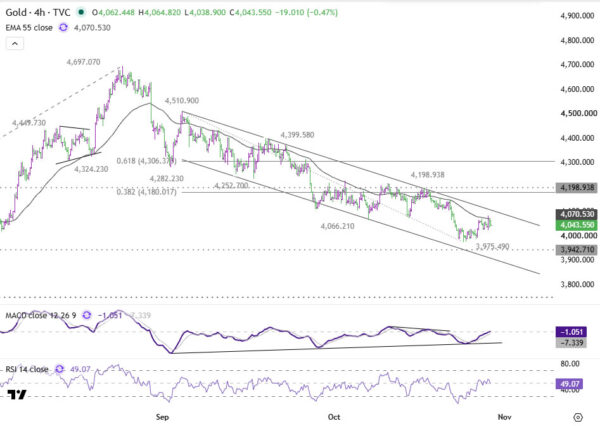
Break below $3,975.49 will immediately put $3,942.71 low into focus. Firm break there will confirm resumption of the whole downtrend from $5,598.75. That would set up a deeper decline to the 100% projection of $4,890.96 to $3,942.43 from $4,697.07 at $3,748.81 next.
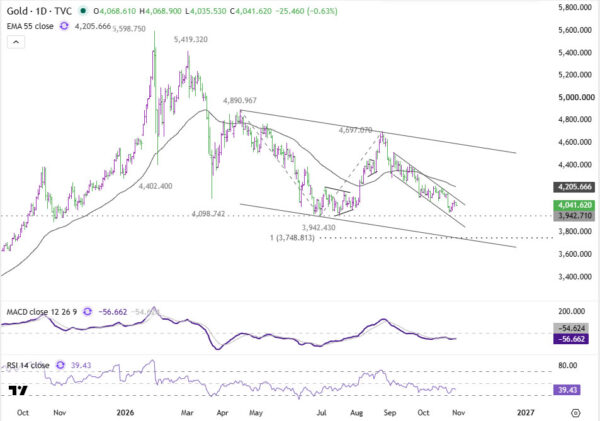
Overall, Gold’s subdued reaction to the Fed suggests that neither the widely anticipated hold nor Cook’s unexpected dissent has provided sufficient impetus to change the prevailing trend. The immediate focus remains on whether $3,975.49 support can withstand the next round of US economic data, while $4,198.93 continues to define the resistance level that would need to be overcome to challenge the bearish near-term outlook.
Key Takeaways
- Gold showed little lasting reaction to the Fed’s expected hold at 3.75–4.00%, briefly topping $4,070 before fading back toward $4,040.
- Governor Lisa Cook’s dissent for an immediate hike was the real surprise—her first since joining the Board in 2022—but the 10–2 vote still shows her view hasn’t become the committee’s prevailing position.
- December hike odds rose from 76.4% to 88.0% after the decision, even as longer-dated tightening expectations through mid-2027 edged lower.
- Today’s US Q3 GDP and September PCE data are the next real catalyst: strong growth plus firm core PCE would pressure Gold further, while softer inflation could support a recovery.
- Gold’s key level is $3,975.49 support: a break exposes $3,942.71 and then a deeper target near $3,748.81, while the bearish bias persists as long as $4,198.93 resistance holds.