
TL;DR: Two unrelated shocks converged on speculative assets: disappointing AI capex returns sent Alphabet down 12.64% and dragged Nasdaq, Nikkei and Asian semiconductors lower, while a ~$6.3B Binance security breach pushed Bitcoin toward $77,000. A falling Treasury yield hints at mild spillover, but broader equity performance stops short of confirming a generalized risk-off move—Nasdaq’s 25,802.96, Nikkei’s 61,462.61 and Bitcoin’s $75,000–$76,000 zone are the levels that will decide if it deepens.
Why This Matters
Risk appetite deteriorated sharply as concerns over the financial returns on AI investment collided with a major security breach at Binance, sending technology shares and cryptocurrencies lower while triggering selling across Asian semiconductor stocks. Nasdaq Composite fell 1.38% on Thursday, while Nikkei 225 dropped around 2.5% in Friday’s Asian session and Bitcoin extended its decline toward $77,000. The two shocks originated from different sources but converged on speculative assets already vulnerable to a reassessment of valuations and confidence. Although the selling has not developed into a broad market panic, US Treasury yields have declined noticeably, raising the possibility that risk aversion is beginning to spread beyond the most exposed sectors.
AI Spending Comes Under Scrutiny as Earnings Disappoint
The larger shock originated in technology earnings, where investors are increasingly questioning whether exceptional AI-related capital expenditure can generate sufficient near-term financial returns. Thursday’s reporting season delivered a sharply mixed verdict:
- Alphabet: −12.64% after revenue of $127.58B missed the $128.22B estimate; Google Cloud revenue more than doubled to $30.7B, but quarterly capex reached $51.4B and free cash flow was negative $9.07B
- Amazon: ~−6% in after-hours trading on an earnings miss and reaffirmed ~$220B in annual capex
- Intel: ~−21% following disappointing guidance
- Microsoft: a counterpoint—stronger revenue and 48% Azure growth
Microsoft’s results suggest that investors are becoming more selective rather than abandoning AI-related investment altogether.
The selling spread into Asian technology shares, with Kospi falling around 5% and triggering a temporary sell-side trading curb, while Nikkei 225 declined more than 2%. Major semiconductor-related names, including SK Hynix, Advantest and Tokyo Electron, came under pressure. The market is increasingly distinguishing between strong AI-related demand and the valuations assigned to companies financing or supplying the investment boom.
That distinction matters because the underlying expansion in AI infrastructure has not necessarily weakened. Indeed, BoJ’s latest economic outlook continues to identify global AI demand as a support for Japanese exports and business investment. The immediate concern is whether the financial returns from that spending can justify current expectations, particularly as investment requirements remain exceptionally large.
Binance Security Breach Adds a Separate Shock to Crypto
A major security incident at Binance introduced an additional source of pressure on cryptocurrencies, reinforcing selling in assets already vulnerable to deteriorating risk sentiment. Binance said its preliminary investigation indicated that a compromised engineer’s laptop may have enabled unauthorized withdrawals, with the estimated financial impact reaching approximately $6.3B. The exchange reported that around $3B of affected assets had been frozen on-chain and said it would cover losses using its SAFU fund and company resources. Deposits and withdrawals were temporarily suspended while security checks continued.
Although Binance maintained that user funds were safe, the scale of the incident raised concerns about exchange security and counterparty exposure. Bitcoin fell toward $77,000, while Ether and other cryptocurrencies also weakened. The precise impact of the breach on broader markets remains difficult to separate from the simultaneous technology sell-off.
Treasury Rally Signals Caution, but Broader Panic Is Not Evident
The cross-asset response suggests concentrated de-risking rather than a generalized liquidation, although the decline in Treasury yields warrants attention. US 2-year and 10-year yields fell by approximately 11bps and 9bps respectively from Thursday’s midday levels, indicating stronger demand for government bonds alongside weaker technology stocks.
However, the movement cannot be attributed entirely to safe-haven buying, as economic data and interest-rate expectations also influenced yields. Meanwhile, Dollar weakened, Gold and Silver declined, and European equities had closed higher on Thursday. The Dow lost only 0.25%, while broader US market participation was considerably healthier than Nasdaq’s headline decline suggested. The evidence points to pressure concentrated in AI-related equities and cryptocurrencies, with some signs of spillover into bonds but no uniform flight to safety.
ActionForex’s Technical View
Nasdaq Composite, Structural Support at 25,802.96 Comes Into Focus
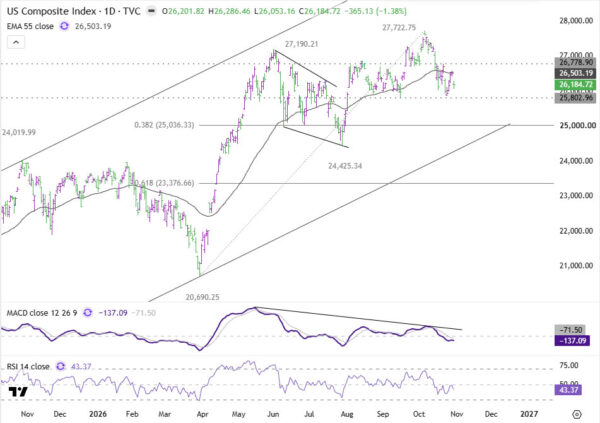
Thursday’s decline in Nasdaq Composite to 26,184.72 suggests rejection by the area of both the 55-period 4H EMA and 55-day EMA, keeping the near-term bias firmly on the downside. Immediate focus is now on 25,802.96 structural support.
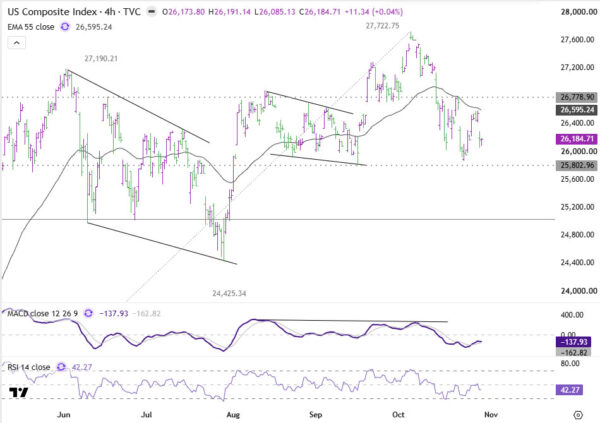
Considering the bearish divergence condition in daily MACD, a firm break of this level would indicate that a larger-scale correction is likely underway. That would bring a deeper decline toward the 38.2% retracement of 20,690.25 to 27,722.75 at 25,036.33, with risk of extending toward medium-term rising channel support, currently around 24,200.
Conversely, a break above 26,778.90 resistance would suggest that 25,802.96 has been defended, revive near-term bullishness and bring a retest of 27,722.75 into focus.
Nikkei 225, Failed Recovery Raises Risk of a Deeper Decline
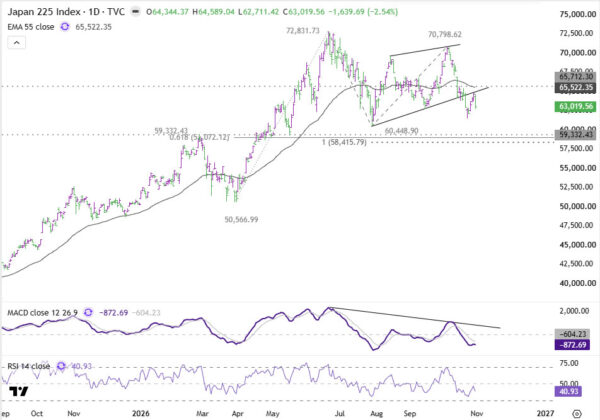
Nikkei 225’s decline toward 63,019 on Friday suggests that the recovery from 61,462.61 may have completed after rejection by the rising trend line turned resistance, with gains also capped below the 55-period 4H EMA.
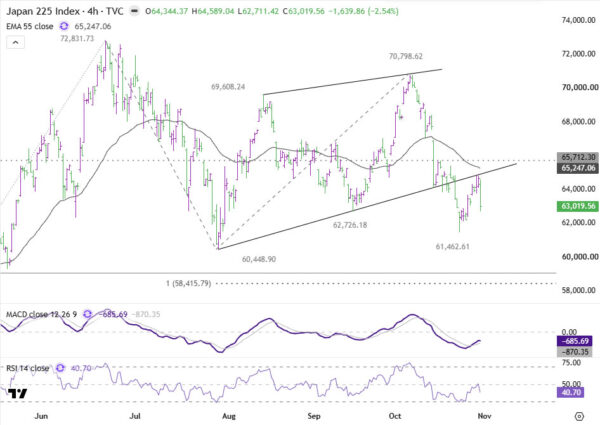
Attention is turning back to 61,462.61 support. A firm break would likely resume the decline from 72,831.73 through 60,448.90, bringing the 100% projection of 72,831.73 to 60,448.90 from 70,798.62 at 58,415.79 into focus. That projection will be important in determining whether price action from 72,831.73 is developing into a medium-term downtrend or remains a correction within the broader advance.
On the upside, a break above 65,712.30 resistance would indicate that the decline from 70,798.62 has completed, keeping price action from 72,831.73 within a consolidation pattern.
Bitcoin, $75,000–$76,000 Support Zone Becomes Critical
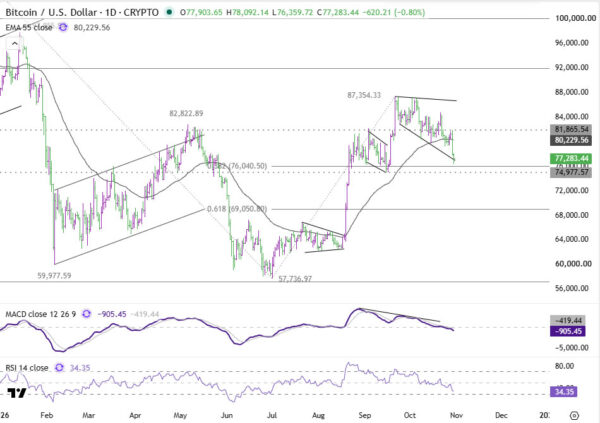
Bitcoin’s extended sell-off has produced a decisive break below its 55-day EMA, strengthening the case that price action from 87,354.33 is correcting the entire five-wave rally from 57,736.97. Some support could emerge between the 38.2% retracement at 76,040.50 and horizontal support at 74,977.57, potentially bringing a recovery.
However, the near-term risk will stay on the downside as long as 81,865.54 resistance holds. A sustained break below the $75,000–$76,000 zone would pave the way toward the 61.8% retracement at 69,050.80, slightly below the psychological $70,000 level. The Binance incident adds a separate confidence risk to an already weakening technical structure, although the relative contribution of the security breach and broader risk aversion cannot be determined precisely.
Key Support Tests Will Determine Whether Selling Deepens
The immediate question is whether concentrated selling in technology and cryptocurrencies develops into a more extensive market correction. AI investment concerns are challenging equity valuations even as underlying demand remains substantial, while the Binance breach introduces a separate confidence shock to digital assets.
The Treasury rally indicates that the pressure may be reaching beyond the most exposed markets, but broader equity performance and mixed safe-haven reactions stop short of confirming a generalized risk-off episode.
Technically, Nasdaq’s 25,802.96, Nikkei’s 61,462.61 and Bitcoin’s $75,000–$76,000 support zone are the critical levels to monitor. Sustained breaks would materially strengthen the case for deeper corrections, while successful defenses could keep the recent declines contained.
Key Takeaways
- Alphabet fell 12.64% on a revenue miss and negative $9.07B free cash flow, while Amazon (~−6%) and Intel (~−21%) also sold off—though Microsoft’s 48% Azure growth shows investors are being selective, not abandoning AI exposure entirely.
- A separate ~$6.3B Binance security breach, tied to a compromised engineer’s laptop, added an unrelated confidence shock that pushed Bitcoin toward $77,000.
- US 2-year and 10-year yields fell ~11bps and ~9bps, but the Dow lost only 0.25%—evidence of concentrated de-risking in AI-exposed equities and crypto rather than a broad market panic.
- Nasdaq’s key level is 25,802.96 support; a firm break opens 25,036.33 and risks extending toward 24,200, while a break above 26,778.90 would revive near-term bullishness.
- Bitcoin’s $75,000–$76,000 zone (76,040.50–74,977.57) is the critical test; a sustained break exposes 69,050.80, just below the psychological $70,000 level.