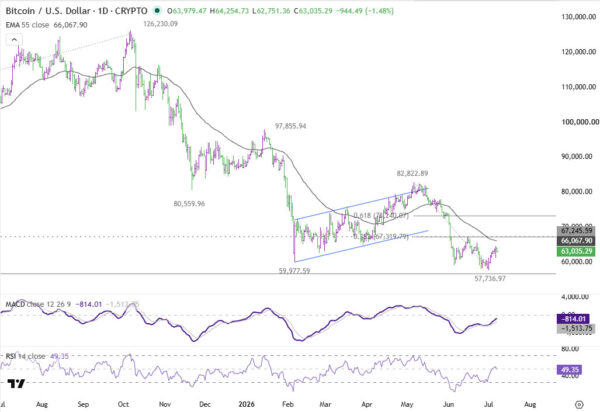
Bitcoin may have delivered one of its most encouraging signals in weeks, but it was not the rebound itself that mattered. Instead, it was the market’s ability to absorb heavy institutional selling without extending its decline. After briefly falling below USD 58,000 last week, Bitcoin quickly reclaimed the USD 60,000 level and still finished the week higher despite one of its largest corporate holders reducing its position.
The key event came from Strategy, which disclosed that it sold 3,588 Bitcoin for net proceeds of approximately USD 216 million, reducing its holdings to 843,775 BTC. Under normal circumstances, a sale of that magnitude would be expected to weigh on market sentiment and prices. Instead, Bitcoin stabilized and recovered, suggesting demand was sufficient to absorb the additional supply.
That resilience offers an important message about market positioning. If a large, well-telegraphed institutional sale cannot push prices materially lower, it suggests the pool of marginal sellers below current levels has become much smaller. Much of the forced liquidation and leverage-driven selling that dominated recent weeks may already have been flushed out, allowing the market to begin establishing a near-term base around the USD 58,000 area.
However, that should not be confused with confirmation of a durable market bottom. On-chain analysis of long-term holder realized losses indicates that supply held at a loss has reached levels typically associated with deep bear markets, but not yet the degree of capitulation historically seen near major cycle lows. In other words, the market may have exhausted its short-term selling pressure without completing the broader cleansing process that often accompanies the end of a bear cycle.
That distinction suggests Bitcoin could enter a period of consolidation rather than a new up trend. With forced selling appearing to ease and large institutional supply being absorbed, downside momentum may slow. But without stronger evidence of renewed long-term accumulation, buyers may also struggle to generate the conviction needed for a lasting breakout.
Technically, the long term Fibonacci level, 61.8% retracement of 15,479 (2022 low) to 126230 (2025 high) at 56,775 is providing the needed support for Bitcoin to prevent deeper selloff for now. The market’s ability to defend that area reinforces the view that downside momentum is fading, at least in the near term.
However, for the recovery to become technically more convincing, Bitcoin would need to break decisively above the 66,069 resistance zone, which also coincides with the 38.2% retracement of 82,822 to 57,736 at 67,319. Such a move would provide the first meaningful indication that a near-term bullish reversal is developing.
Until then, price action is more likely to represent a broad consolidation phase before another test of the 56,775 support later in the cycle.