
TL;DR: EUR/CAD gapped sharply lower at the weekly open, falling from 1.6269 to as low as 1.5777, as violent weekend unrest in France compounded an already elevated fiscal risk premium while Canadian Dollar held onto support from Friday’s oil surge—with Tuesday’s French budget vote and Friday’s Moody’s review now the key tests of whether the breakdown toward 1.5733 and 1.5610 extends.
Why This Matters
EUR/CAD opened the week under renewed selling pressure as violent unrest in France added a fresh political shock to an already substantial fiscal risk premium. At the same time, Canadian Dollar continued to draw support from Friday’s sharp oil rally, even as crude prices retreated on Monday. The combination drove EUR/CAD sharply lower at the weekly open, extending its decline from 1.6269 to as low as 1.5777 before recovering. The initial low occurred during thin Sunday-evening trading, leaving some uncertainty over how much of the move will persist as European markets reopen. Early-session currency movements suggested that euro weakness and CAD strength contributed roughly equally to the cross’s decline, rather than the move being driven exclusively by either currency.
French Riots Add Political Pressure to an Existing Fiscal Crisis
The immediate catalyst was Saturday’s nationwide protests over living costs and deteriorating school conditions, which descended into rioting and looting across major French cities, including Paris, Marseille, Lyon and Bordeaux. Authorities estimated participation at approximately 550,000, compared with 800,000 claimed by organizers. The latest Interior Ministry figures indicated nearly 2,400 arrests and around 1,000 injured police officers and gendarmes. Approximately 1,500 businesses were damaged, with losses estimated in the hundreds of millions of euros. While most demonstrators were peaceful, violent groups caused extensive destruction. President Emmanuel Macron condemned the violence in a Sunday evening address, promised tougher enforcement and called for consultations with students, teachers, unions, lawmakers and businesses to develop responses to public grievances.
The greater financial risk is political rather than the direct cost of the destruction. France was already struggling to reconcile demands for public spending with the need to reduce its fiscal deficit. The grievances behind the protests concern precisely the areas where additional spending commitments could further complicate consolidation. Prime Minister Sébastien Lecornu’s minority government is seeking to reduce the deficit from approximately 5.4% of GDP in 2026 to 5.0% in 2027, but faces considerable parliamentary resistance. Eurasia Group’s Mujtaba Rahman has warned of market concerns that France is becoming “socially volatile and institutionally paralyzed.” The weekend unrest did not create France’s fiscal risk premium; it has increased uncertainty over whether the government can prevent that premium from widening further.
French Bond Markets Face Budget and Credit Rating Tests
The deterioration in French sovereign sentiment was already well established before the weekend. The 10-year French OAT yield spread over German Bunds widened substantially during September and early October, reaching levels around 140bps by the end of last week. The widening reflected France-specific political and fiscal concerns alongside broader pressure on European bond yields. The crucial question is whether the latest unrest generates another sustained increase in France’s borrowing premium, rather than merely producing a short-lived reaction in currency markets. Previous episodes of protest-related volatility have not necessarily resulted in lasting spread widening, making confirmation from the bond market particularly important.
Two developments could provide that confirmation. The National Assembly faces a scheduled vote on the revenue portion of the 2027 budget on Tuesday, October 20, while Moody’s has a scheduled review of France’s Aa3 rating, currently carrying a negative outlook, on Friday, October 23. Failure to advance the budget, renewed threats to the government’s survival or unfavorable rating action could amplify concerns about fiscal credibility. Conversely, progress through the budget process and stabilization in sovereign spreads would weaken the argument that the weekend’s unrest has materially increased France’s financial risks.
CAD Rides Friday’s Oil Surge Despite Monday’s Retreat
Canadian Dollar’s resilience provides the other side of EUR/CAD’s decline. Brent crude surged 3.7% on Friday to $109.86 a barrel, while WTI gained 3.5% to $101.41, closing above $100 for the first time since September. WTI advanced more than 10% over the week as escalating Middle East tensions and renewed threats to oil infrastructure intensified supply concerns. Attacks on shipping around the Strait of Hormuz, threats to Saudi energy facilities and renewed Ukrainian strikes against Russian oil infrastructure contributed to the rally. Elevated crude prices can support Canada’s export revenues and provide a favorable backdrop for CAD.
However, oil has retreated in Monday’s Asian session, partly following Washington’s decision to waive some sanctions and tariffs affecting Russia, potentially allowing additional fuel exports. This creates an important divergence: CAD is retaining some support from last week’s energy surge even as its immediate oil catalyst weakens. The broader US Dollar backdrop is also less supportive of sustained Dollar strength after Friday’s retreat in expectations for an October Fed rate hike. Nevertheless, the key EUR/CAD question is whether Canadian Dollar can maintain its resilience if crude extends its correction, or whether renewed French political pressure will need to carry more of the bearish momentum.
ActionForex’s Technical View: EUR/CAD Outlook, 1.5733 and 1.5610 in Focus
EUR/CAD’s technical structure has turned increasingly bearish following the gap lower and extension of the decline from 1.6269. The rebound from the initial 1.5777 low has not yet altered the near-term downside outlook. As long as 1.5945 minor resistance holds, further decline is favored toward the 161.8% projection of 1.6247 to 1.5998 from 1.6136 at 1.5733. Firm break of this level would target the 200% projection at 1.5638, just above the important 1.5610 support. The sharp opening move and oversold short-term momentum leave room for temporary consolidation, but a sustained recovery above 1.5945 would be needed to ease immediate downside pressure.
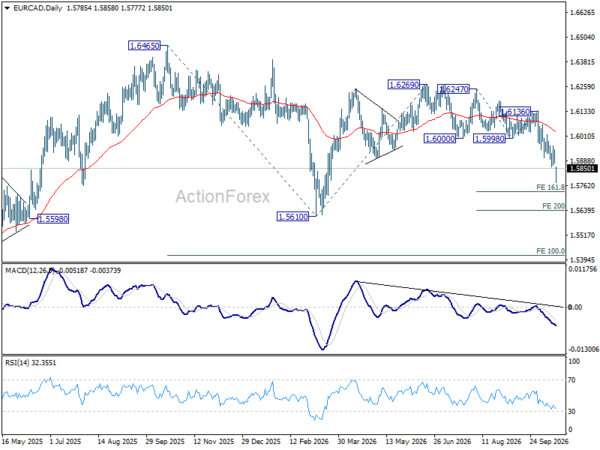
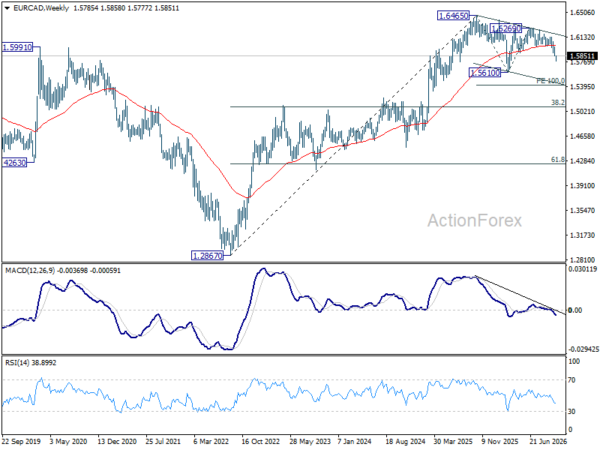
In the bigger picture, the decline from 1.6465, the 2025 high, is viewed as a correction of the broader uptrend from 1.2867, the 2022 low. The developing bearish momentum on the daily and weekly charts raises the possibility of a deeper correction. Decisive break below 1.5610 would strengthen that interpretation and target the 100% projection of 1.6465 to 1.5610 from 1.6269 at 1.5414 over the medium term. However, the larger corrective scenario still requires confirmation through a sustained break of 1.5610.
What Would Confirm or Challenge the Breakdown?
The next direction will depend on whether the fundamental developments validate EUR/CAD’s bearish technical signals. Renewed widening in the French OAT–Bund spread, setbacks in Tuesday’s budget process or an unfavorable Moody’s decision would reinforce the euro’s vulnerability. Weakness spreading into other euro crosses, particularly EUR/CHF, would provide additional confirmation that French political concerns are affecting the currency more broadly. A renewed rise in Brent toward $110 would strengthen the CAD side of the argument and increase pressure for EUR/CAD to break through 1.5733 and eventually challenge 1.5610.
Conversely, stabilization in French sovereign spreads, progress on the budget and continued oil weakness would undermine the convergence of bearish forces. EUR/CHF stabilizing above 0.9258 would also suggest that euro selling is becoming less broad-based. The decisive question is whether weekend unrest develops into a renewed French sovereign risk repricing while CAD retains its oil-related support. Without confirmation from either side, Monday’s sharp opening decline could prove vulnerable to a corrective rebound, despite the bearish technical structure.
Key Takeaways
- EUR/CAD gapped from 1.6269 to a low of 1.5777 at the weekly open after violent nationwide unrest in France (~2,400 arrests, ~1,500 businesses damaged) compounded an existing fiscal risk premium.
- France’s OAT–Bund spread was already near 140bps before the unrest; Tuesday’s budget vote and Friday’s Moody’s rating review are the key tests of whether the premium widens further.
- CAD is holding support from Friday’s oil surge (Brent +3.7% to $109.86, WTI above $100) even as crude retreats Monday on eased US sanctions on Russian fuel exports.
- EUR/CAD’s near-term bias stays bearish below 1.5945, targeting 1.5733 and then 1.5610; a break of 1.5610 would open the medium-term target at 1.5414.
- Confirmation would come from renewed French spread widening, a weak budget vote or Moody’s action, plus weakness spreading into EUR/CHF; stabilization in French spreads and continued oil weakness would argue for a corrective rebound instead.
Related Reading
- GBP/USD Rebounds on Dollar Weakness, but EUR/GBP and GBP/CHF Hold the Sterling Verdict
- AI Credit Fears Eclipse Hot CPI as Treasury Yields Reverse and Dollar Loses Haven Bid
- Has the Dollar Rally Stalled, or Is It Already Waiting for the Midterms?
Stay ahead of France’s fiscal risk and the EUR/CAD breakdown it’s driving—subscribe to ActionForex’s daily market commentary for real-time technical and fundamental analysis.